



Top-rated excavation pros.

Get matched with top excavation pros in El Jebel, CO

Enter your zip and get matched with up to 5 pros

Need a pro for your excavation project in El Jebel, CO?

Select your specific project to find the pro for you.

Find Excavation pros in El Jebel

Avatar for Ayala's Tree Trimming & Landscaping
Ayala's Tree Trimming & Landscaping
4.7(
54
)
Landscape - Minor Grading or Resloping

Serving El Jebel, CO and surrounding areas

Approved

Super Service Award Winner

In business since 2008

Free estimates

Credit card accepted

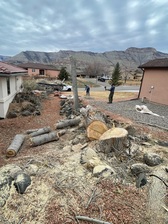
"Isaac and his assistant provided excellent service in removing one of our Blue Spruce trees. It was a costly project, but we expected that due to the complexity of the removal process. They arrived on the scheduled date and spent almost seven hours in reducing our tree to a stump, which we will need to camouflage. We decided to remove the tree as it had grown so tall and wide it became too close to our home and that of our neighbor. With heavy winds and threat of lightening storms, it was the right decision for us. The cut branches necessitated two trailerloads to haul away, meaning two trips to the disposal site, and they never complained in the 95+degree weather. The cleanup was very thorough, and we are happy to highly recommend this company to others."
Response time5 hrs
Response rate95%
16 neighbors recently requested a quote
T J Irrigation
5.0(
5
)
Landscape - Minor Grading or Resloping

Serving El Jebel, CO and surrounding areas

Approved

In business since 1999

Free estimates

Warranties offered

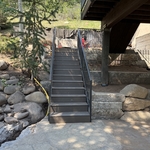
"TJ Irrigation was an excellent choice. The crew was professional at all times. They were quick, on time, and worked hard. They moved 10 sprinkler heads in a little more than 9 hours. The job was charged to time and materials and that was the right way to go. Saved me money."
Response time2 days
10 neighbors recently requested a quote
Recommended by100%of homeowners
...
Showing 1-10 of 56
Excavating questions, answered by experts

Trenchers can dig holes as narrow as 4 inches or as wide as 4 feet. Check the specifications of the trencher you rent or buy to determine how wide it will cut into the landscape. Better yet, let the excavation company know how wide you’d like the trench to be, and they can help you choose the right trencher for the job (or do it for you).

Trenching and boring are two distinct methods for installing underground utilities. Trenching involves digging a channel using equipment like an excavator, trencher, backhoe, or shovel. While it is a simpler process, it causes significant disruption to the surface, landscaping, and surrounding ecosystems.

Boring, also known as directional boring, is a less invasive alternative that uses a drill to create a tunnel for utility lines without disturbing the surface. This method is more precise and is ideal for installations that need to go underneath buildings, roads, or bodies of water. Although boring is less disruptive, it is generally more expensive than trenching.

Directional drilling is complex and requires training to use the advanced machinery. It can be challenging to monitor the position of the drill since there’s no direct line of sight. Directional drilling can also be more expensive with a cost of $10 to $30 per linear foot compared to $5 to $12 per linear foot for trenching. 

The best method for digging a trench depends on the scope of the project. For a short, shallow trench (less than 2 feet deep) in light, soft soil, digging by hand may be sufficient. However, digging by hand is labor-intensive, so consider the effort required. A machine trencher is the better option for longer trenches (over 100 feet), deeper ones, or when dealing with difficult soil conditions, such as rocky or hard ground, or obstructions like tree roots. A machine can save significant time and energy in these situations.

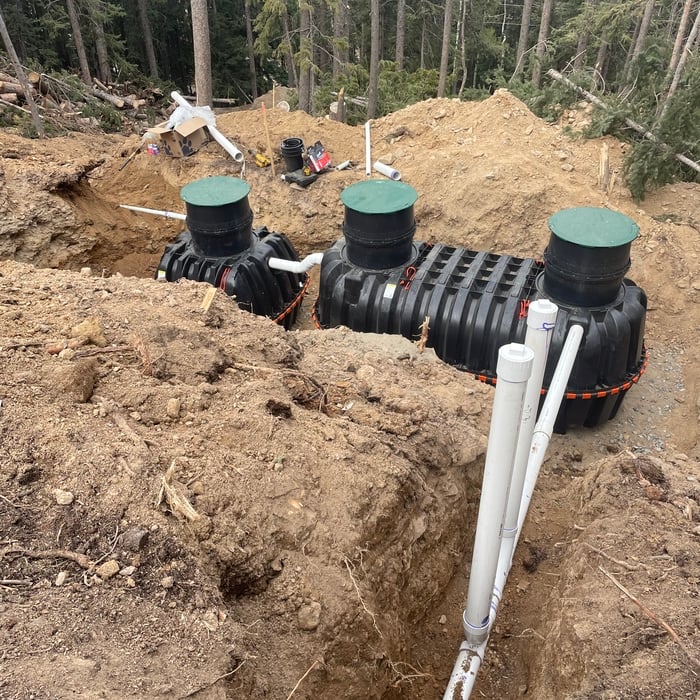
There is no standard depth for burying a septic tank; they are typically buried anywhere from 4 inches to 4 feet underground. The final depth depends on several factors, including the depth of your main sewer line, the height of the bedrock, soil type, local regulations, and the property's landscape. If you plan to grow grass or plants over the tank, a depth of at least 4 to 6 inches is recommended. Deeper tanks can be more difficult to locate, but a septic professional can help find it for you.

The El Jebel, CO homeowners’ guide to excavation services

From average costs to expert advice, get all the answers you need to get your job done.