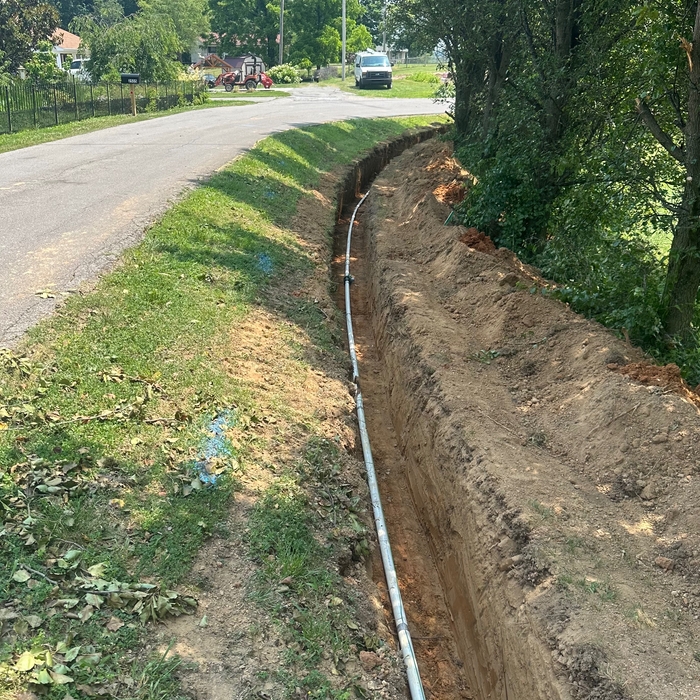

Top-rated excavation pros.

Get matched with top excavation pros in Coalfield, TN

Enter your zip and get matched with up to 5 pros

Need a pro for your excavation project in Coalfield, TN?

Select your specific project to find the pro for you.

TRUSTED BY COALFIELD, TN HOMEOWNERS

  • Average homeowner rating star icon4.9
    Average homeowner rating
  • Verified reviews icon40
    Verified excavation services reviews

Find Excavation pros in Coalfield

Avatar for Andrew Pazder Excavation
Andrew Pazder Excavation
5.0(
2
)
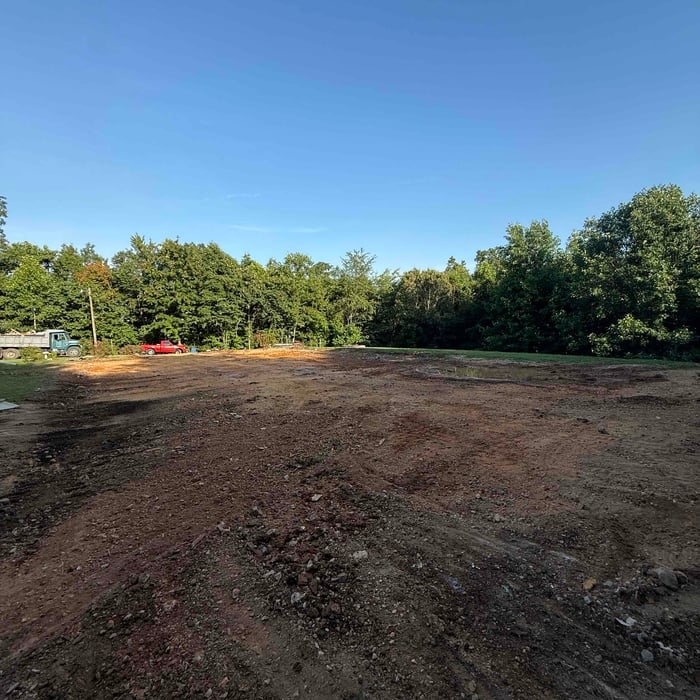
Landscape - Minor Grading or Resloping

Serving Coalfield, TN and surrounding areas

Approved

Emergency services offered

I started off in a skid steer at young age with my family owning an excavation business and became very interested at a young age. I’ve been in excavation full time since I was 15 years old working at 2 grading company’s one residential and the other commercial to better my knowledge for whatever the job throws at my crew and I.

Project petree
Project petree
Lake view lot
Lake view lot
Lake view lot

+16

1 neighbors recently requested a quote
Blaine Henry Excavating LLC
3.7(
15
)
Landscape - Minor Grading or ReslopingBuilding Site - Preparation and Clearing

Serving Coalfield, TN and surrounding areas

Approved

In business since 2018

Free estimates

Offers commercial services

"I met Blaine and his father, Ron in December. I instantly knew they were the people I wanted to do the job. As we walked around my yard I was impressed with their knowledge and courtesy. I was particularly happy to hear they'd been in this business for 3 generations. I interviewed two other companies getting the obligatory 3 references. The difference between the 2 and Blaine was night and day. Neither of them really knew what they were doing. One, it seemed had to check with my engineer on every step. Blaine knew exactly what to do without consulting anyone (except sometimes his dad)- they were a Team! They are the experts. The job was finished sooner than expected. I've never seen people work so efficiently.. They worked in tandem with the structural engineers specifications. Although I don't think they needed his instructions. They left a very clean worksite (after excavation work!) I highly recommend this excellent company."
Response time1 day
12 neighbors recently requested a quote
Recommended by84%of homeowners
...
Showing 1-10 of 123
Excavating questions, answered by experts

Your contractor should handle dust control during the project. It's best to speak with your contractor beforehand to check if they plan to cover your furniture, protect your vents, or use fans to redirect dust. Eliminating drywall dust is a particularly large challenge during construction, so always take this into account during your planning phase.

Excavation is priced in cubic yards, so you’ll need to find the volume of the area in order to calculate costs. Multiply the length, width, and proposed depth of your excavation site, then convert it into yards to get the volume. Multiply this figure by the price per cubic yard.

Most homeowners can measure by hand to get a rough estimate, even if it’s tedious. You may want to pull out a tape measure or use a string to help mark the area.
Septic drain lines (or leach lines) are typically buried between 18 and 36 inches underground, and should be at least 6 inches below the surface. These pipes are perforated and surrounded by filtering materials like sand or gravel. Burying the lines at this depth helps minimize odors and allows bacteria and other biological processes in the soil to effectively treat the wastewater. Burying lines too close to the surface can cause issues unless the soil is very compact and stable.

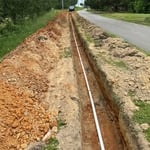
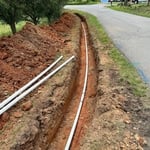
Trenches are typically 12 to 24 inches deep and 8 inches wide. However, the required depth depends on the specific project and local ordinances. For example, a French drain may need to be 18 inches deep, while a water pipe might require a depth of 24 inches and a drainage pipe 36 inches. Your city or county may have specific regulations, so it's wise to consult with an excavation professional to determine the correct depth for your project.

Trenching and boring are two distinct methods for installing underground utilities. Trenching involves digging a channel using equipment like an excavator, trencher, backhoe, or shovel. While it is a simpler process, it causes significant disruption to the surface, landscaping, and surrounding ecosystems.

Boring, also known as directional boring, is a less invasive alternative that uses a drill to create a tunnel for utility lines without disturbing the surface. This method is more precise and is ideal for installations that need to go underneath buildings, roads, or bodies of water. Although boring is less disruptive, it is generally more expensive than trenching.

The Coalfield, TN homeowners’ guide to excavation services

From average costs to expert advice, get all the answers you need to get your job done.