



Top-rated arborists.

Get matched with top arborists in Vandalia, MO

Enter your zip and get matched with up to 5 pros

Need a pro for your arboricultural service project in Vandalia, MO?

Select your specific project to find the pro for you.

Find Arborists in Vandalia

Avatar for GS Outdoor Service's, LLC
GS Outdoor Service's, LLC
4.9(
6
)

Serving Vandalia, MO and surrounding areas

In business since 2012

Free estimates

Warranties offered

"The service done involved shrubbery and ornamental tree trimming and a clean up of landscaping gone amuck. I did not have any deadline nor did I know exactly what I needed, but I needed help to get some order back to our landscaping. Greg was courteous and knowledgeable explaining not only what he could do but what the various plants/shrubbery/trees needed. He had some nasty weather to work through and the job was finished just before company and Thanksgiving. The work he did made a very noticeable improvement with the landscaping. I was very pleased with the work done and very pleased that Greg was professional and courteous in his approach to this job. I would recommend this service to others in a heartbeat. Our landscaping, although we are in Fall approaching Winter, actually looks like someone cares for it. Thanks GS Outdoor Services."
Response time1 day
Recommended by100%of homeowners
Showing 1-10 of 50
Arborists questions, answered by experts

Since overwatering can harm mature trees just as much as a lack of water, it’s important to know the signs of an overwatered tree. If your tree’s leaves are yellowing, wilting, or dropping leaves, it’s likely that you’re overwatering. Other common signs include rotting, fungi, soggy soil, soft or peeling bark, falling leaves, and brittle roots. 

If you realize that you’ve been overwatering your mature tree, stop watering and give the soil time to dry out. Then moving forward, increase time between watering sessions. 

Early signs that a tree is struggling include premature leaf shedding and lesions or other strange markings. Peeling bark, dead or rotten branches on the ground, and a conspicuous lack of leaves can all be signs that a tree has started to die. By the time a tree starts leaning, it’s usually too far gone to save.

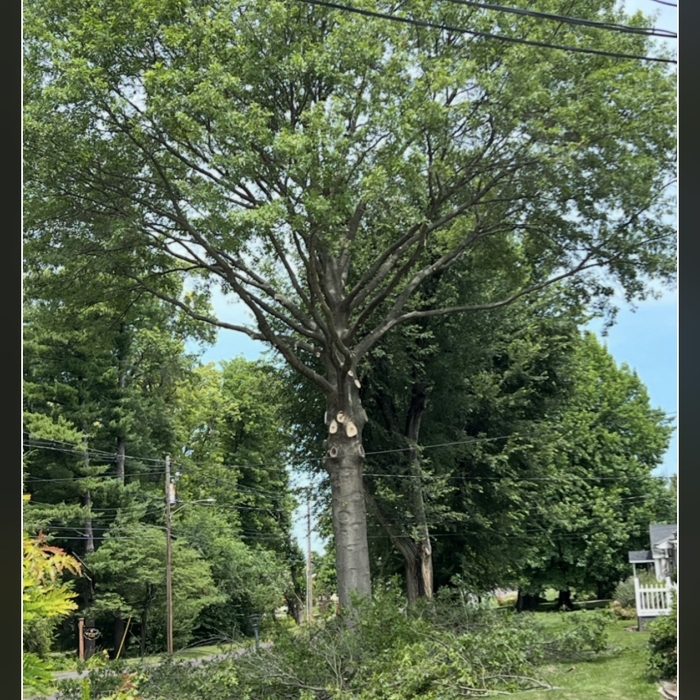
Cutting down a tree next to power lines is never a DIY job, and it’s a good idea to contact your utility company first. In most cases, the utility company will need to take care of any tree problems within 10 to 15 feet of power lines. If you want to remove the tree for aesthetic reasons, hire a pro to do the job. Trying to cut trees near power lines yourself can create many safety hazards, and you could be liable if you inadvertently cause damage to electrical equipment.

You may be looking to identify maple trees to use for home improvement projects. In that case, you can tell hard maples by looking at their leaves. Leaves will have a U-shaped dip, or sinus, between the points, or lobes, of the leaves. Leaves of soft maples tend to have V-shaped sinuses.

If you already have the cut wood in front of you, look for a light, uniform color to identify hard maple wood and check for variations of red, gray, or brown streaks and an overall darker color in soft maple wood.

While the trees in your backyard are good for the environment and look beautiful, they could present a danger to your home under the wrong circumstances. This task is typically beyond the capabilities of the average homeowner due to its dangerous nature, so it’s best to leave this task to a professional. In some cities, it’s even illegal to remove a tree yourself.

The Vandalia, MO homeowners’ guide to arboricultural services

From average costs to expert advice, get all the answers you need to get your job done.