




Top-rated generator install pros.

Get matched with top generator install pros in Lowell, NC

Enter your zip and get matched with up to 5 pros

Need a pro for your generator install project in Lowell, NC?

Select your specific project to find the pro for you.

Find Generator install pros in Lowell

Avatar for Mr. Electric of Gastonia
Mr. Electric of Gastonia
4.8(
60
)

Serving Lowell, NC and surrounding areas

Approved

Super Service Award Winner

In business since 2025

Free estimates

Emergency services offered

"I want to take a minute and note that Carleton B. is incredible. Truly one of if not the best interactions I have had with a technician in any field and he is the sole reason we purchased a one year plan today. We are very pleased with his quality of work, communication, and timeliness. He has provided a great experience for us and for that we are very thankful."
Additional Photos
Additional Photos
Additional Photos
Additional Photos
Additional Photos

+89

8 neighbors recently requested a quote
Recommended by84%of homeowners

Avatar for ALB Electric L.L.C
ALB Electric L.L.C
5.0(
17
)

Serving Lowell, NC and surrounding areas

Approved

Super Service Award Winner

In business since 2023

Free estimates

Emergency services offered

"Great work and excellent communication. I would recommend to anyone. Charger was installed quickly and professionally. Will hire in the future for more work. Thank you again!"
Response time2 hrs
Response rate96%
27 neighbors recently requested a quote
...
Showing 1-10 of 80
Generator Install questions, answered by experts

Yes. You can connect your home back-up battery to a generator with its designated charger. Be sure that the output of the generator matches the input requirements for the battery for best results.

Most homeowners won't be able to claim a home generator as a tax write-off. However, a whole-house generator may be tax-deductible in certain situations depending on its purpose. For instance, if it's needed to power essential medical equipment, it may qualify as a medical expense deduction. Also, in some cases, businesses can deduct a generator as a business expense if it supports operations. Always consult a tax professional to determine eligibility based on your specific circumstances and the applicable IRS regulations.
A portable generator can supply power to selected appliances and circuits in a home, but it's generally not designed to handle the entire household's electrical needs simultaneously. Portable generators have limited wattage capacity, so they are only designed to power essential devices and electronics temporarily until local power is restored. If your power needs outweigh the capabilities of a portable generator, consider installing a whole-home generator instead.

Sizing a generator is a careful process that requires calculating the electrical load of your entire house. You have to take into account every device you want to use and their wattage requirements, plus the wattage needed to start them, and look for a generator that can safely run all that at around 80% capacity.

In more practical terms, a small home can run on a 10,000-watt generator (and if you only want to power a few key appliances, much less than that). A mid-sized home may need something between 15,000 and 22,000 watts. Larger homes require 25,000 watts or more. 

To reduce AC startup power for a whole-house generator, install a soft start kit or hard start capacitor, which lowers the initial surge by gradually ramping up the compressor. Using a smart load manager can also help by staggering startup loads, preventing a system overload and future costly repairs.
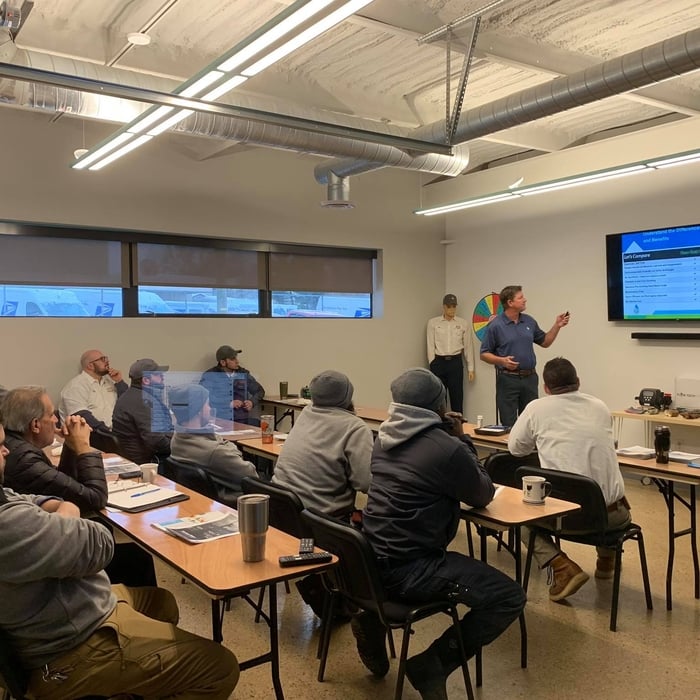
The Lowell, NC homeowners’ guide to generator installs

From average costs to expert advice, get all the answers you need to get your job done.