







Top-rated electricians.

Get matched with top electricians in New Richmond, OH

Enter your zip and get matched with up to 5 pros

Need a pro for your electrical service project in New Richmond, OH?

Select your specific project to find the pro for you.

TRUSTED BY NEW RICHMOND, OH HOMEOWNERS

  • Average homeowner rating star icon4.7
    Average homeowner rating
  • Verified reviews icon553
    Verified electrical services reviews

Find Electricians in New Richmond

Avatar for Bowling Power & Electric
Bowling Power & Electric
5.0(
12
)
Electrical Wiring or Panel Upgrade

Serving New Richmond, OH and surrounding areas

Approved

In business since 2025

Free estimates

Emergency services offered

"Thomas and his crew replaced my old electric service with a new 200 amp service. They were on time and completed the work in the time frame he gave me. They did an outstanding job and were very competitive with their price. The crew was very friendly and courteous. I would highly recommend them for your electrical needs."
Exterior lighting
Exterior lighting
Panel upgrades
Panel upgrades
Panel upgrades

+18

Response time9 hrs
Response rate100%
13 neighbors recently requested a quote
Avatar for RS Lightning Protection
RS Lightning Protection
4.9(
81
)
Lightning Protection - Install or Repair

Serving New Richmond, OH and surrounding areas

Approved

In business since 1999

Free estimates

Emergency services offered

"I estimate I have just under $100k in electronics and appliances in my house. We have significant lightning storms in my location. To NOT have lightning suppression installed is significant risk in my mind based on my location in New Jersey. RS LIGHTNING PROTECTION was responsive with a quick cost estimate and a reasonable price based on my research for installation. By the way...installation is part art, such as bends in cable are not more than 90 degrees. It's not just about running grounded cables. This installation in conjunction with surge protection on my electrical panel performed by my electrician and cable protection gives me significant piece of mind that all my appliances and electronics are protected from lightning and any potential surge generated by a near strike. Mr Richard Sherlock knows his subject. Highly recommended. Five stars."
Carriage house concealed
New home
Storage building
Beau
Grain lake system

+12

Response time3 days
16 neighbors recently requested a quote
Recommended by95%of homeowners
...
Showing 1-10 of 240
Electrical questions, answered by experts

When converting a standard 120-volt outlet to a 240-volt outlet, the only components you can typically reuse are the existing electrical box and the hole in the wall. Everything else—including the wiring, breaker, and receptacle—should be replaced to ensure both safety and efficiency. Appliances designed for 240 volts have different plug configurations that won’t fit into a standard 120-volt outlet, making it necessary to install a compatible 240-volt receptacle. This design helps prevent overloading or underloading the power available to any one outlet or circuit.

Just as fluorescent lights are more efficient than incandescent lights, LED lights are more efficient to run than fluorescent lights. The specifics will vary from product to product, but LED lights are typically twice as efficient as equivalent fluorescent lights. A 13-watt CFL bulb can replace a 60-watt incandescent bulb, but a 6- to 8-watt LED bulb can offer the same amount of brightness. Fluorescent lights offer about 50 lumens per watt, while LEDs offer about 100 lumens per watt. LED light bulbs typically last two to three times as long as CFL bulbs, too. 

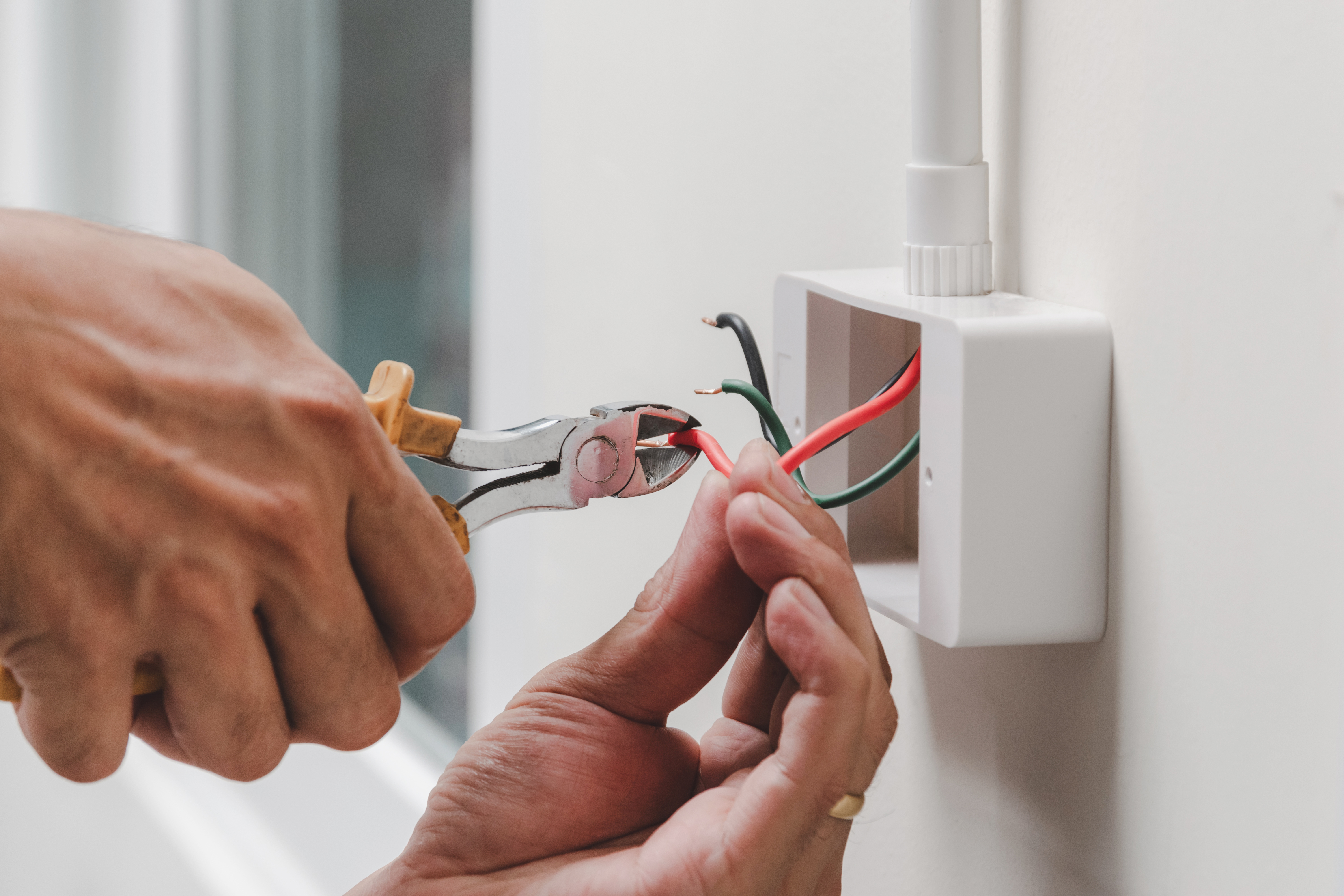
Yes. You should always turn off the power to the work area before beginning, use a voltage tester to ensure it’s off, and wear protective gear, such as insulated gloves or safety glasses, to prevent risk of injury. Proper wiring and grounding techniques are also necessary to make sure the job is done right the first time and won’t harm any future homeowners. 

The American Wire Gauge system calculates wire size diameters using the complicated formula D(AWG)=.005·92((36-AWG)/39) inch. A simpler rule of thumb is that every six-gauge decrease doubles the wire diameter, and every three-gauge decrease doubles the wire’s cross-sectional area. On the other hand, wavenumbers are typically measured in reciprocal meters (1/m or m−1) or reciprocal centimeters (1/cm or cm−1).

The National Electric Code states that outlets should not be spaced more than 12 feet apart, and there should be an outlet placed every 6 feet at the floor line in areas designated as living spaces. Most homes in the United States have 75 outlets, but it will depend on the amount you need based on your home's size and your needs.

The New Richmond, OH homeowners’ guide to electrical services

From average costs to expert advice, get all the answers you need to get your job done.