



Welcome to Upstate Structural Repair. We have been doing structural repair work for close to 20 years. Working out of Taylors, SC but covering the Greenville, Spartanburg, Anderson, SC area and more We do everything from slab repairs, failing brick walls, floor leveling and more! Our expertise comes from understanding the way structures are built, there for we know how to repair them correctly. Upstate Structural Repair, we’ve been doing structural and foundation repairs for close to 20 years. Notice cracks in your foundation? Leaning brick wall? Floors are sagging? Call us today for your free estimate (864)214-0686.
Gaines Engineering & Design, LLC is dedicated to providing our customers with the best quality and craftsmanship. We are here to build relationships with our customers and communities and to provide our employees with a great place to work. We look forward to working with you! \n \nGaines Engineering & Design, LLC has become a staple of professionalism and quality work in 21 area for years. With decades of experience, there is no job too large or small for our crew. Call today to schedule an appointment! \n
We take great pride in our experience, expertise, quality, and customer service that we provide to meet the consumer's needs. It is our mission to provide excellent workmanship and complete customer satisfaction from start to completion of a project. In order to understand the needs and expectations of our customers, we take great care to work and communicate with every customer in a professional manner. Our reputation is based on service, safety, and quality, regardless of how large or small the job.
CNT Foundations is the best foundation repair company in the industry. Locally owned and operated since 2010, we service commercial and residential foundation repairs, crawl space repairs, and New Construction projects in the Carolinas, Savannah and Augusta, Georgia. Call today for a free estimate and find out why CNT Foundations is #1.
We specialize in Structural Engineering, and Foundation Engineering. Consulting and design for all your building projects. Quality, timely work to get your project back on track. My name is Tommy and I'm a licensed Professional Engineer with over 30 years of experience. Give us a call today for your free estimate!
Criterium - Payne Engineers brings you expertise and accuracy with all of your engineering needs. We have a reputation we pride ourselves on and we look forward to speaking with you soon!
I specialize in foundation repairs and footers. We can help with sinking foundations or adding to a foundation. I work with all types of foundations; brick, concrete, or wood. \n\nI am a Licensed structural engineer AND Licensed electrician. If you have any other home repairs that may need attention, feel free to give me a call today!
We Fix Rot.\nIt really is as simple as that.\nWe repair joists, sills, girders and piers in your crawlspace. Employ NADRA certified deck safety inspectors for deck repairs and perform repairs made to last on the exterior of your home including soffit, fascia, wood or Hardie siding.\nWe are your neighbors, here to help.
Structural Engineering questions, answered by experts
Many horizontal cracks in home foundations result from water and soil pressure from outside of the building or from a footing that is shifting. Under those circumstances, horizontal cracks are a structural problem that requires repair before they become worse and more difficult to fix. However, in very specific cases, thin horizontal cracks may simply be a cosmetic blemish due to concrete shrinkage.
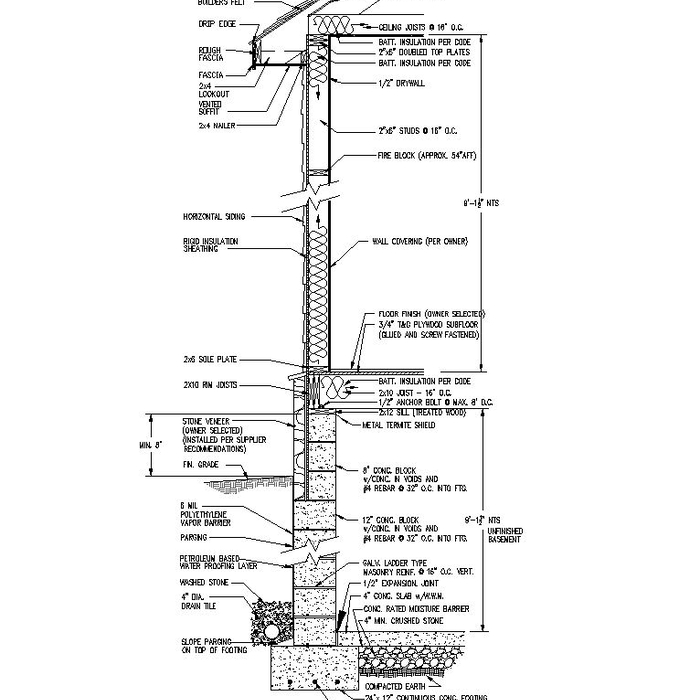
The depth of any foundation style depends on your climate and how deep the frost line is, as building code requires that the footers of a foundation—which are built into a monolithic slab—sit at least a foot below the frost line. At the southern tip of Florida, for example, a monolithic slab foundation would only need to sit 12 inches under the soil at the widest parts. On some parts of the Canadian border, the frost line is 100 inches, which would mean a minimum of 112 inches, which is prohibitively deep for a monolithic slab.
A freestanding brick wall that's only one brick thick can usually stand six to eight feet high. If you need a higher wall, it should be at least two bricks thick for adequate stability, and it might require a footing to support the added weight. Additionally, some areas have regulations and codes dictating how high a brick wall can be, so check with local code enforcers to ensure your proposed wall complies with any regulations.
Foundation cracks that are 1/8 inch wide or less, aren’t uneven across the gap, and don’t continue widening over time are usually just normal settling cracks and don’t suggest structural issues. Horizontal cracks and stair-step cracks on foundation walls, any cracks that continue widening, are wider than 1/8 inch, or where one side juts out beyond the other, are often indicative of structural damage.
According to the Earthquake Country Alliance—a public and private alliance in California that works to improve earthquake and tsunami readiness—reports that unreinforced masonry, such as stone, bricks, and hollow clay tiles, is more susceptible to earthquake damage. The mortar between bricks isn’t as stable as other building materials and methods.
The Williamston, SC homeowners’ guide to structural engineering services
From average costs to expert advice, get all the answers you need to get your job done.
The cost of a structural engineer is easily justifiable given the value they bring to the table. Use this guide to see what hiring your professional will total.
A bowing basement wall needs immediate repair. Learn how much it costs to repair a bowing basement wall and what factors can affect the final price tag.
It can be hard to choose the right pro for any job, but it matters. Learn how to hire a structural engineer who'll get the job done right from start to finish.