







Top-rated ceiling fan pros.

Best ceiling fan pros near Ansonia, CT

Enter your zip and get matched with up to 5 pros

Need a pro for your ceiling fan service project in Ansonia, CT?

Select your specific project to find the pro for you.

TRUSTED BY ANSONIA, CT HOMEOWNERS

  • Average homeowner rating star icon4.5
    Average homeowner rating
  • Verified reviews icon72
    Verified ceiling fan services reviews

Top-Rated Ceiling fan pros in Ansonia - Updated Nov 2026

Avatar for Power Forward LLC
Power Forward LLC
4.8(
24
)
Ceiling Fan - InstallCeiling Fan - Repair

Serving Ansonia, CT and surrounding areas

Approved

Free estimates

Warranties offered

Credit card accepted

"Phenomenal job installing a whole-house fan. Arrived on time, did a great job on installation and did a professional job of cleaning up after themselves. Price was fantastic too - can't rate them highly enough."
2 neighbors recently requested a quote
Recommended by95%of homeowners

Avatar for Power Forward, LLC
Power Forward, LLC
4.9(
19
)
Ceiling Fan - Install

Serving Ansonia, CT and surrounding areas

Approved

In business since 2017

Free estimates

Credit card accepted

"Ian was able to schedule me within 24 hrs of contact. Corrected my wiring problem and installed new fixture efficiently, even fixed a noise problem with unit (range hood) Answered my many questions thoroughly. Being new to area it was a great find Would definitely recommend."
Broken driveway lights
Front walk way post light
Response time3 hrs
Recommended by100%of homeowners

Avatar for HARP Home Services, LLC
HARP Home Services, LLC
3.6(
102
)
Ceiling Fan - InstallCeiling Fan - Repair

Serving Ansonia, CT and surrounding areas

Approved

In business since 1989

Free estimates

Emergency services offered

We pride our company on reliability, great communication, integrity, and quality work. We are experts in our trade and will do our best to keep you as educated as we can on your particular task or project. We look forward to earning your business! Feel free to book online with us today!

Recommended by74%of homeowners
...
Showing 1-10 of 62
Ceiling Fans FAQs, answered by experts

If you’re replacing an old fixture with a ceiling fan, you usually won’t need a permit, but if your electrician runs new wiring for the fixture, you likely will need a permit. Building permits are necessary in most municipalities if you’re making changes to your electrical system, so even if you have partial wiring run to the area and need new wiring installed for added functionality, you’ll probably need a permit. Your electrician should be able to let you know if you need one, and they’ll typically file the paperwork for you.

The most efficient ceiling fan height is 8 to 9 feet from the floor to the fan blades. For ceilings higher than 9 feet, a downrod can be used to lower the fan to the optimal height. This positioning ensures adequate air circulation and maximizes the cooling effect. Remember, fans should be installed at least 7 feet above the floor for safety.

If you’re removing a ceiling fan without visible screws, start by locating the fan canopy—a round cover placed above the fan blades and motor. There should be a thin ring that can be turned counterclockwise to remove the canopy and reveal the screws. After unscrewing the fan, you can disconnect the wires and remove the entire fan from the mounting hardware. For safety, make sure the fan switch is turned off before you remove the canopy. It may be easier to remove the fan blades first, too.

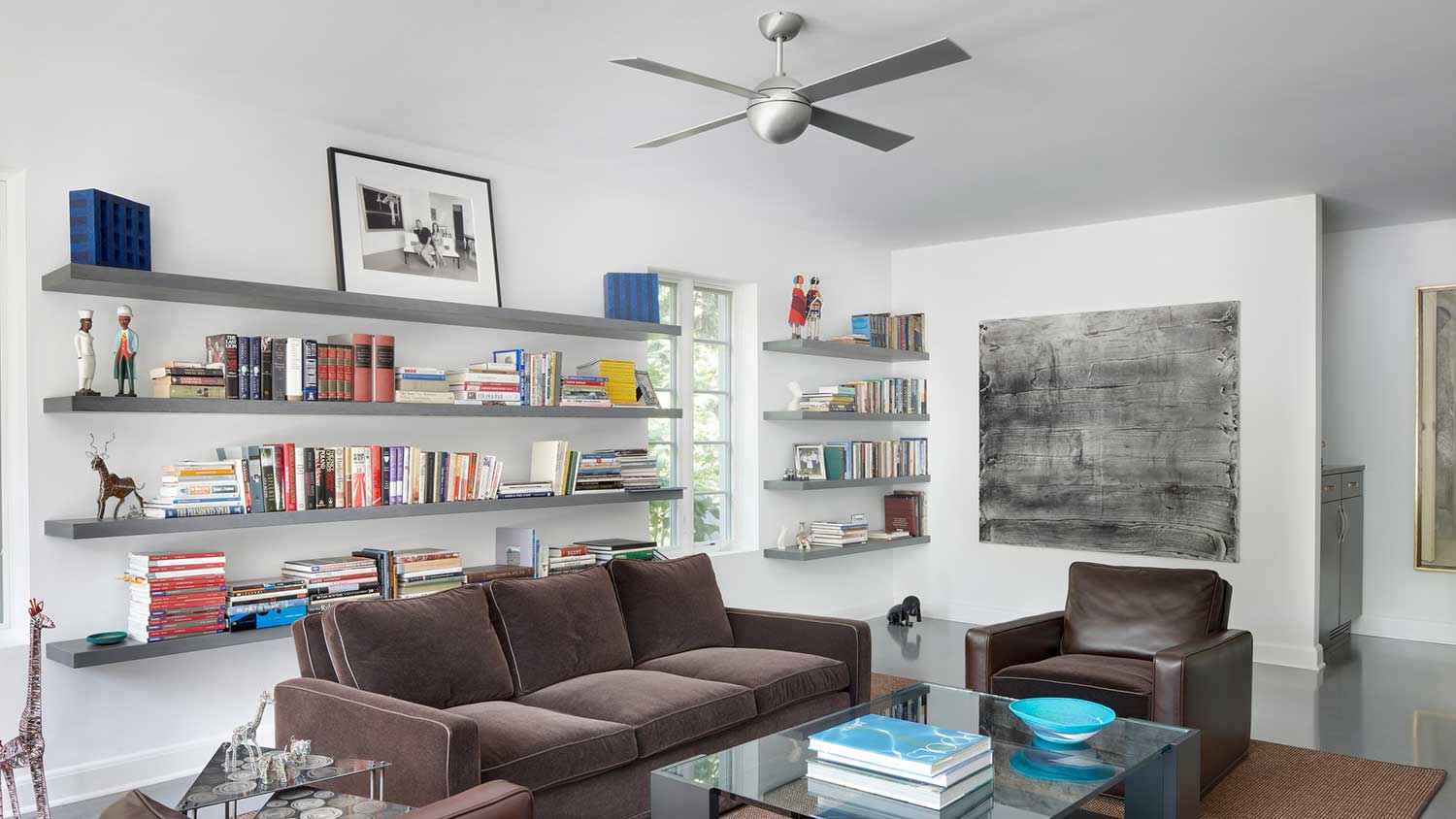
The number of blades for your fan poses both advantages and disadvantages. Typically, the more blades on a fan, the better the air distribution and cooling effect, but this also means that your fan will have more wear on its motor. For small rooms, three-blade fans should work fine. For larger areas like living rooms, four or five-blade fans might be the better option. 

Stainless steel or aluminum fans are long-lasting and have less air resistance. They are best for outdoor use as their durability helps them withstand unpleasant weather conditions. Their heavy weight requires a stronger motor, which leads to more noise than other blade materials.

Wooden fan blades are a classic, durable option. They are much quieter than metal fans and feature a wide range of styles and finishes to choose from. However, they can be damaged by moisture if not covered with plastic.

Plastic fan blades are lightweight, easy to clean, and versatile. There are various shapes and styles to choose from as plastic is easily molded and dyed. They will also deteriorate slower than other materials as they aren’t as susceptible to humidity and moisture.

The Ansonia, CT homeowners’ guide to ceiling fan services

From average costs to expert advice, get all the answers you need to get your job done.