

Amps, volts, watts—it’s easy to get confused about what these different electrical terms mean. Our guide explains what you need to know about amps vs volts vs watts.
Understanding home electricity, measure by measure

Understanding the difference between amps and volts helps you stay safe during home electrical projects, as amps measure current flow while volts measure electrical pressure.
Amperage poses the greatest safety risk to your body, as exposure to just 50 to 150 milliamperes can cause intense pain or respiratory failure.
Your home circuits are rated for 15 or 20 amps, and knowing which voltage your appliances need (120 or 240 volts) prevents equipment damage.
Hiring a local electrical professional keeps you safe when working with live circuits, providing guidance on proper breaker sizing and voltage requirements for your projects.
The wonders of electricity are so deeply embedded in our lives that, from a young age, we learn specialized terms from physics without understanding what they mean outside of the context of buying different types of light bulbs or choosing the right outlet. Once you start doing DIY home projects, however, understanding the ins and outs of your power supply can be the difference between a job done well and a severe injury. So what are these units anyway, and what exactly is the difference between amps versus volts?

Amperes, or amps, were named after French scientist André-Marie Ampère, often called “the father of electromagnetism.” These are the standard unit of measure for electrical current, indicating the volume of electrons contained in a flow.
Think of the circuits in your home like pipes. Increasing the amperage is like turning the faucet handle and increasing the amount of water trickling through the pipes; more amps indicates a heavier flow of current to all the outlets downstream. If the amperage is too low, your devices won’t receive the electricity they need to function effectively and safely.
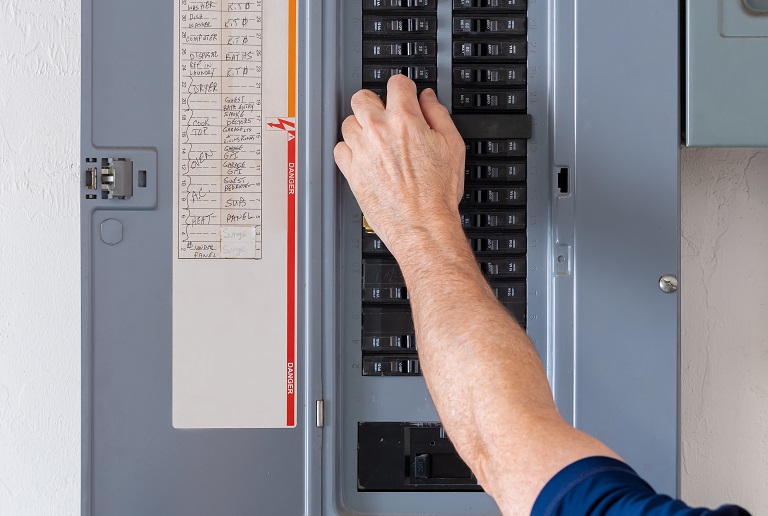
When you open the breaker box in your home, you’ll see circuit breakers of different sizes that are rated for 15 or 20 amps. These circuits can safely carry about 80% of the indicated ampacity (the maximum electrical current), or about 12 and 16 amps, respectively. Most of the circuits in your home are rated for 15 amps, which is the typical volume needed for most lighting fixtures and receptacle outlets. Usually, 20-amp circuits are dedicated to heavier-duty areas with lots of big appliances, like the kitchen and laundry area.

Volts indicate the amount of force pushing electrons through a circuit. The measure comes from the “electric potential difference” between terminals. This is essentially just the pressure required to carry a charge from point A to point B.
In the United States, service panels in most homes receive electricity from the grid in two different voltages: 120 and 240 volts. Small devices in your home, like light bulbs, computer chargers, and televisions, are powered at 120 volts. Bigger, energy-hungry appliances, like garbage disposals, clothes dryers, and air conditioners, must receive electricity at 240 volts to work properly.
If amps are compared to the amount of water flowing through your pipes, volts are like the water pressure. Even if the amperage meets your needs, your devices won’t get what they need if the flow is too weak.

Amps and voltage measure distinct things, and understanding both is important to keep yourself safe when DIYing any home electrical project. Even if you have experience, it’s always good to re-familiarize yourself with the basics of electrical safety. Working with electricity can be extremely dangerous, so if you don’t understand what you’re doing or want to minimize risk, you should always hire a local electrician instead of going it alone.
If you’re working on electrical tasks at home, always take a few essential precautions to decrease the risks that come with electrical work. First, wear rubber electrical gloves and rubber-soled shoes. These will prevent current from flowing through your body. Next, don’t work on anything electrical without first turning off the power at the breaker box. If there’s no current running to a device, you won’t fall victim to a dangerous shock. You can use a multimeter to double-check that you’re in the clear.
If you don’t remember anything else about electrical safety, remember this: Never work on a wire or circuit that’s live, aka one that has power running to it. Doing so is a recipe for electrocution.
Amperage is the most important measure to consider when evaluating the safety of an electrical project. If your body comes into contact with a small enough number of amps, you’ll feel nothing more than a slight shock. If the amperage is high enough, however, it can be instantly fatal, according to the Occupational Safety and Health Administration.
The effect of electrical current on the human body is usually discussed in terms of milliamperes (mA), which are 1/1,000th of an amp. It only takes 50 to 150 mA for you to potentially experience intense pain or even respiratory failure.

Being exposed to a high dose of current will wreak havoc on your body, no matter how slowly it comes. Voltage, on the other hand, is less likely to cause severe injury at levels as low as amps. Don’t make the mistake of thinking that volts are less dangerous, however. There have been reported deaths following exposure to as little as 42 volts.
There are two other terms of electrical measurement you may frequently encounter in the home: ohms and watts. Here’s what they mean for you and any projects you might embark on.
Ohms measure resistance in the flow of electricity. Electricity travels through circuits on wires made of materials that conduct electricity with more or less friction. More friction means more resistance, which is also affected by other factors, like distance. Understanding the total amount of this resistance, in ohms, allows us to understand how much amperage and voltage will be needed to overcome it.
Along with voltage and current, this measure forms an empirical equation called Ohm’s law. It states: V = IR (voltage = current X resistance).
Watts measure the rate of power flow, or the power requirements of a particular device. The number captures electrical output over time given a particular resistance. In other words, it tells us how much electricity a device must consume to perform its job.
To calculate wattage, you can multiply volts by amps. Doing so can be really helpful in figuring out how much you’re paying for common household appliances, like your refrigerator, microwave, or ceiling fans, per hour, day, month, or even year.
I recently had Mosby Electric perform an electrical installation on 8-14-2026, and I couldn’t be more satisfied with the service. From the moment I called, their team demonstrated fast arrival and professionalism. The electricians were highly knowledgeable, completing the installation...
 Mosby Electric
Great company! Price was competitive, technician showed up on time and completed the job (exterior electric Radon fan replacement) quickly. Would hire them again.
 MaGen Property Inspections and Radon Mitigation
I conferred with 2 other contractors before Armstrong Electric. Nick and his crew showed me that the project was not as convoluted as the other contractors made it appear to be. They completed the entire project on time. They were professional, friendly and cleaned up after at completion. I...
 ARMSTRONG ELECTRIC, LLC
The techs on my project, Shawn and Cliff, were great. They were prompt, courteous, and efficient. I am very happy with the results and would definitely contact Mr. Electric for any future electrical projects.
 Mr. Electric of Columbus
Victor was wonderful. He was on time, professional, and explained everything he was doing. He was thorough and figured out that the problem was electrical instead of with my HVAC system. Very knowledgeable. I will be using this company in the future for any HVAC needs. Thanks!
 Hubbs Heating & Air LLC
They were excellent. They did a great job. I was totally satisfied. They put tremendous effort in making sure the work was completed. They were great. They provided immediate response to any inquires I made. I would hire them again. I would recommend them to anyone who needs electrical work....
 JCB & Associates, LLC DBA Property-Tech Industries
Initially, the repairman could not find the problem. Apparently, there was some electrical shortage, but he could not find the definite problem. He left, but called back later to say he had a new idea. He returned and replaced the light switches on the doors. The refrigerator seemed to return...
 Appliance Pro LLC
The initial quoted price from a walk-through seemed high, but we discussed that the quote represented worst case scenario (re-wiring to two floors) and we were excited about the opportunity to have the work done in a timely manner with closing for fire safety reasons, etc. When the job was...
I have to tell you I am all about customer service - I will go out of my way and even pay more for it if you give me great customer service. <br> <br>In a world where this is hard to find, these guys were awesome! I can not sing their praises enough. They were prompt, personable, funny, got...
 Waibel Electric
When I challenged the markup on the generator, Bruder Electric withdrew its bid. They only want naïve customers.
From average costs to expert advice, get all the answers you need to get your job done.
Amps, volts, watts—it’s easy to get confused about what these different electrical terms mean. Our guide explains what you need to know about amps vs volts vs watts.

Understand the concept of amps vs. watts. Learn what the terms mean, how they relate to each other, and when to use them.

Although sometimes used interchangeably, watts and volts represent very different aspects of electricity. Learn the major differences between watts vs. volts.

Learn how many amps you'll need to have for your water heater to operate. Some homeowners will need to upgrade amperage before installing new water heaters to avoid electrical outages and fires.
When you need to choose between a 100-amp versus 200-amp electrical panel, check out our easy-to-understand explanation of your home’s power options.

Knowing how many amps your fridge uses helps monitor your electric bill and ensures you use the proper circuit. Learn how many amps your fridge uses.