
•
Discover how much it costs to build a cob house, including average prices, cost factors, and tips to help you plan your sustainable home project.
Watt you know can save you money on your electric bill

Your home's electricity use in watts depends on house size, family size, climate, insulation quality, and how energy-efficient your appliances are.
Knowing where your energy goes helps you reduce costs by swapping old appliances for EnergyStar-rated models and unplugging devices when you're not using them.
A home energy audit identifies where your house loses energy and shows you practical steps to lower your monthly electric bill through better insulation.
Hiring a local electrical professional provides reliable guidance on reducing energy consumption and completing upgrades that improve your home's efficiency and lower costs.
Whether you're looking to reduce energy costs, install a new generator, or switch to a renewable energy source, knowing how many watts a house uses can serve as a starting point for determining your family's wattage needs.
However, you're not alone if you're unsure what all the wattage jargon means. Learn about watts (W), why it matters, and how many watts a home typically uses. If you need help calculating or reducing your home’s wattage needs, hire a local electrician to make a professional determination and assist with any necessary repairs or upgrades.

A watt is a basic measuring unit of energy primarily used to calculate larger volumes of electrical power. A watt equals an amount of energy for one second.
Watts are calculated by multiplying volts (V) by amps (A). For example, if your microwave oven requires 1,200 watts and your home supplies 120V power, you'll need ten amps to make it run. A watt is a small unit that's not very practical by itself when discussing home-energy consumption. A watt-hour (Wh) is the number of watts used in one hour, and a kilowatt-hour (kWh) equals 1,000 watts per hour.
When discussing electrical device power consumption, like a microwave, we usually refer to its immediate energy needs in watts. If we measure the amount of energy a device needs to operate for an extended period, such as a month, we use kilowatt-hours. When you receive an electric bill each month, you're paying a dollar amount per kilowatt-hour of energy use. If you’re not sure of your home’s energy usage, one way to find out is to conduct a home energy audit.
An average household uses between 800 and 1,000 kWh each month or 9,600 to 12,000 kWh of energy consumption each year. If you divide that by the number of days per year, the average home uses roughly between 26 and 33 kWh per day, or 26,000 to 33,000 watt-hours.
To determine how many watts an average house uses, we divide Wh by the hours in a day. So, a typical home uses an average of 1,083 to 1,375 watts.
While watts measure a small amount of energy, they add up over time. Knowing how many watts your home uses at any given time can be valuable information when reducing energy costs, calculating how many solar panels you need, or determining what size backup generator to purchase.

Knowing the energy consumption rate of various items around your home provides valuable information about where you can start reducing energy consumption and costs. Here's where an estimated average number of watts commonly go.
| Appliance | Average Watt Consumption |
|---|---|
| Space heater | 1,500W |
| Central air conditioner | 3,500W |
| Window air conditioner | 500–1,500W |
| Refrigerator | 300W |
| Microwave | 1,000W |
| Electric oven | 3,000W |
| Dishwasher | 1,350W |
| Coffee maker | 1,200W |
| Water heater | 1,300W |
| TV | 100W |
| Wi-Fi | 10W |
| Hair dryer | 1,250W |
| Electric garage heater | 4,000W |
| Pool pump | 2,000W |
Several factors determine how many watts your home and family consume. The most significant factors include the size of the house and the number of people living there. At least one of these two variables dramatically affects the other ones.
The size of your house affects the energy used to heat and cool the space. Air conditioning uses significant electricity, whether the AC is central, window, portable, or a heat pump. However, central AC uses much more energy than window air conditioner units.
Generally, the more people that live in the house, the more energy the home will use. Appliance usage, water heater cycling, laundry machine use, and several other variables increase as the household grows.
Heating and cooling are major energy consumers in the home. The outdoor temperature affects how often your furnace or air conditioner must run. That’s why we recommend following tips to reduce air conditioning costs in the summer when the temperature rises, including cleaning the filter, shading your windows, and programming your thermostat according to when you’re home.
Adequate insulation installed correctly can reduce the number of watts consumed per day and maintain a comfortable indoor temperature. If parts of your home aren’t properly insulated, like the attic or basement, your heating and cooling system will likely work overtime to regulate the spaces, increasing energy usage.
The quantity of appliances, computers, and other electrical devices in your home directly impacts your home’s wattage needs. Plus, if your household members use several wattage-pulling devices simultaneously, it will likely result in a higher electric bill.
Newer appliances tend to be more energy efficient than older models. The higher the efficiency rating on an electric device, the fewer watts it will use. Replacing an older appliance, like a dishwasher, refrigerator, or washing machine, with an Energy Star-rated appliance can reduce your home’s energy needs over time.
Reducing your watt usage can result in lower energy costs on your monthly electric bill. With that in mind, consider applying these ways to reduce your home's watt usage.
Hire a local energy audit company to inspect your home and offer efficiency tips.
Add insulation to your home's attic and other easy-to-access areas.
Unplug chargers and small appliances when not in use.
Swap incandescent and fluorescent light bulbs with LED ones.
Purchase EnergyStar-rated appliances and devices when you replace old ones.
I recently had Mosby Electric perform an electrical installation on 8-14-2026, and I couldn’t be more satisfied with the service. From the moment I called, their team demonstrated fast arrival and professionalism. The electricians were highly knowledgeable, completing the installation...
 Mosby Electric
Great company! Price was competitive, technician showed up on time and completed the job (exterior electric Radon fan replacement) quickly. Would hire them again.
 MaGen Property Inspections and Radon Mitigation
I conferred with 2 other contractors before Armstrong Electric. Nick and his crew showed me that the project was not as convoluted as the other contractors made it appear to be. They completed the entire project on time. They were professional, friendly and cleaned up after at completion. I...
 ARMSTRONG ELECTRIC, LLC
The techs on my project, Shawn and Cliff, were great. They were prompt, courteous, and efficient. I am very happy with the results and would definitely contact Mr. Electric for any future electrical projects.
 Mr. Electric of Columbus
Victor was wonderful. He was on time, professional, and explained everything he was doing. He was thorough and figured out that the problem was electrical instead of with my HVAC system. Very knowledgeable. I will be using this company in the future for any HVAC needs. Thanks!
 Hubbs Heating & Air LLC
They were excellent. They did a great job. I was totally satisfied. They put tremendous effort in making sure the work was completed. They were great. They provided immediate response to any inquires I made. I would hire them again. I would recommend them to anyone who needs electrical work....
 JCB & Associates, LLC DBA Property-Tech Industries
Initially, the repairman could not find the problem. Apparently, there was some electrical shortage, but he could not find the definite problem. He left, but called back later to say he had a new idea. He returned and replaced the light switches on the doors. The refrigerator seemed to return...
 Appliance Pro LLC
The initial quoted price from a walk-through seemed high, but we discussed that the quote represented worst case scenario (re-wiring to two floors) and we were excited about the opportunity to have the work done in a timely manner with closing for fire safety reasons, etc. When the job was...
I have to tell you I am all about customer service - I will go out of my way and even pay more for it if you give me great customer service. <br> <br>In a world where this is hard to find, these guys were awesome! I can not sing their praises enough. They were prompt, personable, funny, got...
 Waibel Electric
When I challenged the markup on the generator, Bruder Electric withdrew its bid. They only want naïve customers.
From average costs to expert advice, get all the answers you need to get your job done.
Discover how much it costs to build a cob house, including average prices, cost factors, and tips to help you plan your sustainable home project.

How many watts does a ceiling fan use? It depends on the type you have. Most average ceiling fans use 75 watts and cost pennies per day to power.

How many watts an air conditioner uses depends on the size and type of the AC, among other factors. Learn more to stay on top of your energy costs.

When calculating the size of your solar upgrade, you're likely asking yourself, “How many solar panels do I need?” Let's do some math.

Knowing how many watts your home uses can give you insight into your energy consumption and help you save money. Learn how to calculate watts in this guide.
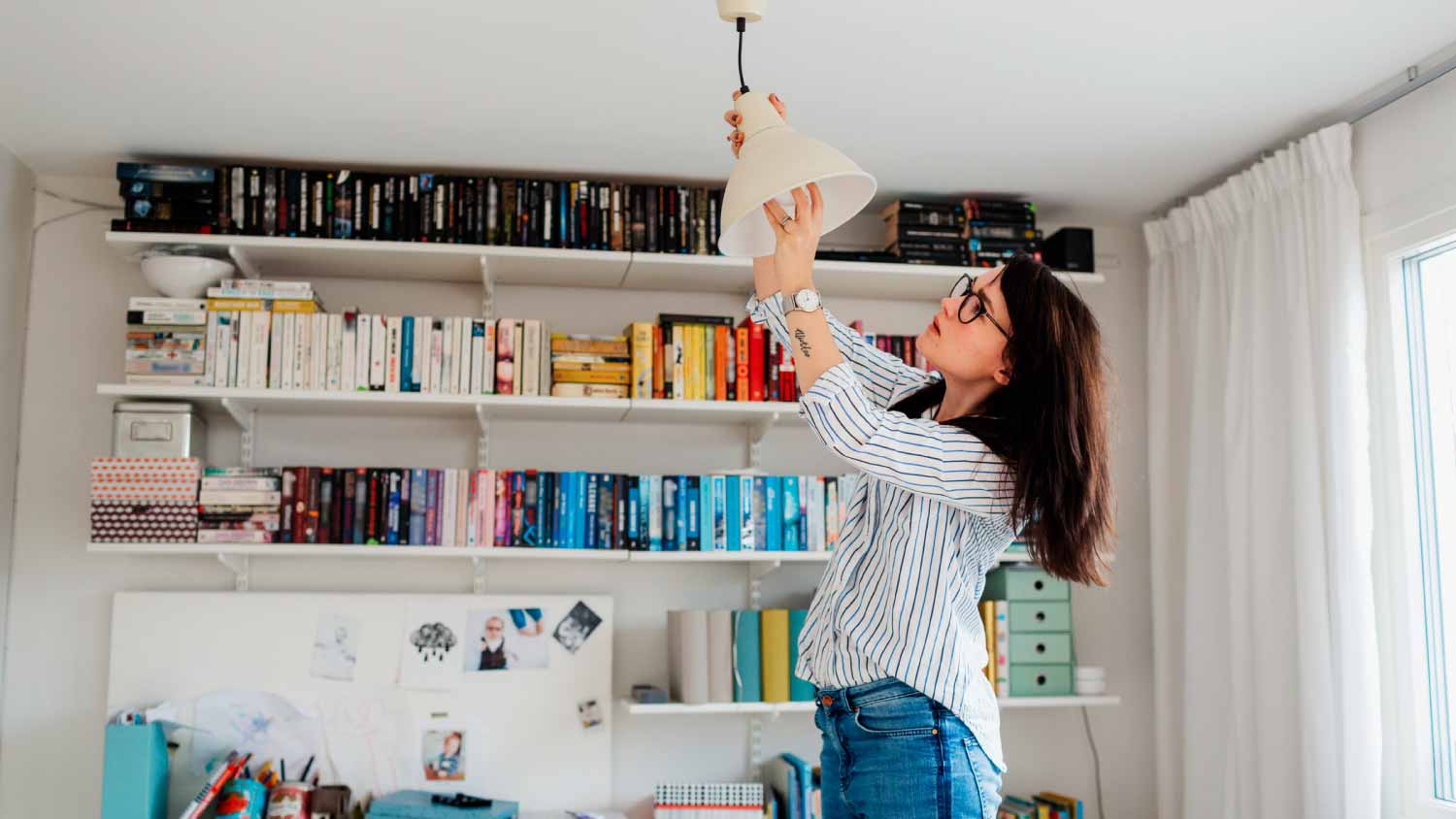
Learning about light bulb wattage is essential for calculating how much electricity your home uses and finding ways to reduce the amount.