
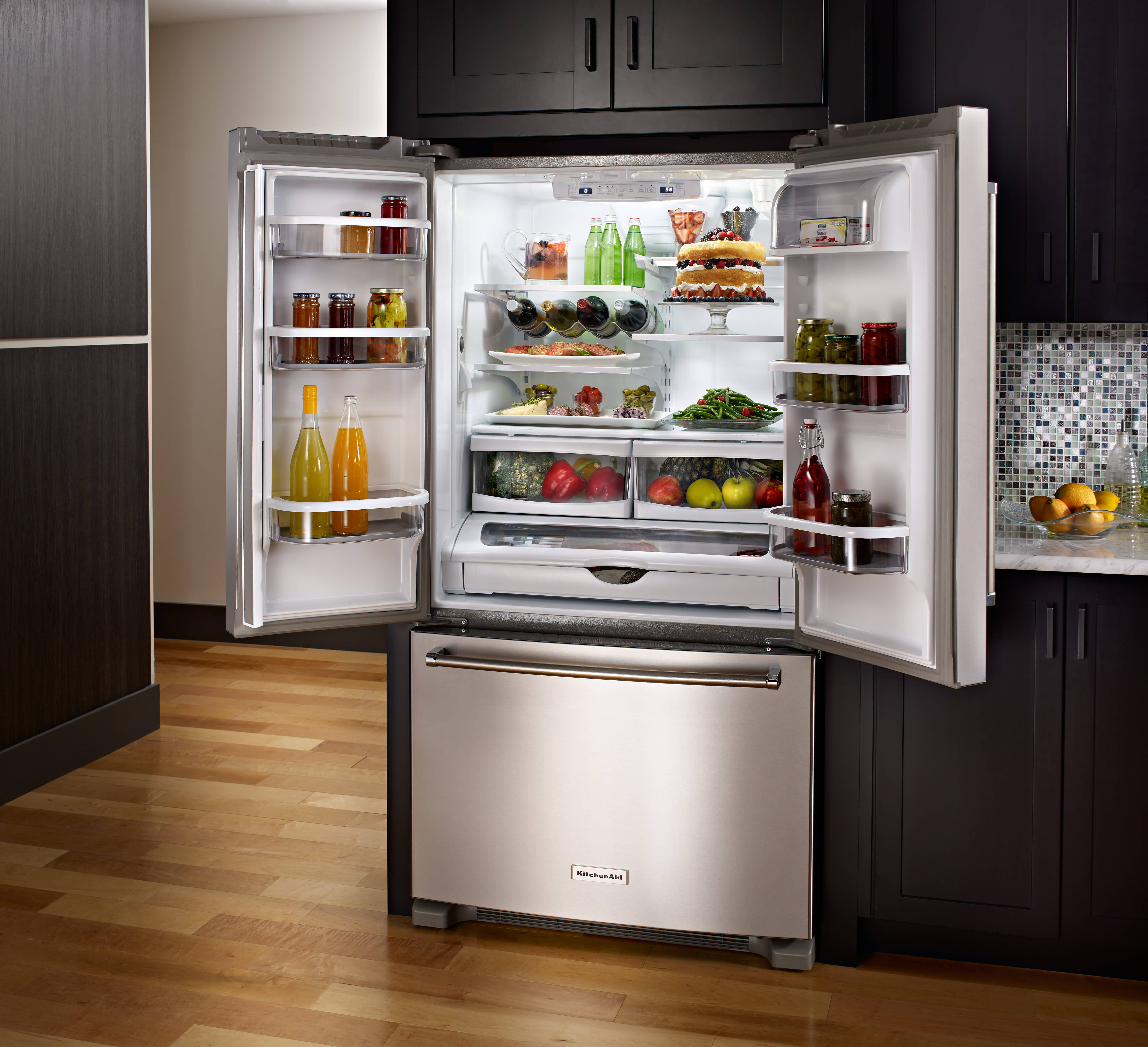
One of the most common fridge problems is a blown compressor motor. Use this guide to determine the cost of replacing the compressor and to estimate the total cost of your repair.
Watt’s the scoop on refrigerator wattage?

Standard home refrigerators use between 100 and 300 watts during normal operation, with your compressor running about 30% of the day.
Your refrigerator's age, cleanliness, kitchen temperature, placement, and size all impact how much power it needs to keep your food fresh.
You should account for backup generator costs if power outages are common and electric usage monitor expenses when you want precise measurements.
Hiring a local appliance installation professional provides reliable help with refrigerator questions and saves you time tracking down energy use details.
It’s easy to take your refrigerator for granted until a power outage strikes. That big appliance humming in the background, keeping your food fresh, is a constant presence in the kitchen. The fridge often seems more like a piece of furniture than a machine constantly consuming power, which leads us to refrigerator wattage. Unlike the passed-down couch sitting in the living room, your fridge is costing you money every single day.
When you think a little about your daily energy usage—whether it’s because you need to rely on a backup generator, you’re switching over to solar panels, or you’re simply trying to cut down the monthly bills or your carbon footprint—you’ll want to get into the weeds of your fridge’s power consumption. The first step is determining how many watts an average refrigerator needs for its daily operation.
Though you’ve probably spent a whole lifetime making casual decisions about wattage when buying light bulbs, you may first find yourself wondering: What are watts, anyway?
Watts are a unit of measure that describe the rate at which power flows. When it comes to home electricity, watts indicate the amount of power a device consumes in its operation.
Watts are related to, but distinct from, these other units of electrical measure:
Volts: Volts are used to quantify the speed at which a current passes through a circuit.
Amperes (or amps): Amps measure the volume of current in an electrical circuit.

The wattage actually consumed by a refrigerator depends on a number of different factors: the age and cleanliness of the appliance, the temperature of the kitchen, the fridge’s size and placement, and more. Keep in mind that wattage ratings are an estimate, indicating the minimum number of watts required by an appliance to run.

Home refrigerators come in many different sizes, with capacities ranging from 11 to 28 cubic feet. Today, the average home refrigerator typically uses between 300 and 900 watts, but it’s a little more complicated than that.
These ratings are an estimate of the electricity consumed by the fridge at its full capacity when the compressor is running, which only happens during a portion of the day (roughly 30%). The actual running wattage of a typical fridge (which is usually between 22 and 31 cubic feet) falls closer to something between 100 and 300 watts.
Mini fridges are designed to keep a smaller number of food items and drinks fresh using less electricity than a standard fridge. Due to advancements in technology, most contemporary mini fridges use between 50 and 65 watts, though some older models use as much as 100 watts.

When it comes to determining how many watts are required to operate your own refrigerator, there are some steps you can take to remove some of the guesswork. When in doubt, you can also always consult a local appliance installer.
If you’ve held on to the owner’s manual for your appliance, or if you can find one online, you can simply look up the wattage rating. Grab your fridge’s brand and model number (you can typically find this on a label somewhere inside the fridge), and get to Google-ing!
Even if you no longer have access to the manual, most of the information you need will be included on the manufacturer’s label posted on the inside of the refrigerator. In most cases, the label won’t indicate the wattage, but it will include the maximum amps and the rated voltage. To calculate the wattage, simply multiply these numbers. To approximate the running wattage, divide it by three.
For example, you may find a voltage rate of 115 V and a maximum amp capacity (ampacity) of 6.5. Multiply them, and you have 747.5 watts. This will be the wattage required under normal conditions for the fridge to operate at the peak of its cycle.
Remember, your refrigerator’s compressor only runs around 30% of the day. So, you can divide that last number by three for a total of 249.2 watts. This is the rate at which your refrigerator consumes energy during most of the day.
All of the above methods of finding out how many watts your refrigerator requires are estimates made with the assumption that the appliance is functioning well in average conditions. But if you really want to measure the number of watts your fridge is using every day, you can buy an electric usage monitor. This device can be inserted into the same outlet as the fridge to take and display live readings of the power consumption. Typically, these monitors will come within 1% to 6% accuracy.
Once you’ve determined the number of watts your refrigerator requires to run, you can use the number to get a rough calculation of what it means for your energy bill.
First, multiply the wattage by 24 so that you have the total requirement for one day.
Next, divide the result by 1,000 for the total number of kilowatts (kW).
Consult your electric bill to find out how much your local utility company charges per kilowatt-hour (kWh).
Multiply that cost by the total number of kilowatts.
The result is your daily cost. You can multiply it by 30 to determine the monthly costs of running your fridge or by 365 to determine the annual total.
So, continuing our example above, if your fridge needs 250 watts for normal use, the total daily usage is 6,000 watts. Dividing by 1,000 gives us 6 kW. Say your electricity rate is 23 cents per kilowatt-hour; the daily total cost to run your fridge would be $1.38 per day or roughly $41.40 per month.

If you’re concerned about all the wattage being gobbled up, there are a number of different things you can try to reduce the electricity burden of your refrigerator.
No matter how much you hope, the fridge won’t magically create a new, tasty snack for you the third time that you open the door in 30 minutes. The easiest way to minimize your refrigerator’s energy consumption and reduce your electric bill is to decrease the amount of time you leave the door open. The more cool air that escapes into your kitchen, the harder the fridge is going to need to work to get back to the right temperature.
Many homeowners don’t know that they need to clean a refrigerator’s condenser coils regularly. When dust and grime accumulate, the condenser no longer works efficiently, draining more power to function. Keep a regular cleaning schedule to cut your usage costs.
When a refrigerator is kept in direct sunlight or placed close to a heat source, like an oven, it needs to work even harder to keep its contents fresh and cool. Make sure your fridge is located in a darker, cooler corner of the kitchen to maximize efficiency.
If the seal of your fridge has started to loosen, cool air will constantly be leaking, placing greater demand on the power supply.
You can check your fridge’s seal with the dollar bill test. Place a crisp dollar bill between the door and seal and then close it. Try gently pulling it out. If it doesn’t stay in place, the seal should be replaced.
I recently had Mosby Electric perform an electrical installation on 8-14-2026, and I couldn’t be more satisfied with the service. From the moment I called, their team demonstrated fast arrival and professionalism. The electricians were highly knowledgeable, completing the installation...
 Mosby Electric
Great company! Price was competitive, technician showed up on time and completed the job (exterior electric Radon fan replacement) quickly. Would hire them again.
 MaGen Property Inspections and Radon Mitigation
I conferred with 2 other contractors before Armstrong Electric. Nick and his crew showed me that the project was not as convoluted as the other contractors made it appear to be. They completed the entire project on time. They were professional, friendly and cleaned up after at completion. I...
 ARMSTRONG ELECTRIC, LLC
The techs on my project, Shawn and Cliff, were great. They were prompt, courteous, and efficient. I am very happy with the results and would definitely contact Mr. Electric for any future electrical projects.
 Mr. Electric of Columbus
Victor was wonderful. He was on time, professional, and explained everything he was doing. He was thorough and figured out that the problem was electrical instead of with my HVAC system. Very knowledgeable. I will be using this company in the future for any HVAC needs. Thanks!
 Hubbs Heating & Air LLC
They were excellent. They did a great job. I was totally satisfied. They put tremendous effort in making sure the work was completed. They were great. They provided immediate response to any inquires I made. I would hire them again. I would recommend them to anyone who needs electrical work....
 JCB & Associates, LLC DBA Property-Tech Industries
Initially, the repairman could not find the problem. Apparently, there was some electrical shortage, but he could not find the definite problem. He left, but called back later to say he had a new idea. He returned and replaced the light switches on the doors. The refrigerator seemed to return...
 Appliance Pro LLC
The initial quoted price from a walk-through seemed high, but we discussed that the quote represented worst case scenario (re-wiring to two floors) and we were excited about the opportunity to have the work done in a timely manner with closing for fire safety reasons, etc. When the job was...
I have to tell you I am all about customer service - I will go out of my way and even pay more for it if you give me great customer service. <br> <br>In a world where this is hard to find, these guys were awesome! I can not sing their praises enough. They were prompt, personable, funny, got...
 Waibel Electric
When I challenged the markup on the generator, Bruder Electric withdrew its bid. They only want naïve customers.
From average costs to expert advice, get all the answers you need to get your job done.
One of the most common fridge problems is a blown compressor motor. Use this guide to determine the cost of replacing the compressor and to estimate the total cost of your repair.

Get transparent refrigerator repair cost info. Learn what impacts price, compare repair vs. replacement, and find ways to save on your fridge repair.

Whether you’re upgrading an old appliance or rearranging a kitchen layout, our guide breaks down the costs to move your fridge.

Knowing how many amps your fridge uses helps monitor your electric bill and ensures you use the proper circuit. Learn how many amps your fridge uses.

When your refrigerator runs continuously, it has to work harder, which can reduce its life span and efficiency. Use this guide to troubleshoot a running refrigerator.

How many watts does a house use? Understanding what a watt is and where they go can help you know how to cut energy costs.