


Top-rated electricians.

Get matched with top electricians in Bloomfield, NM

Enter your zip and get matched with up to 5 pros

Need a pro for your electrical service project in Bloomfield, NM?

Select your specific project to find the pro for you.

TRUSTED BY BLOOMFIELD, NM HOMEOWNERS

  • Average homeowner rating star icon4.8
    Average homeowner rating
  • Verified reviews icon58
    Verified electrical services reviews

Find Electricians in Bloomfield

Avatar for Red, White, and Blue Lightning Protection
Red, White, and Blue Lightning Protection
4.7(
78
)
Lightning Protection - Install or Repair

Serving Bloomfield, NM and surrounding areas

In business since 1970

Free estimates

"Honest family business that does outstanding work, quickly? How can you top that. He explained a lot about lightning and the various dangers. Given my tall, metal roofed home in a wooded setting, I needed lightning protection. I've never had a problem in 23 years, until the past 3 months. The frequency and intensity of electrical storms is increasing. I had two close calls (at the expense of over $1,000 of electronics (that I had plugged into expensive surge protectors!) With something as important as lightning protection, go with experience. Red, White, and Blue has that!"
Lightning rod system
Lightning rod residential

+5

Response time4 hrs
Recommended by100%of homeowners
D & R Services
4.6(
47
)
Ceiling Fan - InstallCeiling Fan - RepairOutdoor Lighting - Plan and Install+1 more

Serving Bloomfield, NM and surrounding areas

In business since 2010

Free estimates

Emergency services offered

"Aside from the delay in making an appointment, everything went smoothly.  He arrived exactly on time and cleaned up afterwards. One edge of the drywall did  not hit the stud so he worked with  a leftover piece of wood  I had  to fix that problem.  All other materials were provided by them.  The gap on the adjoining wall (between the wall and the garage door) was also covered.  Overall I was very pleased with the work.
"
Additional Photos
stamped concrete and curb
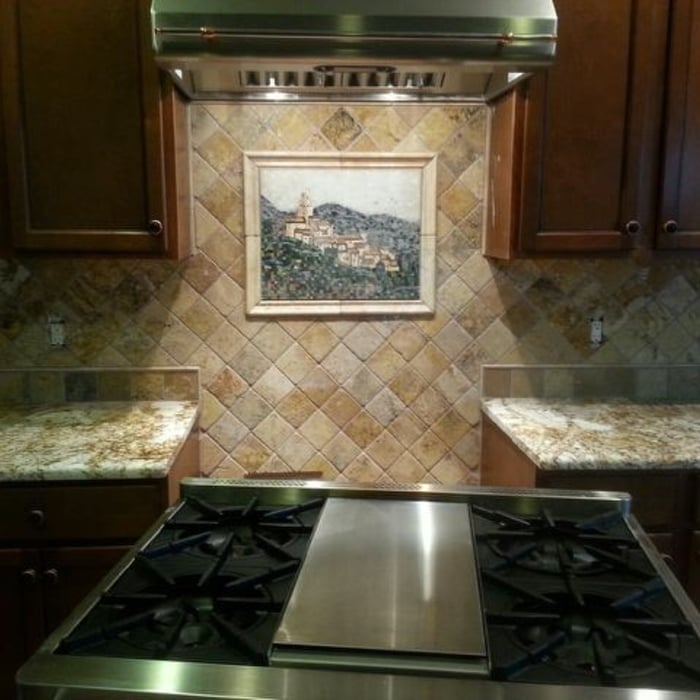
tile

+107

Recommended by82%of homeowners
M & J Troubleshooting, Inc.
4.0(
5
)
Electrical Switches, Outlets & Fixtures - Install or RepairElectrical Switches, Outlets & Fixtures - Install or Repair - For BusinessElectrical Wiring or Panel Upgrade+3 more

Serving Bloomfield, NM and surrounding areas

In business since 2002

Free estimates

Credit card accepted

"I had all of my light switches and electrical outlets in my home replaced with decorative switches/outlets. They were efficient and clean. I would hire them for other projects."
Response time10 mins
Recommended by100%of homeowners
Showing 1-10 of 44
Electrical questions, answered by experts

How far you can run underground electric depends on the wire gauge (generally AWG) and the circuit voltage. Too much voltage drop in an electrical circuit can negatively affect performance, so the smaller the voltage drop, the better. Ideally, it shouldn't exceed 3%. The smaller the wire and the longer the run, the more significant the voltage drop. 

For example, with a 120-volt circuit, you can run 60 feet of 12 AWG cable without losing more than 3% voltage. With a 240-volt circuit, you can run 120 feet of 12 AWG wire while maintaining a voltage drop of 3% or less.

Running conduits through an exterior wall is an effective method for powering outdoor spaces. From gardens to sheds to garages and more, it can be important to have electricity outdoors. Using conduit, which safely covers wires outdoors, is an easy way to get power where homeowners need it.

Window ACs use 500 to 1,400 watts per hour of electricity, while mini-splits use 500 to 700 watts per hour. However, if you need to cool multiple zones in your house, your mini-split can use as much as 2,000 watts per hour. How often you run your system will impact how much electricity you use (and how much you pay per month).

The American Wire Gauge system calculates wire size diameters using the complicated formula D(AWG)=.005·92((36-AWG)/39) inch. A simpler rule of thumb is that every six-gauge decrease doubles the wire diameter, and every three-gauge decrease doubles the wire’s cross-sectional area. On the other hand, wavenumbers are typically measured in reciprocal meters (1/m or m−1) or reciprocal centimeters (1/cm or cm−1).

A larger heater requires a larger breaker—unless there’s one already installed. The longer answer to this question is more nuanced. Do you place demands on the heater at the same time as running other heavy-duty appliances like ovens and washing machines? Do you live in an older home that may not have considered the higher electrical demands we have now? Breakers need to be sized at 125% of the load. To find that load, you should call a local electrical pro.

The Bloomfield, NM homeowners’ guide to electrical services

From average costs to expert advice, get all the answers you need to get your job done.