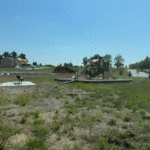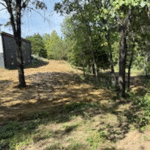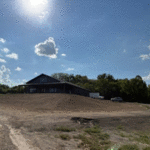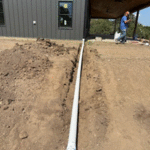





Top-rated excavation pros.

Get matched with top excavation pros in Knob Noster, MO

Enter your zip and get matched with up to 5 pros

Need a pro for your excavation project in Knob Noster, MO?

Select your specific project to find the pro for you.

Find Excavation pros in Knob Noster

Avatar for Wilson Land Management  LLC
Wilson Land Management LLC
5.0(
1
)
Building Site - Preparation and ClearingExcavation - Major Grading or ReslopingBuilding Site - Preparation and Clearing - For Business+1 more

Serving Knob Noster, MO and surrounding areas

Approved

In business since 2025

Free estimates

Small jobs welcome

We pride our company on reliability, great communication,\nintegrity, and quality work. We are experts in our trade and will do our best\nto keep you as educated as we can on your particular task or project. We look\nforward to earning your business!

Response time8 hrs
Response rate100%
26 neighbors recently requested a quote
Avatar for Kuhl-Rock Construction
Kuhl-Rock Construction
New to Angi
Building Site - Preparation and ClearingBuilding Site - Preparation and Clearing - For BusinessExcavation - Major Grading or Resloping+1 more

Serving Knob Noster, MO and surrounding areas

Approved

In business since 2021

Free estimates

Small jobs welcome

leader in providing our customers with the highest quality service in an honest, efficient, and professional way. Our pledge is to create successful relationships with our customers, employees and community by building trust, treating every project with the utmost integrity and exceeding expectations. We look forward to working with you!

Response time1 day
Avatar for Floydoesit
Floydoesit
4.3(
18
)
Landscape - Minor Grading or Resloping

Serving Knob Noster, MO and surrounding areas

In business since 2019

Emergency services offered

Warranties offered

"This contractor was efficient and did an excellent job at repairing our fence. He was the first to reach out to us when we began our search thru Angi. His price was fair and he made sure that we were pleased when he finished . We will be using him again to complete some other projects that we have. I have also recommended him to several friends."
Response time2 days
Recommended by81%of homeowners
...
Showing 1-10 of 55
Excavating questions, answered by experts

There are several methods to hollow out a tree stump, and the best one depends on your tools, experience, and priorities. Common methods include using a chisel and hammer, a chainsaw, or burning.

  • Chisel and Hammer: This is often considered the easiest approach for those with limited tools or experience, though it is the most time-consuming.

  • Chainsaw: Using a chainsaw is the fastest method, but it comes with significant safety risks, especially for inexperienced users.

  • Burning: This can be an effective method, but it is not recommended unless you can first drill holes into the stump. Without holes, the stump will be difficult to light and may not burn completely through.

A power drill with at least a ⅜-inch diameter bit can make the job quicker and easier, regardless of the primary method. While you can use a chisel or chainsaw without a drill, it will require more time and effort. Always wear protective goggles and thick gloves, as splinters are an inevitable risk.

The best way to protect tree roots is to avoid the roots entirely by excavating outside the root radius of the tree. For nearby projects, it’s a good idea to construct a temporary retaining wall. But that’s not always possible, depending on the project and the root system. In these cases, consider using alternative equipment like an auger to tunnel under the ground.

Remember, tree roots can damage nearby cement foundations as they grow. If a tree is close enough to interfere with large excavations, it may be better to remove the tree than risk future problems.

Septic drain lines (or leach lines) are typically buried between 18 and 36 inches underground, and should be at least 6 inches below the surface. These pipes are perforated and surrounded by filtering materials like sand or gravel. Burying the lines at this depth helps minimize odors and allows bacteria and other biological processes in the soil to effectively treat the wastewater. Burying lines too close to the surface can cause issues unless the soil is very compact and stable.

The best type of soil to build on is a mixture of sand and clay, known as loam soil. Loam soil has the best combination of these soil types to build a foundation on. The clay particles help with water retention, so it won’t erode like sandy soil might, and the sandy particles help with drainage, so you won’t see unsafe soil expansion or have an increased risk of leaks from water sitting against your foundation.

Trenches are typically 12 to 24 inches deep and 8 inches wide. However, the required depth depends on the specific project and local ordinances. For example, a French drain may need to be 18 inches deep, while a water pipe might require a depth of 24 inches and a drainage pipe 36 inches. Your city or county may have specific regulations, so it's wise to consult with an excavation professional to determine the correct depth for your project.

The Knob Noster, MO homeowners’ guide to excavation services

From average costs to expert advice, get all the answers you need to get your job done.