


Get matched with top excavation pros in Dry Fork, VA
Top-rated excavation pros.

Need a pro for your excavation project in Dry Fork, VA?

Select your specific project to find the pro for you.

Find Excavation pros in Dry Fork

Avatar for Gabriel & Gail Better Business
Gabriel & Gail Better Business
3.6(
33
)

Serving Dry Fork, VA and surrounding areas

In business since 1999

Free estimates

Emergency services offered

"

Initially, he seemed like he was very very knowledgeable, very friendly and gave us thoughts that he knew what he was doing. They arrived on time. They're very good. The crew was pretty quick and efficient. One problem I had was they didn't come with enough materials. They had to reschedule for a completion of some. There were some minor issues that we ran into. They were supposed to paint the chimney cap and never actually did that. It's not a big deal but the other thing was the warranty and we kind of had a fight with them for the warranty to actually be processed. The warranty was the big thing and it was a lifetime warranty and I guess there were personal things that came up. It was just basically what I've learned late, but it took us probably eight months to get the warranty to be processed. That was my biggest concern, but the warranty company ensures me that everything is good even though the paperwork has the wrong number on there and I am assuming that's because they had the wrong number initially which is why they didn't have enough material.

"
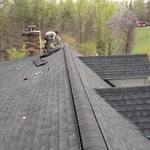
Charcoal GAF High Definition Shingle
Vent Ridge Installation
Recommended by75%of homeowners
Showing 1-10 of 31
Excavating questions, answered by experts

Whether you grind or dig up and remove your tree stump depends on your landscaping goals. Using a stump grinder leaves the root system in place for it to decompose over time, whereas digging up the tree stump removes the roots and the stump. Overall, stump grinding is a far simpler process since you won’t need to deal with the roots. Stump removal will make your yard look like a demolition site, but you’ll have an easier time replanting in the same place as your former tree.

Septic drain lines (or leach lines) are typically buried between 18 and 36 inches underground, and should be at least 6 inches below the surface. These pipes are perforated and surrounded by filtering materials like sand or gravel. Burying the lines at this depth helps minimize odors and allows bacteria and other biological processes in the soil to effectively treat the wastewater. Burying lines too close to the surface can cause issues unless the soil is very compact and stable.

In most areas, you will need a permit for excavation work, even for projects that only involve grading or yard leveling. Permit requirements depend on your local government and the scope of the project, but they are especially common for significant digging or work that could affect utilities or public property. These permits help protect the local topography and prevent drainage issues. An experienced excavation company will typically know whether permits are needed and can often handle the process of pulling and closing them for you. You can also verify permit requirements by contacting your local building department and describing your project.

Trenching and boring are two distinct methods for installing underground utilities. Trenching involves digging a channel using equipment like an excavator, trencher, backhoe, or shovel. While it is a simpler process, it causes significant disruption to the surface, landscaping, and surrounding ecosystems.

Boring, also known as directional boring, is a less invasive alternative that uses a drill to create a tunnel for utility lines without disturbing the surface. This method is more precise and is ideal for installations that need to go underneath buildings, roads, or bodies of water. Although boring is less disruptive, it is generally more expensive than trenching.

There are several methods to hollow out a tree stump, and the best one depends on your tools, experience, and priorities. Common methods include using a chisel and hammer, a chainsaw, or burning.

  • Chisel and Hammer: This is often considered the easiest approach for those with limited tools or experience, though it is the most time-consuming.

  • Chainsaw: Using a chainsaw is the fastest method, but it comes with significant safety risks, especially for inexperienced users.

  • Burning: This can be an effective method, but it is not recommended unless you can first drill holes into the stump. Without holes, the stump will be difficult to light and may not burn completely through.

A power drill with at least a ⅜-inch diameter bit can make the job quicker and easier, regardless of the primary method. While you can use a chisel or chainsaw without a drill, it will require more time and effort. Always wear protective goggles and thick gloves, as splinters are an inevitable risk.

The Dry Fork, VA homeowners’ guide to excavation services

From average costs to expert advice, get all the answers you need to get your job done.