"I only use James when I need some work done to my house. He responds fast, gets the work done quicker than just about anyone else I've ever used and seems very concerned with leaving his customers happy."
David Ferguson's construction business is dedicated to quality and outstanding customer service. Our job is to provide you with quality service at a great price. Please don't wait call us today.
Limewash and whitewash do not harm surfaces if you apply them correctly. Use on non-suitable surfaces can cause issues. For instance, applying limewash or whitewash to surfaces with existing sealants or incompatible materials may lead to poor adhesion or flaking. Also, harsh cleaning agents on limewashed or whitewashed surfaces can damage the finish. Proper preparation, application, and maintenance ensure that limewash and whitewash do not harm surfaces.
Yes, staining or sealing a cedar deck or fence is highly recommended to extend its lifespan, typically by five to 10 years. While cedar is naturally resistant to mold and mildew, it can still fall victim to moisture, sun exposure, and rot over time. Applying a treatment creates a protective shield that helps prevent splintering, fading, and decay, preserving the wood's strength and appearance. A combination stain and sealer often provides the best protection, as it soaks into the wood grain rather than just sitting on top. This offers superior defense against UV damage and rot and lasts longer than a sealer alone. To maintain the wood's natural look, consider using a near-translucent stain. You should plan to reapply the stain or sealer every two to three years.
You don’t necessarily have to remove all the old paint before repainting your deck, but it’s best to remove as much as possible to ensure a smooth and long-lasting finish. Prioritize scraping off loose, peeling, or flaking paint, and sand down rough areas to create a smooth surface for the new paint to bond with.
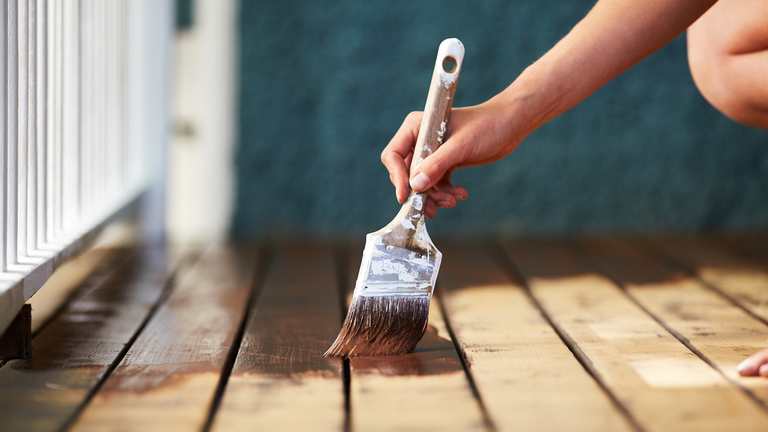
Whether to brush or roll stain on wood depends on the project and your preference. Brushing is ideal for smaller, intricate areas and offers more control over the application, ensuring thorough coverage and penetration into the wood's grain.
Conversely, rolling is efficient for more extensive, flat surfaces and can save time. However, it is not always the best fit for textured or uneven wood. Some projects may benefit from combining both methods, using a brush for detail work and a roller for broader areas. Ultimately, the choice between brushing and rolling depends on the specific requirements of your staining project.
Beyond liquid rubber, homeowners can use sealants, stains, membranes, or tapes as waterproofing options. Oil-based or water-based sealants soak into the wood, creating a moisture-resistant barrier. Waterproofing stains—available in transparent, semi-transparent, and solid colors—add both protection and style to your deck. For heavy-duty waterproofing, deck membranes and waterproof tapes can be applied under the deck boards to direct water away from the structure below. Whatever method you choose, clean and prep the deck first to ensure the best, longest-lasting results.
The Mission, SD homeowners’ guide to deck staining services
From average costs to expert advice, get all the answers you need to get your job done.
The best time to stain a deck is when it’s dry but not too sunny. How often you restain a deck depends on climate and wood type, but every two to three years is normal.