







Top-rated tree service pros.

Get matched with top tree service pros in Waldron, MI

Enter your zip and get matched with up to 5 pros

Need a pro for your tree service project in Waldron, MI?

Select your specific project to find the pro for you.

TRUSTED BY WALDRON, MI HOMEOWNERS

  • Average homeowner rating star icon4.7
    Average homeowner rating
  • Verified reviews icon15
    Verified tree services reviews

Find Tree service pros in Waldron

Avatar for Toler Tree Service
Toler Tree Service
3.9(
14
)

Serving Waldron, MI and surrounding areas

In business since 2018

Free estimates

"Called within minutes of me contacting Home Advisor. Did my tree next day. I had called 5 others and they would not answer my calls after 5 times. Did great job with 2 trees. Cleaned up everything. I would call them again."
Response time1 day
Recommended by83%of homeowners
Avatar for Molina Tree Service
Molina Tree Service
3.8(
12
)

Serving Waldron, MI and surrounding areas

In business since 2017

Free estimates

Emergency services offered

"Mitchell was awesome. He & his team went right to work, cleaning as they went to cutting down our tree (which was close to the house). Would highly recommend &hire again should the occasion arise."
Response time3 days
Recommended by100%of homeowners
Showing 1-10 of 37
Tree Service questions, answered by experts

You should prune ornamental trees once every other year after the fruit has matured and begun to drop. You should also prune out dead branches whenever you see them. Pruning too often can stimulate more growth, especially in faster growing varieties like Bradford pears.

Most trees can be successfully transplanted while they are young, but pines, walnuts, and some oak tree varieties are more difficult to move because their root systems grow deeper than most other trees. Also, trees adapted to sandy soil with wide root systems like beeches, willows, and aspens are harder to dig out because their roots spread much farther out from the trunk. In these cases, unless the trees are very young and small, it’s a good idea to consult a tree planting professional.

Palm trees are unique in that their roots don't grow straight down; they grow horizontally. Typically, palm tree roots go down between 12 and 36 inches deep. The roots grow far and wide from the base of the palm tree to absorb as much water and soil nutrients as possible. In addition, the horizontal roots are also very strong—keeping palm trees stable and helping them sway during storms.

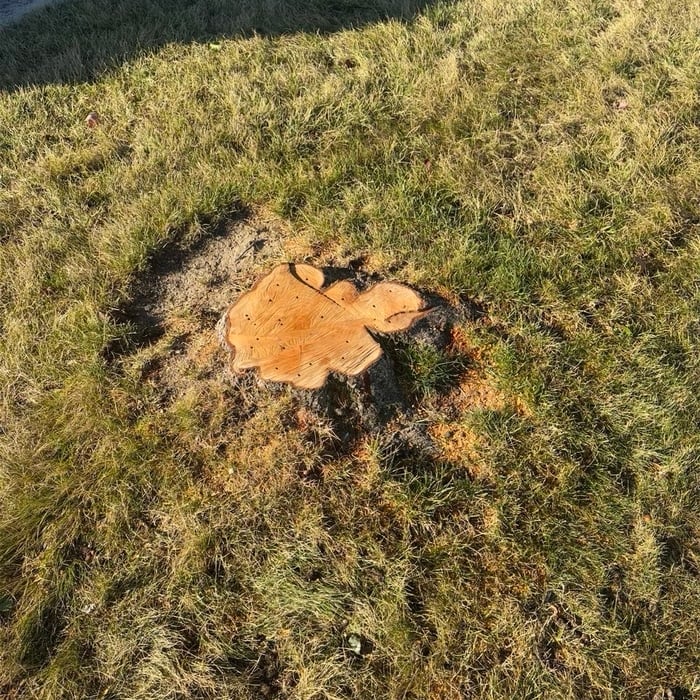
Unless there’s some sort of rule in your community’s homeowners’ association that requires you to remove a stump, there’s no law that says you have to take it out. If you’re not wedded to the idea of removing it, there are plenty of ways to get creative with this tree remnant. Using the stump as the medium for a wood carving or turning it into a planter are just two examples of ways to repurpose a tree stump.

Unfortunately, palm tree stumps are one of the most difficult types to remove due to how their roots grow. Unlike other trees, palm tree roots grow horizontally and vertically. Palm tree roots grow as deep as three feet into the ground, although soil and growing conditions could mean they go as far as 50 inches into the earth. 

If you want to be able to repurpose the grass in the area where you removed a stump later, you’ll have to dig quite deep—and perhaps wide—to trim away all the roots.

The Waldron, MI homeowners’ guide to tree services

From average costs to expert advice, get all the answers you need to get your job done.