






Top-rated paving pros.

Get matched with top paving pros in Roscoe, IL

Enter your zip and get matched with up to 5 pros

Need a pro for your paving service project in Roscoe, IL?

Select your specific project to find the pro for you.

TRUSTED BY ROSCOE, IL HOMEOWNERS

  • Average homeowner rating star icon4.3
    Average homeowner rating
  • Verified reviews icon96
    Verified paving services reviews

Find Paving pros in Roscoe

Avatar for Raindrops Hardscape LLC
Raindrops Hardscape LLC
5.0(
11
)

Serving Roscoe, IL and surrounding areas

Approved

In business since 2010

Free estimates

Warranties offered

"We had them build a front porch over the crumbling cement pouch with treated lumber. It came out great and we are very happy with the workmanship and the amount of time and the cost was very reasonable."
Response time7 hrs
8 neighbors recently requested a quote
Avatar for JL Masonry
JL Masonry
3.8(
32
)

Serving Roscoe, IL and surrounding areas

Approved

In business since 1980

Free estimates

Emergency services offered

"They came to my house and fixed my problem the same day I requested service. Very courteous and polite. Iâ d definitely call them again for any future work needed. Thanks!!"
WV House on the River
Decorative Stone for Fireplace
Jose Working on the Wall

+4

Response time1 day
4 neighbors recently requested a quote
Recommended by82%of homeowners
...
Showing 1-10 of 68
Paving Services questions, answered by experts

Asphalt and tarmac are not the same thing. Traditional tarmac, short for tarmacadam, uses tar as a binder to hold crushed stone together. Asphalt uses bitumen—a byproduct of crude oil—to bind aggregate. Though tarmac was once a go-to for roads, asphalt has become the modern standard. And these days, most surfaces referred to as “tarmac” are actually asphalt. So, while the names may overlap, the key distinction lies in the binder—tar for tarmac and bitumen for asphalt.

If you wish to break up a cracked or broken paver for removal, you can use a hammer or mallet and a chisel to fragment the paver. As you’re working, be careful not to disturb surrounding pavers; the key is to work slowly and steadily and remove the broken pieces gently. You should also wear a mask and goggles to ensure that no dust gets into your eyes, nose, or mouth as you work.

The ideal distance between stepping stones depends on your design preference. A general rule is to place them about 24 inches apart from center to center to match an average person's stride. Another common approach is to leave about 6 inches of space between the edges of each stone; this can be adjusted to fit the path's total length without cutting pavers. If you plan to plant between the stones, leave at least 6 to 8 inches of space to give the plants room to grow.

Recycled asphalt is a durable choice for a driveway, but doesn’t have the same appearance and low maintenance as standard asphalt. For long driveways in rural communities, recycled asphalt can make a great choice. Recycled asphalt is 20% to 30% percent less expensive than standard asphalt and is better for the environment. 

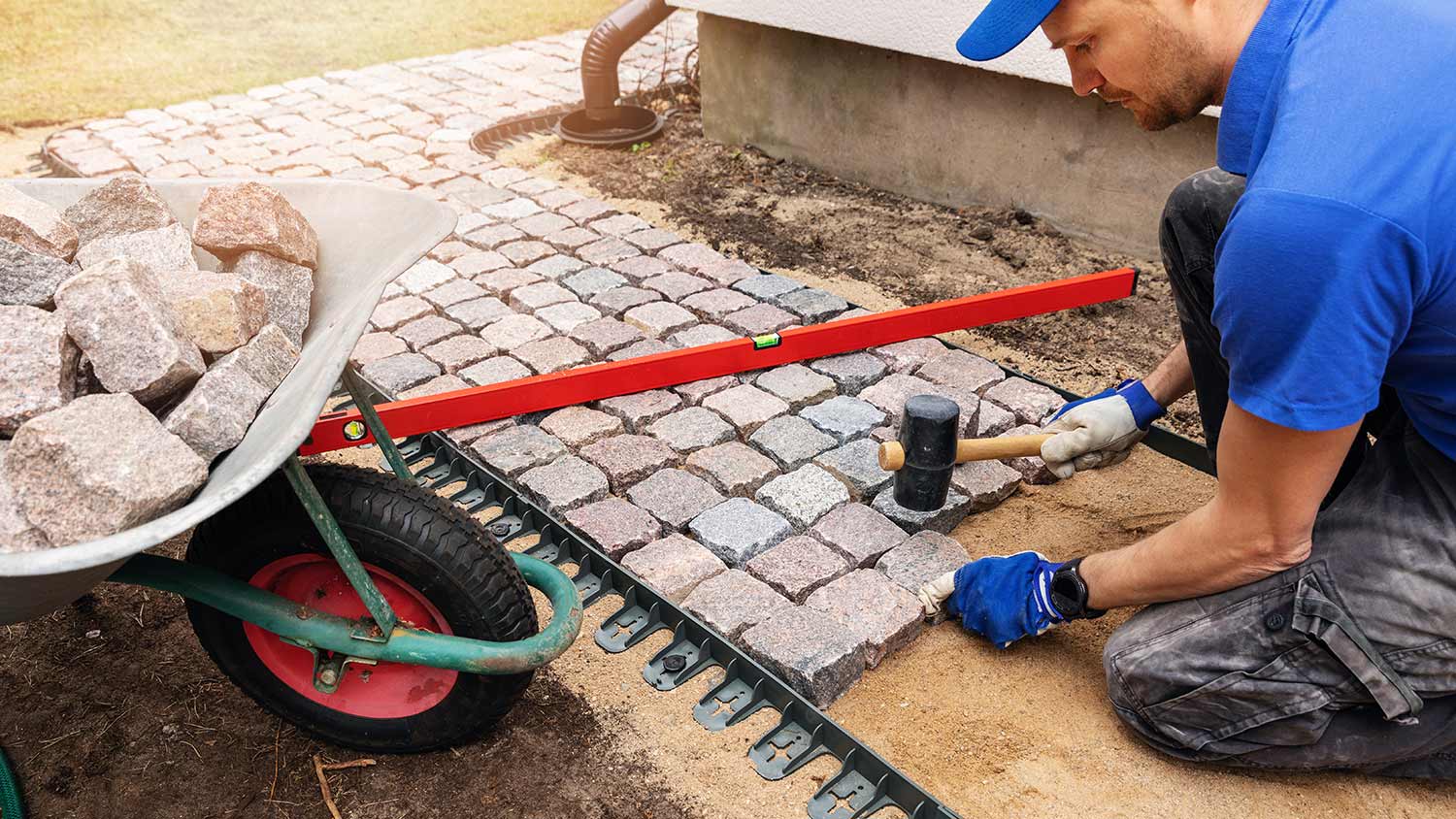
Yes, you should lightly wet the sand with a hose before laying the pavers on top. This activates the bonding agents in the sand, ensuring that your pavers don’t shift around during the installation process. However, you should make sure that the sand is not soaked; overwatering can cause the sand and pavers to not set properly.

The Roscoe, IL homeowners’ guide to paving services

From average costs to expert advice, get all the answers you need to get your job done.