
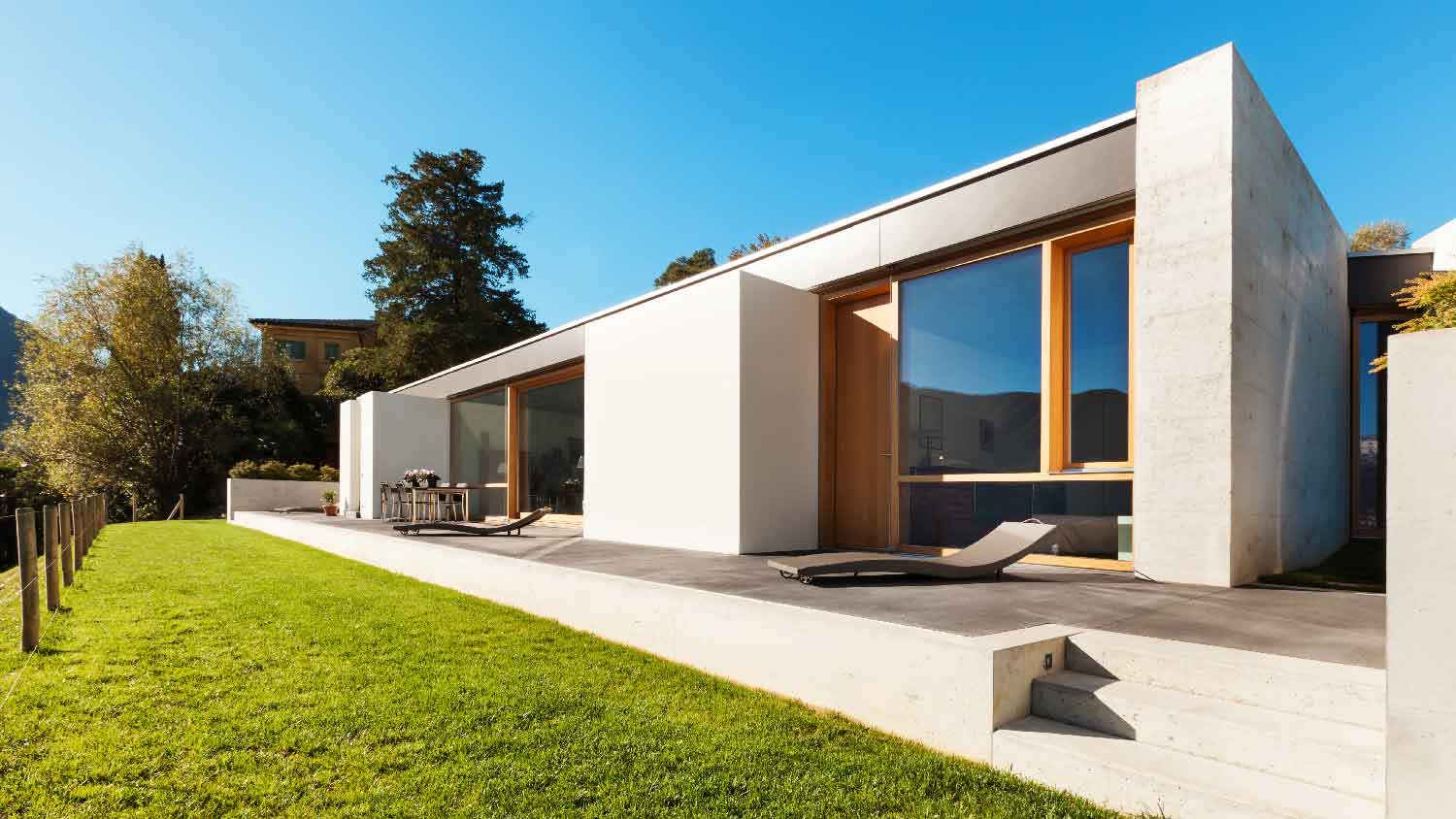
Concrete is a more durable building material than lumber. Learn how much a concrete house costs to build and what factors may affect your pricing.
Whip up your own concrete with this DIY recipe


You may give little thought to the concrete around your home, but there are many advantages of concrete, from its ability to create a solid surface to binding things together. The ingredients for DIY concrete are widely available, and buying them in bulk to make your own mix is more cost-effective than premade options. Follow this guide to understand all the ins and outs of how to mix concrete, from exactly which materials you’ll need and in what ratio to use them.

There are a couple of things to do before whipping up this recipe for concrete, like finding out exactly how much of each material you’ll need and in what ratio to combine them.
Almost all types of concrete are made from the same basic ingredients: sand, stones, Portland cement, and water. It's easy to mix up the terms concrete and cement since cement is a major ingredient—and because the words are often used interchangeably.
The ratio in which you use these ingredients will determine the strength of your concrete. For example, using sand, stones, and Portland cement in a ratio of 1-to-2-to-3 will give your cement a strength of 3,000 pounds per square inch (that’s the amount of weight it can handle before cracking or collapsing). This standard works for most residential purposes, but you can adjust the strength per square inch by increasing the amount of stone aggregate and Portland cement while maintaining the amount of sand.
You can also determine the water concentration by investigating the right concrete slump for your project. Concrete slump measures how much the mixture falls—slumps, essentially—when placed in a set mold and then released to settle. You can purchase a concrete slump kit at your hardware store.
There’s nothing worse than realizing you don’t have enough supplies after you’ve already started mixing your own concrete. That’s why it’s important to take meticulous measurements before you begin.
Start by measuring the area of the project. Determine how long and wide it is, then multiply those two numbers to get the square feet. Then, measure the depth of the project, and multiply that by the square feet to find out how many cubic feet of concrete you will need. Make sure your depth is in feet and not inches.
For example, a 4-foot-by-4-foot-by-4-inch-thick concrete pad would require the conversion of the 4-inch thickness to feet (.33 feet). Each cubic foot of space requires roughly 130 pounds of dry concrete mix. Multiply the amount of cubic feet by 130 to arrive at the total weight of concrete mix that you will need.

Pour sand into a bucket or wheelbarrow with a large surface area, then add Portland cement a few scoops at a time. Use a shovel to fully incorporate the cement until the mixture is consistently colored throughout. Continue with the remaining Portland cement until it’s all used up.

Dump all the stones into the cement and sand mixture, and use the shovel to combine until they’re fully incorporated. Every stone should be completely covered with sand and cement before moving onto the next step.

Make a well in the center of the dry concrete mixture for adding water. Begin by pouring in just a few cups of water and mixing thoroughly with a shovel to combine. It’s better to work with a little bit of water at a time because you can always add more—but you can’t really remove it once it’s in.
Repeat this step until the mixture has a damp, sandy quality and is matte when flattened with the back of a shovel.

Concrete is infamous for how quickly it dries, and that means it can easily get stuck to your shovel and bucket if you don’t clean up ASAP. Use your shovel to remove any large chunks of concrete that are stuck to the inside of your bucket, then spray with a hose to remove as much as possible. Finally, use a wire brush to scrub away anything that remains. Concrete isn’t healthy for grass, so be sure to pour residue in a spot where you won’t have any issues (like on preexisting concrete or in a non-visible area of your yard).
Be sure to also research how to dispose of concrete in your area, especially if you have a large amount leftover from your project.
Mixing and pouring concrete from scratch is both easy to do yourself and less expensive than the cost of professional concrete delivery. Per yard, you'll pay between $110 and $150 per cubic yard, or between $1,110 and $1,440 for a truckload when you hire a professional.
When hiring a local concrete pro, the cost will vary depending on the project. A simple concrete slab costs between $4 and $8 per square foot for both materials and installation. You'll pay more for complex projects, such as for the cost to install a concrete patio. Depending on its size and complexity, you'll pay an average of $1,800 to $4,800.
On the flipside, you only need to pay for the raw materials if you’re going the DIY route. You could pay as little as $100 for a solid (literally) DIY concrete project.
Audrey Bruno contributed to this piece.
Archie did a good job cleaning up the driveway before he laid down the sealer. It looks good. He was gracious and even helped me bring up my groceries. His rate was comparable to another company who came out to give me a quote and he talked to me personally rather than just text me a quote...
 Pro Seal Roofing & Paving
Wonderful. I am going to have them remove and replace my driveway in the spring.
 All Star Paving and Sealing
Working with Peter and his crew was a breeze. They were exceptionally polite and did a neat job to repair and seal our driveway. I will definitely talk to them first for additional work.
 Central Paving
The preformed a really good job the staff is incredible never been so happy with my home, A brand new driveway is like a face lift!!
 Pristine Paving
We recently had our office sidewalk repaired and CT Concrete did an "Outstanding" job. They were quick, friendly and the job is "flawless". I would highly recommend CT Concrete for any of your concrete/sidewalk needs.
Called Mark on a Thursday morning. Not really knowing if he could help me or not. I was having driveway, flooding issues due to a clogged channel drain and I was trying to figure out what direction to take. Heavy rains had come on Monday and again on Thursday leading to flooding in my garage...
 Mark Rodgers Construction
It went really well! The concrete looks, they even did some patch work on my buildings parking lot. That was such a plus! <br />
 AmeriCoat Asphalt & Concrete
Jand J has provided services for clients of mine for 15 years or maybe longer. They are always honest with their recommendations, providing good advice to my clients and competitive pricing. All three of the structural engineers whom I have dealt with in recent years have Jand J on their...
We first had Mark fix the back patio and liked his work so much we had him make a brick patio on the side of the house. When we decided to change our concrete walkway to brick, we wanted Mark to do the job because his prices were fair and he did such good work on t he other two projects.
 Mark Monnette Masonry
Mr. Lewis was extraordinarily responsive. At the time we realized that the concrete could not be repaired, we had intended to put our house on the market. We were anxious to get the work complete so that we wouldn't delay marketing the house. Mr. Lewis promptly returned our calls, provided...
From average costs to expert advice, get all the answers you need to get your job done.
Concrete is a more durable building material than lumber. Learn how much a concrete house costs to build and what factors may affect your pricing.
Concrete plays a role in more than just your foundation. No matter where you need the extra stability, here's how to determine your concrete slab cost.

Discover how much concrete walls cost based on factors like their size, material, location, design, and local labor rates.

How long does it take concrete to dry? Keep reading to learn all about concrete drying and curing times, plus tips to speed up the process.

Did you know there are different types of pre-mixed concrete? Learn what project each type is best for, important terms, and more.

Knowing how to drill into concrete can open you up to all sorts of DIY possibilities. Learn how to use the right bits, techniques, and safety measures.