
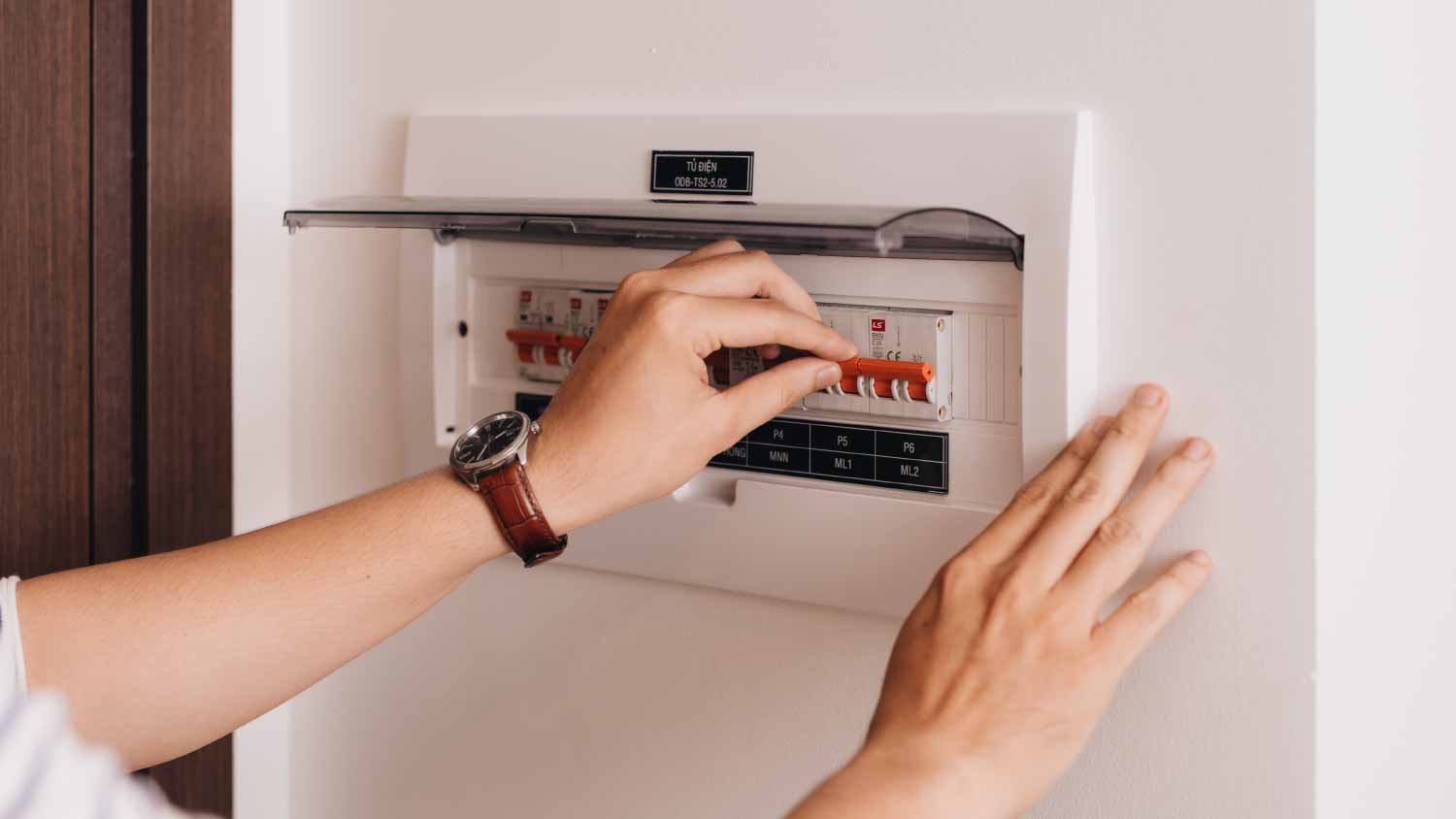
Your budget for moving an electrical panel depends on the type, labor, and more. Find out the average cost to move an electrical panel.
Keep your electrical panel from becoming an eye-catcher by choosing the right location

Your electrical panel needs at least 3 feet of clearance in front with room for the door to open 90 degrees, keeping your access safe and unobstructed.
Expect to pay $1,500 to $2,000 to move an electrical panel, with replacement adding another $1,150 if your existing box needs upgrading.
Position your electrical panel between 4 and 6 feet off the floor so every adult in your home can reach the highest breaker without strain.
Hiring a local electrical professional keeps your panel installation up to code, handling clearance requirements and proper wiring connections for safe, reliable access.
When your circuit breaker trips, it’s convenient to have your electrical panel in an easy-to-reach location. But you must follow electrical panel location rules when choosing a spot—even if incorporating them into interior design is challenging—and you can’t cover them without breaking fire codes. To choose the best location for an electrician panel, consider which rooms you have available and whether you can move your panel to a new spot.

Before you install or relocate your electrical panel box, you’ll need to follow the regulations set forth by the National Electric Code (NEC). The NEC 110.26 states that the electrical panel and equipment must be placed in a location with proper clearance around them. There should be at least a 3 feet clearance in front of the electrical panels. These standards provide safety guidance for preventing fires. Consider these requirements:
Make sure the area around your electrical panel is clutter-free. There must be 3 feet of clearance in front of your electrical panels, and the door must be able to open at least 90 degrees. Move any boxes or objects that obstruct your view.
Ensure a washer or dryer doesn’t block your electrical panel.
Place your panel box in a large, walkable room (no tiny crawl spaces).
Never block the electrical panel—especially if you’re storing large items or doing home remodeling.
Position your electrical panel so that all the adults in your household can reach every circuit breaker. The NEC advises that the highest circuit breaker should not exceed a height of 6 feet and 7 inches.
It’s important for everyone living in your home—and emergency professionals—to have immediate access to your electrical box.
Don’t place any locks on the door to your electrical panel or the room housing the electrical panel.
If you have an outdoor electrical panel, ensure it’s free of snow and debris.
Make sure everyone in the home knows the location of your electrical box. You can perform a mock fire drill with your family so everyone knows the ins and outs of your electrical panel.
To keep your electrical panel in good working condition, don’t place the box near water or high humidity. These elements can damage electrical boxes; the best environment is a clean, dry, and fresh space. Be sure to install a waterproof panel to avoid electrical emergencies triggered by water damage.
The NEC prohibits the installation of electrical panels within clothing closets. Clothing, mothballs, shoe polish, plastic containers, and exposed bulbs are highly flammable—and all of these are commonplace in clothing closets.
There are a few ideal places for electrical panels that keep them accessible and out of areas you want to design and decorate. The top two choices are the basement and the garage. Both allow a pro to access the wiring and keep the panel out of high-traffic areas, like the family room or bathroom.
Not every house has a basement or garage, so you can consider a few other options that keep a panel hidden while still keeping it accessible.
Basement
Garage
Utility rooms
Storage rooms
Entryways
Hallways
Entryways and hallways are more prominent locations than a garage or basement—but they’re rarely the centerpiece of a home—and they’re usually the areas you skip over when you’re giving someone a tour.

Restrictions ensure that your electrical panel is always in an accessible area and limit the risk of fire or electrical shock. Do not put your electrical panel in:
Bathrooms
Bedrooms
Home exteriors
Bedroom closets
Above the stairs
Pantries
Cubbies
You can’t cover or put an electrical panel near flammable materials either. So even after you’ve decided where you want your electrical panel, you’ll still need to limit the items around it. Review your local restrictions for any additional guidance.
Because extending or shortening wires throughout the home is a significant undertaking, you’ll likely need a permit from your local municipality. You’ll also need to contact the electric company to ensure the move is safe. That way, they’ll know to shut off power during the work, so no one’s in for a “shock.” They may even insist on bringing out their own licensed electrician for the job.
Before choosing your final electrical panel location, be aware of the following NEC clearance requirements for working space:
Three feet of clearance from the front of the electrical panel
At least 30 inches of clearance on both sides of the electrical box
A height of at least 6 feet and 5 inches
The electrical box height should be 4-feet tall (off the ground) at a minimum—with an average height of 5–6 feet
The panel door needs to open to a 90-degree angle
Ensure the electrical meter is close to the electrical panel
Emergency lighting is available in case of a power outage
If installing an outdoor panel, weatherproof against corrosion, water, snow, and wind damage.
According to data from Angi customers, most wiring and panel projects (65.7%) involve upgrades to existing service. On the other hand, 34.3% of people need general electrical repairs, such as fixing blown fuses and flickering lights. If any of this sounds familiar, get in touch with an electrician for assistance.
A circuit breaker box, or electrical panel, takes the electricity provided by your utility company and sends it throughout your home as you need it. Because the utility company provides the electricity, they usually have the initial say on where it goes in the home during the building stage.
If you’re building your home, you should reach out to the utility company and ask where you can place it, giving you a little more control over the final location of the circuit breaker box.
You’ll need to consider your home's current wiring and where you want the electrical panel in an existing home. A local electrician will have to shorten the wires or extend them to reach the new location, which costs time and money. You also need proper illumination in the area to ensure you can see the numbers and flip the correct breaker when necessary.
The cost to move an electrical panel is around $1,500 to $2,000 on average. Replacing your circuit breaker box costs an additional $1,150. You may want to upgrade to a 200-amp service to give your home a little more juice, which will cost you around $1,350 on average.
I recently had Mosby Electric perform an electrical installation on 8-14-2026, and I couldn’t be more satisfied with the service. From the moment I called, their team demonstrated fast arrival and professionalism. The electricians were highly knowledgeable, completing the installation...
 Mosby Electric
Great company! Price was competitive, technician showed up on time and completed the job (exterior electric Radon fan replacement) quickly. Would hire them again.
 MaGen Property Inspections and Radon Mitigation
I conferred with 2 other contractors before Armstrong Electric. Nick and his crew showed me that the project was not as convoluted as the other contractors made it appear to be. They completed the entire project on time. They were professional, friendly and cleaned up after at completion. I...
 ARMSTRONG ELECTRIC, LLC
The techs on my project, Shawn and Cliff, were great. They were prompt, courteous, and efficient. I am very happy with the results and would definitely contact Mr. Electric for any future electrical projects.
 Mr. Electric of Columbus
Victor was wonderful. He was on time, professional, and explained everything he was doing. He was thorough and figured out that the problem was electrical instead of with my HVAC system. Very knowledgeable. I will be using this company in the future for any HVAC needs. Thanks!
 Hubbs Heating & Air LLC
They were excellent. They did a great job. I was totally satisfied. They put tremendous effort in making sure the work was completed. They were great. They provided immediate response to any inquires I made. I would hire them again. I would recommend them to anyone who needs electrical work....
 JCB & Associates, LLC DBA Property-Tech Industries
Initially, the repairman could not find the problem. Apparently, there was some electrical shortage, but he could not find the definite problem. He left, but called back later to say he had a new idea. He returned and replaced the light switches on the doors. The refrigerator seemed to return...
 Appliance Pro LLC
The initial quoted price from a walk-through seemed high, but we discussed that the quote represented worst case scenario (re-wiring to two floors) and we were excited about the opportunity to have the work done in a timely manner with closing for fire safety reasons, etc. When the job was...
I have to tell you I am all about customer service - I will go out of my way and even pay more for it if you give me great customer service. <br> <br>In a world where this is hard to find, these guys were awesome! I can not sing their praises enough. They were prompt, personable, funny, got...
 Waibel Electric
When I challenged the markup on the generator, Bruder Electric withdrew its bid. They only want naïve customers.
From average costs to expert advice, get all the answers you need to get your job done.
Your budget for moving an electrical panel depends on the type, labor, and more. Find out the average cost to move an electrical panel.

Electrical panel replacement costs $530 to $2,100, depending on the location, the type of hardware, and any required building materials.
Looking to size up your electrical system to cover higher usage and improve efficiency? Use this guide to see the cost to upgrade an electrical panel.

Is it acceptable to have an electrical panel in a bathroom? Keep reading to find out the best location for this essential feature.
If your electrical panel is interrupting your home’s aesthetic, you can cover it with art, paint it, or try one of these other ways to hide an electrical panel.
When installing a new 200-amp service panel, the right wire size is critical to ensuring sufficient amperage.