

Top-rated plaster repair specialists.

Get matched with top plaster repair specialists in Saint Michael, ND

Enter your zip and get matched with up to 5 pros

Need a pro for your plaster repair project in Saint Michael, ND?

Select your specific project to find the pro for you.

Find Plaster repair specialists in Saint Michael

Veras Construction
New to Angi
Plaster - RepairPlaster - Repair - For Business

Serving Saint Michael, ND and surrounding areas

In business since 2015

Free estimates

Credit card accepted

We here at Veras Construction take pride our work and always pay attention to the minor details. Our customers know they can rely on us no matter what the project may be. We are always going the extra mile to ensure quality on everything we do. For prompt and professional work, call us today for your painting needs.
Triangle Cenit Construction, LLC
2.0(
2
)
Plaster - InstallPlaster - Install - For BusinessPlaster - Repair+1 more

Serving Saint Michael, ND and surrounding areas

In business since 1990

Free estimates

We serve North Dakota with best in class service for roofing, drywall and plaster projects. Call us so we can show you why our 25 years of experience will help you get the job done right the first time. Let us show you why most of our first time customers become long term clients!

Response time1 day
DJS Construction
New to Angi
Plaster - Repair

Serving Saint Michael, ND and surrounding areas

In business since 2001

Free estimates

Credit card accepted

\nWe're a locally owned and operated company that values honesty and integrity and treats your home as if it were our own. We offer a variety of Home Improvement services that are customizable to each individual project. We specialize in Additions and Remodels, Roofing, Siding, and a variety of other projects. We pride ourselves on the quality of our work as well as our commitment to outstanding results. We look forward to building lasting relationships and guarantee your satisfaction!\n\n

Plaster Repair questions, answered by experts

If you’re looking for a reliable plaster repair company, you should start by researching local companies in your area and reviewing their status with the Better Business Bureau. Next, you can contact the potential companies to ask about experience levels, get a list of references, and ask for examples of past work. If you have a textured wall, consider asking if they have examples or references for that particular texture. This method should help you narrow your search even further. You may also want to ask each company if they provide a warranty for their work.

While you should consult with a ceiling professional for larger cracks, especially if you’re not sure what’s causing your ceiling to crack, you can certainly try to repair small cracks on your own. If you’re up for the task, here’s how to repair ceiling cracks for $150 or less.

Plastering and skimming are two different techniques for finishing walls. Plastering involves applying a thick layer of a plaster mixture—typically containing gypsum, lime, cement, sand, and water—to create a new surface. This process often requires multiple coats and is used for repairing significant damage or creating decorative textures. Skimming, on the other hand, is a technique that involves applying a thin layer of drywall compound or joint compound over an existing surface to smooth it out, covering minor imperfections, small cracks, or uneven textures for a polished look. Plastering is generally more costly and labor-intensive than skimming. Although some people use the terms interchangeably, they refer to different processes and materials.

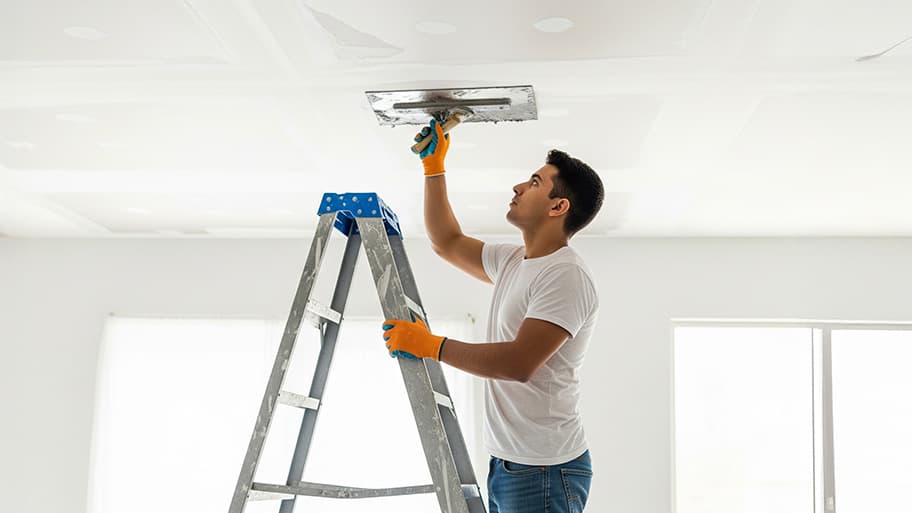
You can repair plaster ceilings yourself after the cause of the ceiling damage has been addressed. However, the repair can easily take 5 hours and can be slightly challenging for those without previous experience. If you do decide to flex your DIY muscle, have a helper to help hold the ladder and pass you the tools for safety purposes.

Although they have similar applications, spackle and joint compound are not the same. Their primary differences lie in their composition, consistency, and ideal use cases.

Spackle is composed of gypsum and binding agents, making it thicker than joint compound. It dries quickly and is easy to sand, which makes it ideal for small wall repair projects like filling nail holes or patching minor damage.

Joint compound, also known as drywall mud, consists of limestone and gypsum. It is primarily used for large-scale projects, such as taping and finishing the seams on newly installed drywall. It tends to shrink more than spackle and can be more difficult to spread.

While both products can be used to fill small depressions and cracks, spackle cannot replace joint compound for taping and mudding new drywall. Conversely, you can often use joint compound for small patching jobs typically done with spackle.

The Saint Michael, ND homeowners’ guide to plaster repairs

From average costs to expert advice, get all the answers you need to get your job done.