"High quality products, excellent service. I have their water treatment systems at my house, office and cabin. I highly recommend them if you are looking for quality products that will last a long time."
Our mission at Lindsay's Crystal Pure Water, Inc. is to continue the growth of our business by doing right by all of our clients. We love seeing that one of a kind smile on a home owners face at the end of a project! Lindsay's Crystal Pure Water, Inc. stacks up with the competition and surpasses it with competitive prices, second to none workmanship and a prompt/responsive team! We give you quality that you can measure, and a finished product that will enhance your home forever. Call us today!
FM Water Systems is your locally owned and operated authorized Kinetico Dealer with over 30 years of experience. We take great pride in our prompt response, expertise and superior customer service every time so call today!
\n
\nCommercial and Residential clients always welcome!
The primary difference between a water softener and a water filter lies in what they remove from the water. A water softener is designed to remove hard minerals like calcium and magnesium. In contrast, a water filter has a broader effect, removing various contaminants above a certain size, which can include bacteria and other impurities.
To decide which you need, consider your goal. If you want to eliminate hard minerals, choose a softener. If you want to remove a wide range of contaminants, a filter is the better option. Filters are also generally less expensive to install. Depending on your water supply, you may need to install both for comprehensive treatment.
The most accurate way to determine whether you have hard water is to purchase a water test kit from a hardware store or send a tap water sample to a lab. But there are some signs you can look out for without professional testing. For instance, if you're consistently dealing with mineral stains on your glassware, windows, and shower doors, you're likely to have hard water. Hard water can also make it harder to lather and rinse soap, so if you're struggling to work up a good lather in the shower, hard water might be the culprit.
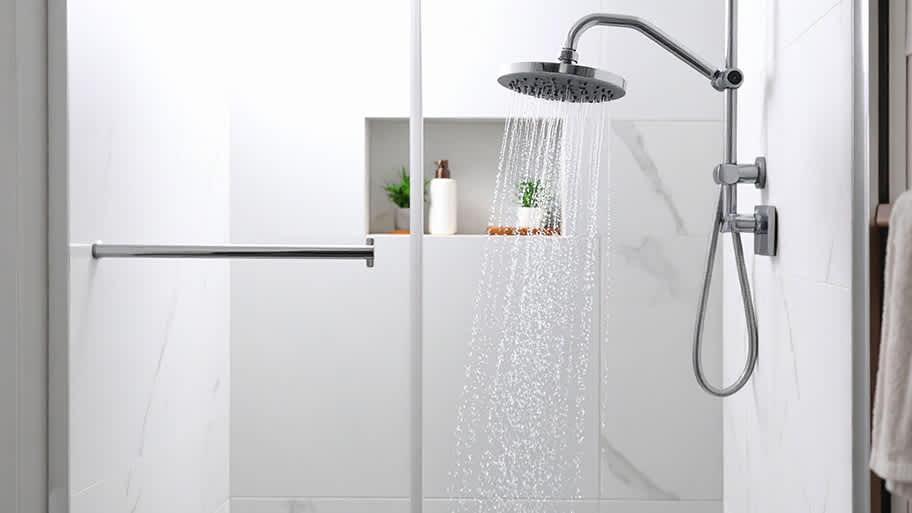
The most effective way to fix hard water in your shower is by installing a whole-home water softening system. This system treats water as it enters your home, removing the minerals that cause hardness before they can reach your shower or any other fixtures. While this is the most comprehensive solution, other methods are often temporary fixes. For a more affordable and shower-specific option, you can install a water-softening showerhead or a shower filter. However, these filters are generally less effective and may not remove all the contaminants that lead to limescale and hard water stains. By implementing a water softening solution, you can expect a reduction in mineral deposits and enjoy the benefits of cleaner-feeling hair and skin.
Some shower water softeners are effective, but this isn’t always the case. Most shower filters only filter out chlorine, not hard minerals like calcium. Other shower filters can't handle the demand in homes with very hard water. It's also important to change the filters on your shower filters. Failure to regularly swap out old filters will make the filter ineffective over time.
Most of the U.S. has hard water, especially across portions of the West and Midwest. The areas with the hardest water include parts of Texas, Oklahoma, Kansas, Colorado, New Mexico, Utah, Wyoming, Illinois, North and South Dakota, Ohio, and New York. You’ll find soft water in parts of New England, the Southeast, the Pacific Northwest, and Hawaii.
The Cooperstown, ND homeowners’ guide to water softener services
From average costs to expert advice, get all the answers you need to get your job done.
Water softener repair costs can add up, but they’re almost always worthwhile. Use this guide to see what your project is going to cost before you get started.
Water softeners work to remove unwanted minerals from hard water through a filtration and recharge cycle. Keep reading to learn how a water softener works.
There are four common softener alternatives available on the market today. We compare and contrast each one to help you find your best-fit solution in this blog.
Water softeners rid your home of hard minerals and, well, soften your water. Even better, the regeneration process is an automatic cycle that works when you’re least likely to use it.