"WOW! Groundworks is a great, reliable company! We had the dream team, Ryan, Alejando (Alex) and Jose, working on our home. Ryan kept us informed on what was going on the during the whole project. Ryan and Alex were so reassuring of all our fears and concerns, we knew we were in good hands. Alex and Jose were so polite and talk about hard working!! All three of them went above and beyond, exceeding our expectations, saving some landscaping we didn't expect to be saved. They took great care with our landscaping and yard and did not cause any unexpected damage to any of it! They did a great job with the clean-up at the end of the job as well. These three men worked great together as a team. We were happy to see them everyday and a little sad when we said good bye."
Concrete Mudjacking questions, answered by experts
Mudjacking typically takes 24 to 72 hours (one to three days) to dry and cure completely before you can resume normal use. The exact time can vary depending on the size of the project. Because the slurry mixture contains cement, it must fully harden to ensure that added weight from walking, furniture, or vehicles won't shift the concrete slab. A professional contractor can advise you on when the surface is safe to use. For comparison, if you use polyjacking instead, the polyurethane foam can dry in just a few minutes, but it's best to wait about an hour before use.
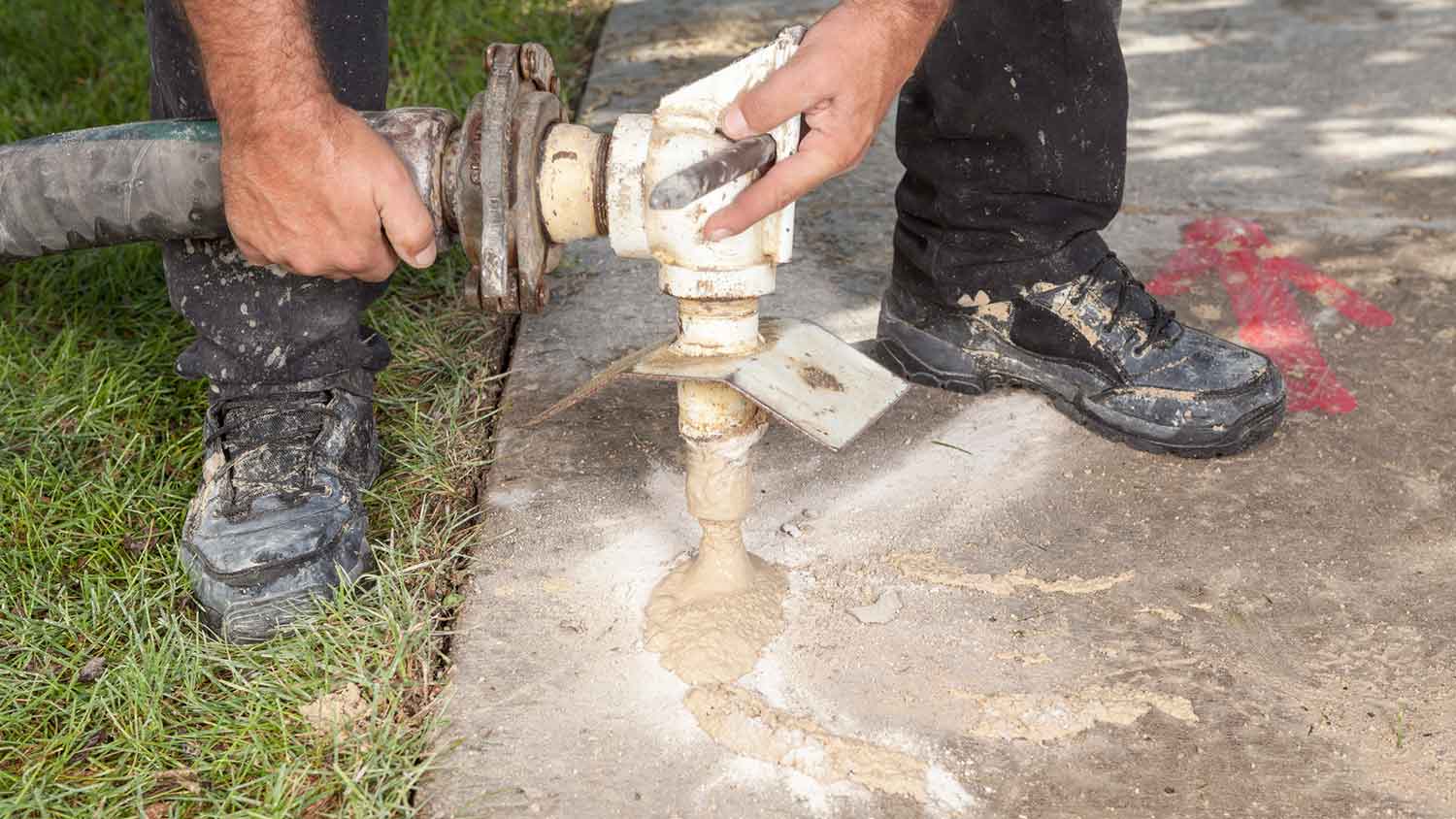
A slurry of cement, sand, and water is injected beneath the concrete to lift and stabilize it.
Concrete leveling is absolutely worth it if you have sunken concrete slabs and want to restore them to level, especially if the slab is part of your home foundation. Concrete leveling is less than half the price of replacing concrete sidewalks, patios, walkways, and pool decks, and it’s about a quarter of the cost of replacing a foundation. If you also treat the underlying problem, it can be a worthwhile and permanent solution.
Polyjacking and mudjacking can both be effective solutions for sinking concrete, but they have key differences. Polyjacking, which uses expanding polyurethane foam, is often considered a better option because the foam is significantly lighter than the cementitious material used for mudjacking. This reduced weight puts less pressure on the underlying soil and lowers the risk of future sinking. Polyjacking is suitable for any sinking concrete slab, while mudjacking is typically only recommended for non-structural concrete, such as sidewalks, patios, pool decks, and driveways. The primary drawback of polyjacking is its cost, which can be up to four times higher than mudjacking—as much as $25 per square foot compared to a maximum of about $6 per square foot for mudjacking.
Most states and municipalities don’t require concrete mudjacking companies to carry a specific license, but they usually need to have a general contractor’s license, and they should be fully insured. The only exception is if the mudjacking company provides foundation repairs as well, or if it offers mudjacking for home foundations. In that case, they will typically need a foundation repair contractor’s license. You can check state requirements and then use Angi’s license lookup tool to confirm that a company is properly licensed to provide mudjacking services in your area.
The Broadus, MT homeowners’ guide to concrete mudjacking services
From average costs to expert advice, get all the answers you need to get your job done.
DIY mudjacking is an advanced task, but learning how to raise a concrete slab is great to know for many scenarios. Let's take a look at how to DIY mudjack.
Sunken concrete can be a structural issue, but a professional can easily repair it. Ask these concrete injection leveling and mudjacking questions before you hire.