"Jeremy showed up right on time. He cleaned the carpet so quietly and efficiently even our normally high strung dog didn't notice him much. He was up front about the things that could and couldn't be fixed and knowledgeable about cleaning carpet. We even had Pad Injection done at the site of a couple of really bad pet soiling areas. The whole house smells nice and clean now, and the carpets look great. There were a few spots that couldn't be gotten totally clean due to abuse on our part (really we should vacuum more often) but it looks fantastic. He took extra time at the end with his UV light to look for any remaining pet stains."
"I greatly appreciated that the work was done when promised. I worked with Darren Paulson and appreciated his attention to detail and the friendliness that he provided."
Radniecki Carpet & Upholstery LLC is a family owned and operated business providing cleaning services to Thief River Falls, MN and the surrounding area. Our Butler System truck-mounted hot-water extraction (commonly know as steam cleaning) method removes stubborn dirt and soil, leaving your carpets and upholstery looking, feeling, and smelling new again. We also offer air duct cleaning to remove built-up dirt, dust, and indoor allergens from your ducts, improving your home's air quality. Contact us today for your residential, and commercial carpet, upholstery, and air duct cleaning needs.
McCarthy Design and Construction is a family owned and operated company. We take pride in our work and care about the needs of all of our customers. There isn't a job to big or small for our staff. Give us a call today; we are located in Kelliher, Minnesota!
Zachary Vig Construction has been in business since 2026, with over 10 years of experience! We specialize in all your home improvement multiple small project needs, and guarantee you a job well done! Whether it be a ceiling fan that needs to be installed, or a door that needs repaired, we are your guys! We strive to exceed the homeowner's expectations each and every time, and get the job done the way you want it. We work in a timely fashion and always pay attention to detail. Proudly serving Hallock & surrounding areas. Free estimates. Call today!\n
We take great pride in our 16 years of experience, expertise, quality, and customer service that we provide to meet the consumers' needs. It is our mission to provide excellent workmanship, and complete customer satisfaction from start to completion of a project. In order to understand the needs, and expectations of our customers, we take great care to work, and communicate with every customer in a professional manner. Our reputation is based on service, safety, and quality, regardless of how large or small the job.
Carpet Installation questions, answered by experts
Yes, carpeted stairs are generally considered safer than stairs with hard surfaces like wood, vinyl, or tile. Carpet provides more traction, which helps reduce the chances of slips and falls, and its cushioning can lessen the severity of an injury if a fall does occur. Hard surfaces often lack the friction needed for a secure tread and can be quite slippery.
However, it's worth noting that some carpets can also be slick, particularly if they are brand new, dirty, or made from certain materials. If any stair surface feels too slippery, traction treads can be added to most materials to increase grip and improve safety.
Carpet tiles are less expensive than traditional carpet. The average cost of carpet installation is $1,800, or $3 to $11 per square foot. In comparison, carpet tiles cost $2.50 to $11 apiece and can often be bought in bulk cartons. Since you can more easily DIY carpet tiles, you may be able to save on installation costs, too.
Deciding whether to clean or replace your carpet depends on its condition and age. If cleaning no longer resolves issues, it's time to consider a replacement. Key signs that you need to replace your carpet include:
Stains that are impossible to remove.
A persistent smell that lingers even after cleaning.
An increase in allergy symptoms.
The age of the carpet. Most manufacturers state that carpets should last about 10 years with proper care.
When cleaning is no longer effective, you should replace the carpet with a new one or consider other flooring options like vinyl or laminate.
Professional installation ensures seamless fitting, extended carpet life, and compliance with workplace standards.
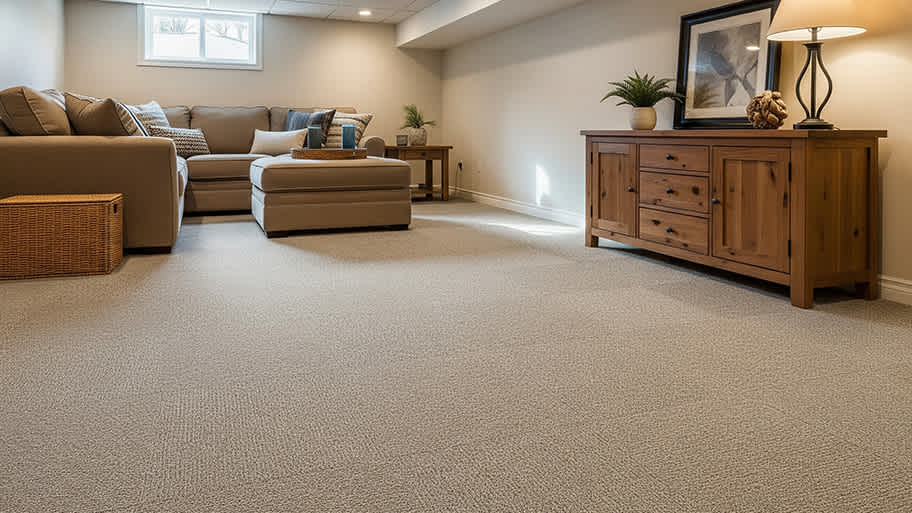
The cost to install carpet is $1,780 on average for 330 square feet, the size of an average living room. This cost could range from $200 to $5,000, depending on the amount of carpet, material, and type of carpet.
If you need 500 square feet of carpet, it’ll cost $1,500 to $5,500, while 1,000 square feet of carpet costs $3,000 to $11,000. Polyester is one of the more affordable options, ranging from $1 to $3 per square foot. Wool is a more luxurious option, ranging from $4 to $20per square foot.
The Badger, MN homeowners’ guide to carpet installation
From average costs to expert advice, get all the answers you need to get your job done.
Not only are carpet tiles easier to install than carpet, but they’re often more affordable. So, how much does carpet tile installation cost? Let’s take a look.