
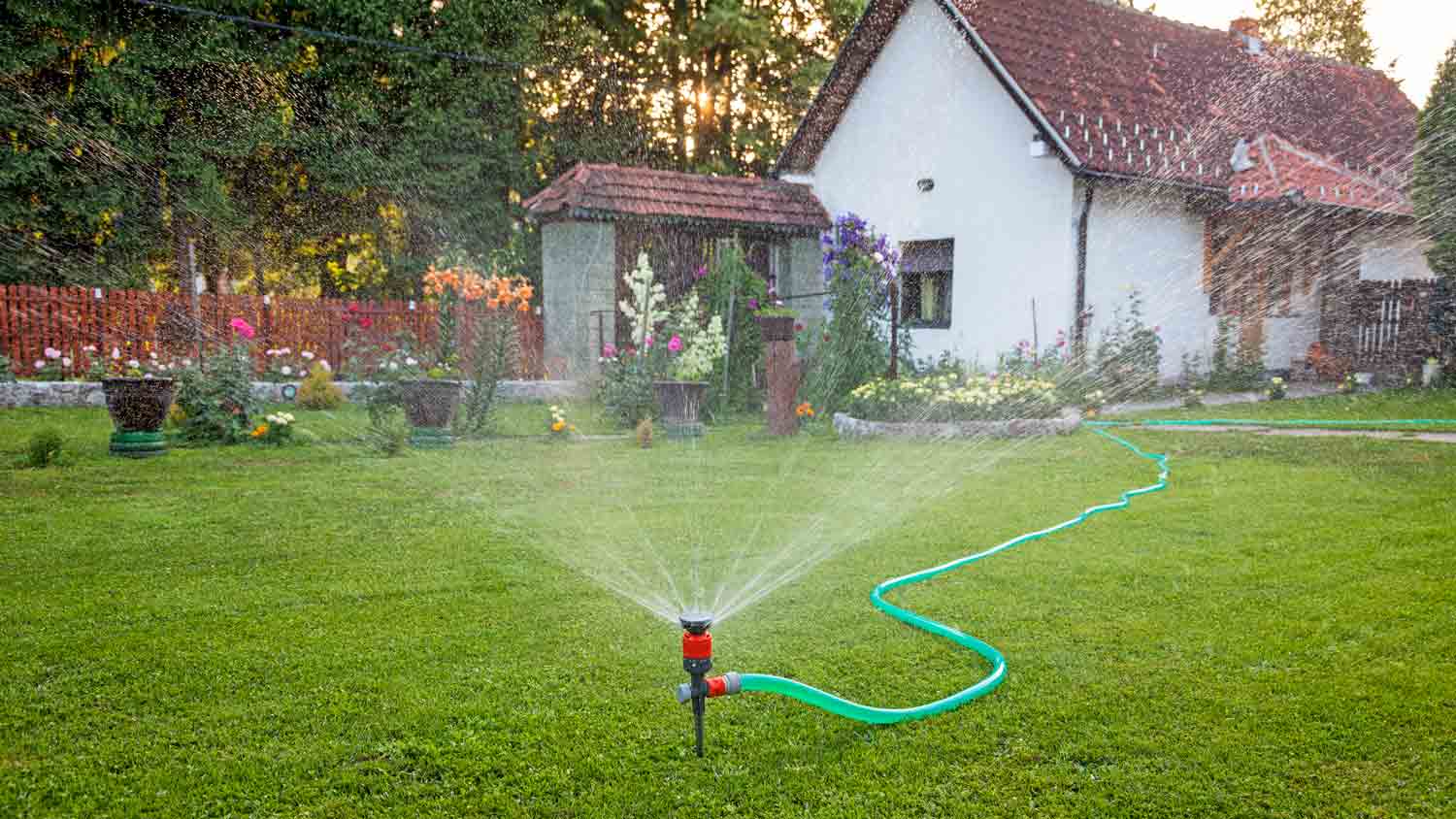
Need to repair a sprinkler or install a new one? Learn the parts of the sprinkler system and how they all work together to water your lawn and garden.
Smart sprinklers keep your yard happy using real-time weather data—here’s how

Smart sprinklers use real-time weather data and soil sensors to adjust your watering schedule, reducing water waste while keeping your lawn healthy and green.
Expect to pay $150 to $350 for a smart controller alone, or $1,800 to $7,000 for professional installation of a complete new smart sprinkler system.
You can swap your traditional timer for a smart controller if you have basic wiring skills, or choose a weather-based or soil-based system for your yard.
Hiring a local sprinkler installation professional removes the guesswork from setup and programming, ensuring your smart controller integrates smoothly with your existing irrigation zones.
From thermostats to refrigerators to speakers and beyond, plenty of “smart” home appliances are available these days—including sprinkler systems. Using the magic of the internet, smart sprinklers can help you reduce water waste, lower your water bill, and keep your lawn looking as healthy as possible—all with less effort from you.
But how do smart sprinklers work, and what does it cost to install them? We’ve got all the answers you (and your lawn) need below.
Smart irrigation, or smart sprinkler systems, are sprinklers that use smart technology to customize your watering schedule. For example, by connecting to Wi-Fi and gaining access to weather forecasts, a smart irrigation system can cut off a programmed watering schedule ahead of time to compensate for the incoming rain.
Smart sprinkler systems can also learn about your programmed watering schedules and weather patterns over time to automatically estimate how much water your landscaping might need at a given moment. Along with online data, the system may use a series of special sensors to help obtain this information and may be controllable from your computer or smartphone.

There are a variety of different models of smart sprinkler systems available on the market, and they use an array of different technologies to do their smart watering work. At the highest level, smart sprinklers can be separated into two major categories: weather-based and soil-based.
| Weather-Based | Soil-Based |
|---|---|
| Adjusts watering based on weather data | Adjusts watering based on soil moisture |
| May use sensors buried on property | Uses sensors buried on property |
| Can water on demand or suspend upcoming water | Can water on demand or suspend upcoming water |
| Less expensive | More expensive because it requires sensors |
Weather-based smart sprinkler controllers use data about the weather to adjust watering patterns. They’re also known as evapotranspiration (ET) sprinkler controllers, referring to evaporation and transpiration (the process of water being used and eventually released into the atmosphere by plants).
Weather-based irrigation controllers rely on the following data points to adjust your irrigation schedule:
Temperature
Wind
Humidity
Sunlight
These irrigation controllers may get their data from publicly available weather sources online, weather information gleaned from sensors installed at your property, or a combination of both. They can also use historical data about water use and weather patterns to predict a sustainable and accurate watering schedule for your locale.
Soil-based irrigation controllers rely on—you guessed it—information about the soil's moisture level, as read by sensors buried into the ground on your property. These sensors are buried at the root zone, and can help sprinkler controllers in one of two ways:
Suspending upcoming cycles when the soil is moist enough and a scheduled watering isn’t needed
Watering on demand based on soil conditions, using thresholds set by the user (that’s you), to make sure you’re always watering at the best time
Both types of smart sprinkler controllers can reduce the overall amount of water used to irrigate your landscaping, saving water and money—all while keeping your yard healthy.

Given how many different types of smart irrigation systems are available, and their various price points, it can be difficult to know what to look for when shopping around to find the right one for you. Fortunately, a few rules of thumb can help ensure you find the best product for your hard-earned money.
Look for a smart sprinkler with a WaterSense certification. Created by the EPA, WaterSense labeling helps customers know which irrigation systems truly offer the best water efficiency on the market, much like the Energy Star label does for appliances.
Keep in mind how many zones you have—or want. Many smart sprinkler controllers can be set up for as many as eight zones, but if you have a particularly large yard with specific watering needs, it’s important to be aware of the number of zones the sprinkler system you’re looking at can handle.
Take control in the way you want. While many smart sprinklers are compatible with multiple different devices and operating systems, some integrate more smoothly with, say, Apple products or your Amazon Alexa than others. In any case, if you have other smart devices installed around your home or a preference for one operating system over another, keep that in mind while shopping.
It might not be waterproof. Like other “smart,” high-tech devices—like your laptop—some smart controllers do not mix well with water. That means they’ll need to be installed inside your home or garage or otherwise be protected from rain, which is something you’ll want to know ahead of time while shopping.
If you’re a confident enough DIYer, you can install your own smart sprinkler controller—though doing so will require some basic electrical and wiring skills. (The process is fairly similar if you’ve ever installed your own thermostat or a traditional sprinkler controller.)
However, if you’re nervous or unsure, your local sprinkler installer will gladly help you set up your smart irrigation system. Then, all you have to do is program it—and then rest easy, knowing that the controller itself will make smart, conditions-based decisions for you and your lawn.
Cody did a great job!
 Itzelpainting
Wonderful. I am going to have them remove and replace my driveway in the spring.
 All Star Paving and Sealing
We had a 20+ year old landscape lighting system that needed replacement. Midwest Lightscapes worked with us to design a much improved lighting system, lighting the exterior of the house and the back yard. Installation of the 45 light system took one and one-half days, and went very smoothly....
 Midwest Lightscapes
Did an amazing job transforming my yard. Also installed sod in places, would recommend to everyone.
 Cardinal Landscaping & Construction LLC
Always been satisfied with the service work and how they have taken care of my pool.
Bill Gerhardt sold the company to his employees at the end of 2019, apparently without a workable succession plan and without notifying prospective customers of this fact. Most aspects of the maintenance contract have not been fulfilled: no installation of anual plantings per contract, no...
They show up and they did take us on as a client which seems to be a problem with other lawn care providers. We have multiple properties and this one was located close to downtown and no one really wants to mess with it.
I was very happy with the service provided by AK Irrigation. They responded quickly to my email, and the woman I spoke with was polite and professional. I was able to get an appointment that same week. <br /> The technician (Tyler) arrived on time. He was very knowledgeable, and worked...
 AK Irrigation
The worker came out when he was supposed to come. He informed me he would honor the Angie's List deal, but would not do any more work for me since my son in law owns lawn care company as well, even though they do not do the same type of work. He said he did not feel comfortable giving me...
 Bello Giardino LLC
E & L Lawn Care was super. They were very responsive before and after service. They were efficient and were able to complete the job within 1 day. I have had concern about one section of sod - the owner was pro-active and did a visit to evaluate. I have no doubt they will stand behind...
 E&L lawn care
From average costs to expert advice, get all the answers you need to get your job done.
Need to repair a sprinkler or install a new one? Learn the parts of the sprinkler system and how they all work together to water your lawn and garden.

The best smart outdoor features can add value, convenience, security, and energy savings to your property. Check out four ways to create a “smart” exterior.
Have you ever wondered, “How does a sprinkler valve work?” Dive into the details of this important component of your sprinkler system.
A smart pergola is a technologically advanced pergola that can be integrated with your existing smart home systems and controlled remotely.
How many sprinklers do I need? This calculator will help you estimate the total based on several key factors, like water flow and yard size.
Your sprinkler system works to keep your garden and lawn cared for. Ensure it’s always performing well. Find out the top tips to care for your sprinklers.