

•
Discover the cost to install a ceiling fan, including labor, materials, and tips to save. Learn what impacts your price and how to budget for your project.
Finally, a use for your loose change

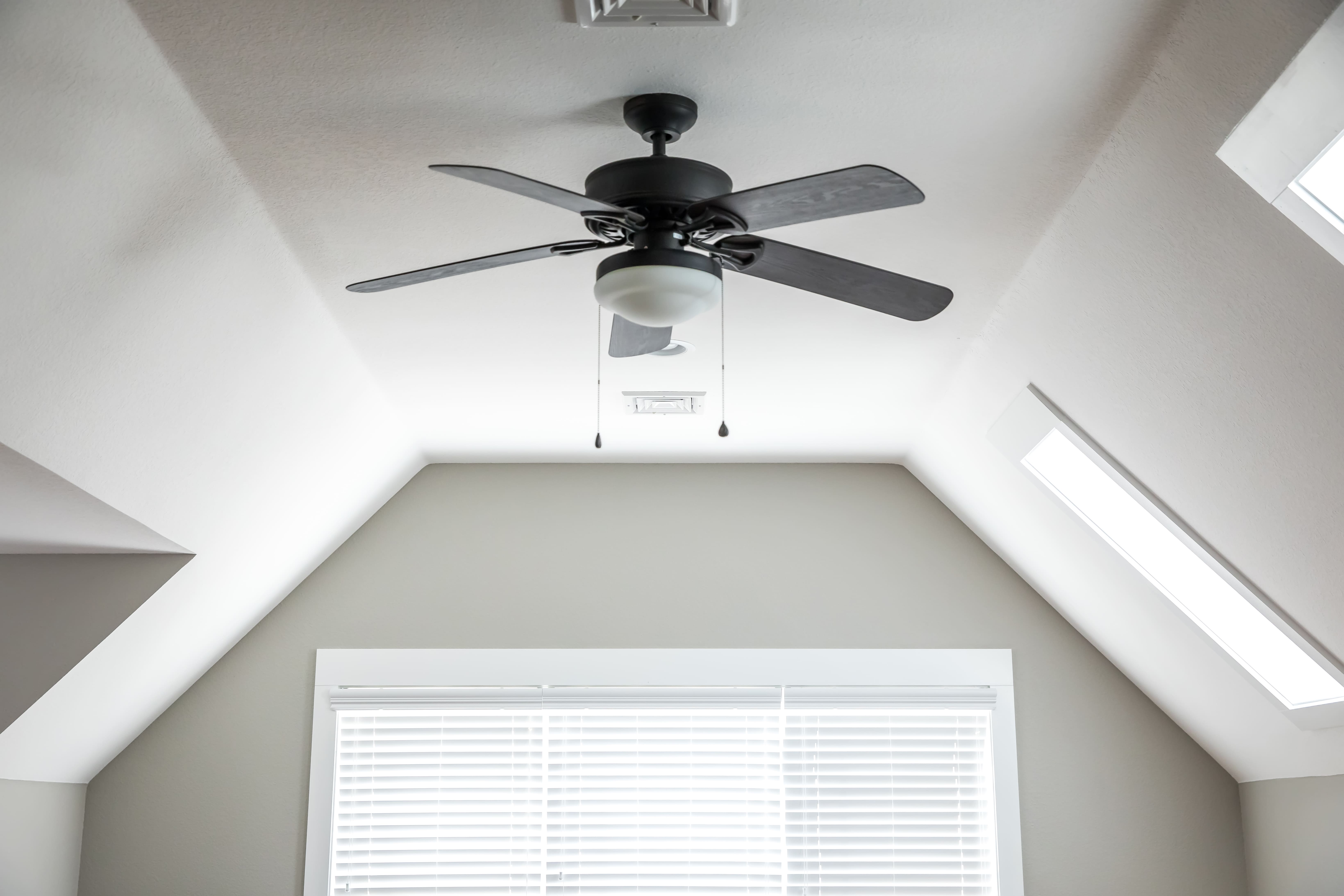
If you have a wobbly fan, the instability can be a safety hazard—not to mention irritating to hear and see. That’s why it’s important to learn how to balance a ceiling fan so you can stop the shaking and enjoy a calmer space. It may take some trial and error to figure out exactly why your fan is wobbling, but it’ll be sturdier in no time when you follow the eight steps below to balance your fan on your own.
First and foremost, cut off all power to your ceiling fan. Just turning the fan off will not keep you fully protected from electric shock. Go to your breaker and flip the switch for the room that the ceiling fan is in.
Sometimes dust and debris buildup can weigh down the blades, causing the fan to wobble or shake.
To clear off any dirt that’s causing the problem, grab your ladder and dust the blades off with a duster. If the dust has hardened, use a damp cloth or microfiber towel with a mild cleaning solution to wipe down both sides of the blade. Allow the blades to fully dry, then turn the fan back on to see if that fixes the problem.
If cleaning the fan fails to balance it, check the mounting setup to ensure it was installed correctly and avoid a potential safety hazard. A ceiling fan should be mounted to an electrical box specifically rated for fans, as a regular light-fixture box can’t support the weight. Fan-rated boxes are oftentimes labeled and mounted to a two-by-four or a specific metal fan brace.
You may need to assess this from your attic or by loosening the housing and looking from below (with the circuit breaker turned off). Check for a label indicating the box is rated for a ceiling fan, and look for hex bolts attached to the wooden or metal brace.
If the brace is wobbly, try tightening the bolts to the bracket. If you discover that the fan has been installed incorrectly, it’s best to check with a local electrician to ensure the fixture is up to code and safe. Our guide on how to install a ceiling fan can also help you determine if your setup is correct.

Another cause for an unstable fan is a misalignment of the blade arms. Over time, they can sag from normal wear and tear or humidity.
Attach a small piece of painter’s tape to each blade arm and number them. This will help you keep track of what you’ve already checked while you're rotating the fan. Check the alignment of the blades by using a yardstick and measuring the distance from the ceiling to the blade to ensure all blades are evenly spaced.
Remember, the amount of vertical space should be between eight to 10 inches to operate efficiently. If you notice one blade is out of alignment, gently bend the blade up or down so that it is even with the other blades.
If the fan and the blades are installed properly and cleaning it didn’t do the trick, check the screws to see if tightening them eliminates the problem. Look for all visible screws on the fan, and use your screwdriver or pliers to secure them. Inspect the screws on the blade holders, the support screws, and the screws on the actual housing to ensure they’re all firmly attached.
If the wobble still persists, try a ceiling fan balancing kit. If you still have the box from the original fan, check to see if one was included from the manufacturer. Otherwise, you can pick one up at your local hardware store or home center.
A ceiling fan balancing kit usually comes with a plastic clip, weights, and adhesive for the weights. Here are the basics on how to use a kit:
Attach painter’s tape to each blade arm and assign a number so you don’t lose track of the problem blade.
Slide the balancing clip to the center of the blade, and turn on the fan. Check to see if that fixes the instability.
If the fan still wobbles with the clip on the blade, turn off the fan, and add the balancing clip to the next blade. Turn on the fan to see if that fixes it.
Repeat the process until you find the blade that stabilizes the fan with the clip attached.
Once you find the problem blade, slide the clip one inch down the fan blade toward the end. Turn the fan on, and see if the wobble has gotten better or worse. Keep sliding the clip toward the end in one-inch increments until you find the most stable position.
After you have located the best position for the clip, line a balancing weight up parallel to the clip. Attach the weight with adhesive. Remove the clip.
You may need to add more than one weight to get the fan to run as smoothly as possible.
Wondering how to balance a ceiling fan without a kit? If you want to save yourself a trip to the hardware store, grab a few pennies, a tube of superglue, and some painter’s tape. Use your materials and follow the tips below:
Number the blades using painter’s tape.
Secure a penny to the center of one of the blades, and make sure it’s firmly attached with painter’s tape.
Turn on the fan to see if that stops the wobble.
If not, repeat this process with each blade until you find the culprit.
After you find the blade that is causing the shakiness, move the penny up and down the blade one inch at a time while turning the fan on and off to check for improvements. This will help you find the best position to fully eliminate the instability.
Glue the penny to the fan blade once you’ve determined the optimal position.
Sometimes, the actual blade arms may be the cause of your wobbly ceiling fan. Using your ladder, stand at eye level with the fan to look for any visible warping or deformities. Blades can warp over time, but if the fan is newer, check with the manufacturer to see if they offer a warranty and can send you a replacement blade.
Otherwise, you can purchase replacement blades by checking the manual or replacement parts guide. Keep in mind, if the fan is more than 10 years old, it’s possible the motor housing has simply weakened. In this instance, it may be worth replacing the fan and starting fresh.
With the right tools and knowledge, you can save some cash by balancing your fan yourself. However, it can be a tricky task trying to figure out what the root cause of your wobbly fan is.
If you’re feeling stumped, or the above methods aren’t working, contact a local ceiling fan technician. They’ll be able to figure out what the problem is, balance your fan, and answer any questions you may have.
If it turns out that you need to pay to install a fan, you can expect it to cost between $145 to $355. Since the wiring will already be installed, installation will be a breeze and you’ll have a properly working fan in no time.
Great company! Price was competitive, technician showed up on time and completed the job (exterior electric Radon fan replacement) quickly. Would hire them again.
 MaGen Property Inspections and Radon Mitigation
Best decision was going with PatchMaster. Greg was wonderful / responsive & Dave did wonderful work. Got me on the schedule quick, matched my popcorn ceiling perfectly, finished the job quick, and was so kind & reasonably priced. Will absolutely be hiring again
 PatchMaster
Jeff was a consummate professional. Responsive, courteous, and focused on meeting our needs. I had a small project of installing and replacing two ceiling light fixtures. He responded to my Home Advisory inquiry within 24 hours and in a span of two weeks our light fixtures were installed. ...
Involved an extensive bathroom remodel, including removing tub & installing walk in shower, new drywall, custome tile work to ceiling, plumbing, etc. Overall, job was done on time and on budget. Nick & his team were very professional and had high attention to detail. Quality was great. Highly...
 Stamos Flooring and Remodeling LLC
Mike and his crew did a great job working through a very challenging task. The job required a full demolition of our ceiling, removing the blown in insulation and removing all the material from the site daily. It involved multiple inspections from the city and many challenges to get the...
 Rising Height Unlimited
Awesome company. Had a jacuzzi tub taken out and replaced with huge walk in shower with partial glass enclosure. Onyx to the ceiling with a decorative border, moved plumbing and installed hand held shower, new ceiling, flooring, and paint. Replaced window with glass block. Everything was done...
 Columbus Bath Design
There isn't much I can add that hasn't already been said about Rhino Painting. Outstanding service and communication from the first phone call through the end of the project, we could not be happier with this company. They painted our kitchen, living room, ceiling, starirwell and wood work,...
 Rhino Painting & Color Consulting LLC
Charlie recommended a separate fan with new lighting to clear steam from the room better. Several weeks ago I contacted Charlie via email to ask about pricing and scheduling, after one follow up he did reply with cost and said it would be about two weeks before he could do the work. I replied...
 Settle Muter Electric
Scott was awesome! This job was not an easy one, especially the relocation of the cable in the Great Room. I had called several other companies on Angie's list only to be turned away due to the tight timeline I was under or the anticipated difficulty of the work. <br /> Scott was realistic...
 SIGNAL DIRECT SYSTEMS
After struggling throgh attempts to fix a persistently leaky skylight, I called Bob at Skylights Plus to check it out. Given the fact that previous attempts to repair the flashing/roofing around the skylight didn't work, he recommended a full replacement. <br /> Even though the weather...
From average costs to expert advice, get all the answers you need to get your job done.
Discover the cost to install a ceiling fan, including labor, materials, and tips to save. Learn what impacts your price and how to budget for your project.

If your ceiling fan stops working due to a bad motor or broken pull chain, here’s what you can expect to pay to get it fixed.

Ceiling fans cool down your home while stylishly accenting your space. With a variety of types of ceiling fan on the market to choose from, you can’t go wrong.

With the right size, ceiling fans are an energy-efficient way to cool a room. Use this ceiling fan size guide to find the perfect model for your space.

How do ceiling fans work? Find out how fans cool your home, and learn pros, cons, and cooling hacks before you buy your next fan.
Use this ceiling fan maintenance checklist to stay on top of your daily, weekly, monthly, and seasonal ceiling fan maintenance tasks.