

Top-rated paving pros.

Get matched with top paving pros in Aniwa, WI

Enter your zip and get matched with up to 5 pros

Need a pro for your paving service project in Aniwa, WI?

Select your specific project to find the pro for you.

Find Paving pros in Aniwa

CM Customs LLC
New to Angi
Interlocking Pavers for Patios, Walks & Steps - Install

Serving Aniwa, WI and surrounding areas

Approved

Free estimates

Emergency services offered

Warranties offered

I have 20 years of experience in the masonry and concrete industry. I also have 10+ years with carpentry and general trades. 10 years of project management experience managing projects from a few hundred dollars to multimillion dollar. Thank you for taking the time to read and looking forward to working with you..

Kovach Paving & Constructions, Inc.
New to Angi
Asphalt Paving - Repair or PatchAsphalt Paving - Repair or Patch - For BusinessGravel or Loose Fill Paving - Install, Spread or Scrape

Serving Aniwa, WI and surrounding areas

In business since 2017

Free estimates

Offers commercial services

We take great pride our experience, expertise, quality, and customer service that we provide to meet the consumer's needs. It is our mission to provide excellent workmanship and complete customer satisfaction from start to completion of a project. Order to understand the needs and expectations of our customers, we take great care to work and communicate with every customer a professional manner. Our reputation is based on service, safety, and quality, regardless of how large or small the job.

Response time1 day
Showing 1-10 of 26
Paving Services questions, answered by experts

It is possible to DIY complete hardscaping projects, but in most cases, hiring a professional is best to get the job done correctly. Hardscaping—including installing patios, decks, retaining walls, walkways, and water features—is challenging and time-consuming, so the money you spend on a professional is typically worth it. Not only will the quality be better, but you could avoid problems that come along with a lack of hardscaping experience, like drainage issues that can lead to costly foundation damage and leaks in your home.

While blacktop is a type of asphalt, the terms should not be used interchangeably, as not all asphalt qualifies as blacktop. The primary differences are in their composition, production process, and ideal applications. Blacktop contains more stone than other types of asphalt and is heated to a higher temperature during production—300°F or more—while hot-mix asphalt is heated to between 275°F and 300°F. The ratio of bitumen (a tar-like crude oil) is a key differentiator, though sources vary: some state blacktop has less bitumen, making it less durable, while others claim it has a higher ratio. Due to these differences, asphalt is generally more durable and better for high-traffic areas like highways and streets, while blacktop is more suitable for playgrounds and residential driveways. For a driveway project, it is best to consult a professional to determine the most appropriate material.

The average cost to repair an asphalt driveway is around $2,459 to $2,500. However, prices can range from $100 for minor DIY crack filling to over $4,000 for more extensive professional work. Costs are often calculated per foot, with minor repairs costing $1 to $3 per linear foot and heavier damage like potholes, sinking, or crumbling costing $2 to $5 per linear foot. Patching smaller potholes can cost around $2 to $3 per square foot. The final price depends on the severity and extent of the damage, driveway design, local contractor rates, and whether sealing is included. For major repairs, it is recommended to hire a professional, and you may get a better deal by bundling repair and sealing services together.

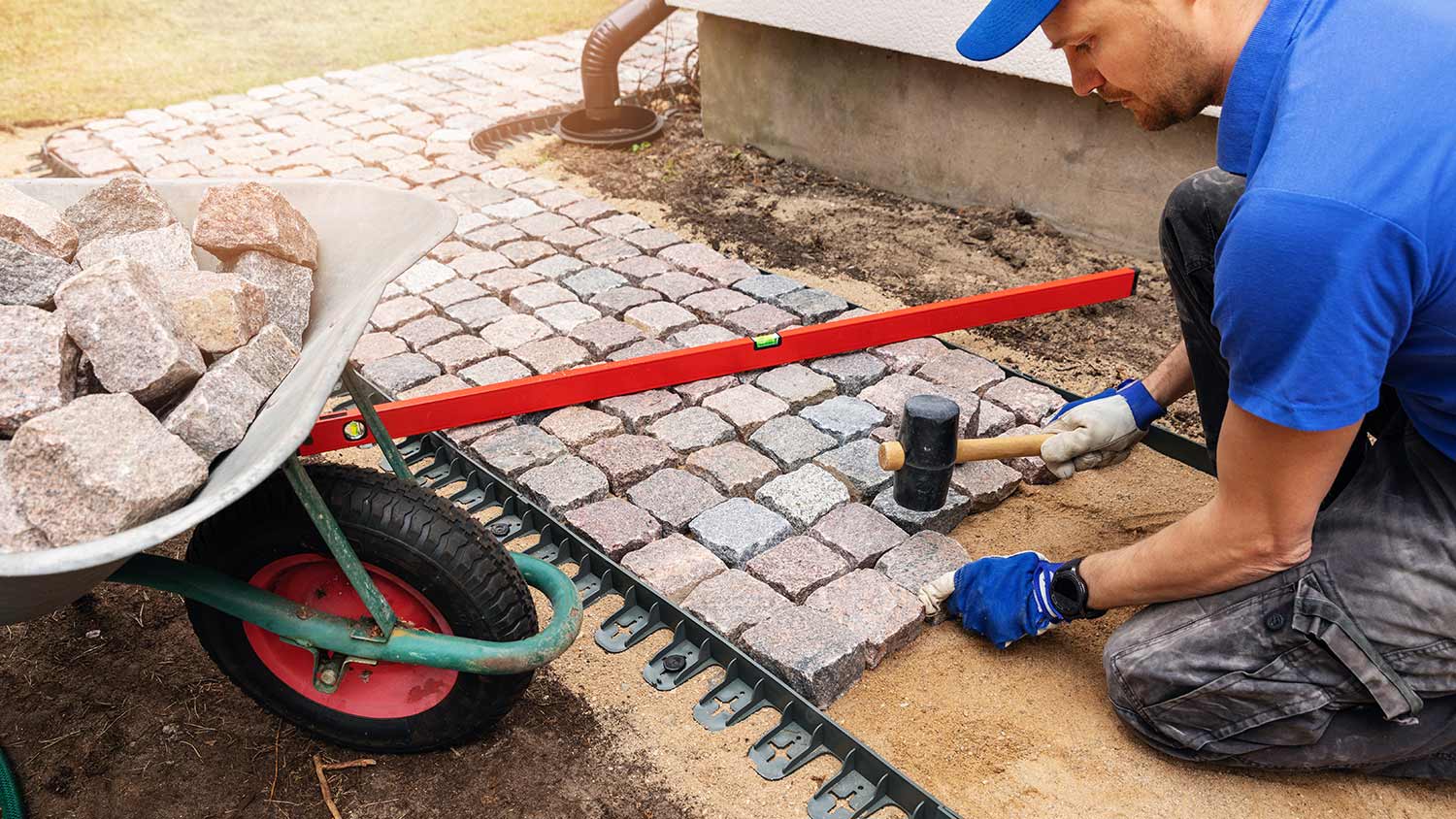
If pavers are uneven but not sunken, lift the affected bricks and check the bedding sand underneath. In many cases, simply smoothing out or adjusting the sand is enough to level them. Add or remove small amounts as needed, then press the pavers back into place and tap them with a mallet until they sit evenly with the surrounding surface.

The dimensions of a driveway apron vary based on local building codes, the width of your driveway, and the distance between the driveway and the road. On average, aprons range from 12 to 24 feet wide and 8 to 18 feet long. Typically, the end of the apron connected to the driveway matches its width—such as 10 to 12 feet for a single-car driveway—while the end at the street flares out to allow cars to turn in and out more easily. In some areas, you may not be responsible for the portion of the apron that extends beyond the sidewalk, but this depends on local laws.

The Aniwa, WI homeowners’ guide to paving services

From average costs to expert advice, get all the answers you need to get your job done.