



Top-rated excavation pros.

Best excavation pros near Lexington, TN

Enter your zip and get matched with up to 5 pros

Need a pro for your excavation project in Lexington, TN?

Select your specific project to find the pro for you.

TRUSTED BY LEXINGTON, TN HOMEOWNERS

  • Average homeowner rating star icon4.9
    Average homeowner rating
  • Verified reviews icon12
    Verified excavation services reviews

Top-Rated Excavation pros in Lexington - Updated Nov 2026

Avatar for Avara Land Management
Avara Land Management
5.0(
4
)
Landscape - Minor Grading or Resloping

Serving Lexington, TN and surrounding areas

Approved

In business since 2025

Free estimates

Emergency services offered

"Eric came out and gave me an estimate on some dirt work I needed done. He was very professional and answered every question I had. Eric and his crew done a fantastic job on my dirt work. They were on time and right on budget. Their now my go to company for all my excavation and land development needs!"
Mayberry land clean up
Short creek driveway job

+8

1 neighbors recently requested a quote
VVM Earthworks
New to Angi
Building Site - Preparation and ClearingExcavation - Major Grading or ReslopingLandscape - Minor Grading or Resloping

Serving Lexington, TN and surrounding areas

Approved

In business since 2018

Free estimates

VVM Earthworks, proudly serves our customers with pride, integrity, and attention to the details that matter most to you. This is one of the many things that sets us apart from the rest. We leave customers happy and give them a part of us of what we are proud too do.

Leedy Farms & Land Management LLC
New to Angi
Landscape - Minor Grading or Resloping

Serving Lexington, TN and surrounding areas

Approved

Leedy Farms & Land Management LLC is a locally owned and operated land management, excavation, and property improvement company based in Buchanan, Tennessee. Established in 2023, our team brings decades of combined hands-on experience in heavy equipment operation, excavation, land clearing, grading, property maintenance, welding, fabrication, construction support, and industrial work.\n\nWe serve West Tennessee and surrounding areas and are willing to travel for larger projects. Our services include excavation, land and lot clearing, tree and brush removal, driveway and road work, gravel spreading, grading, drainage improvements, bush hogging, site preparation, and property cleanup.\n\nWe believe in honesty, dependability, hard work, clear communication, and treating every customer's property like our own. We take pride in doing the job right from start to finish.\n\nFrom clearing to completion – we do it all!

...
Showing 1-10 of 83
Excavating FAQs, answered by experts

As a general rule, the protected area should be about 1½ times as wide as the canopy of the tree’s leaves. This digging measurement can vary by tree species and the age of the tree. Of course, that can be a lot of fencing for larger trees, which is why our first step is about making difficult decisions on which trees to save.

Completion time ranges from days to weeks, contingent on project size, environmental conditions, and regulatory approvals.

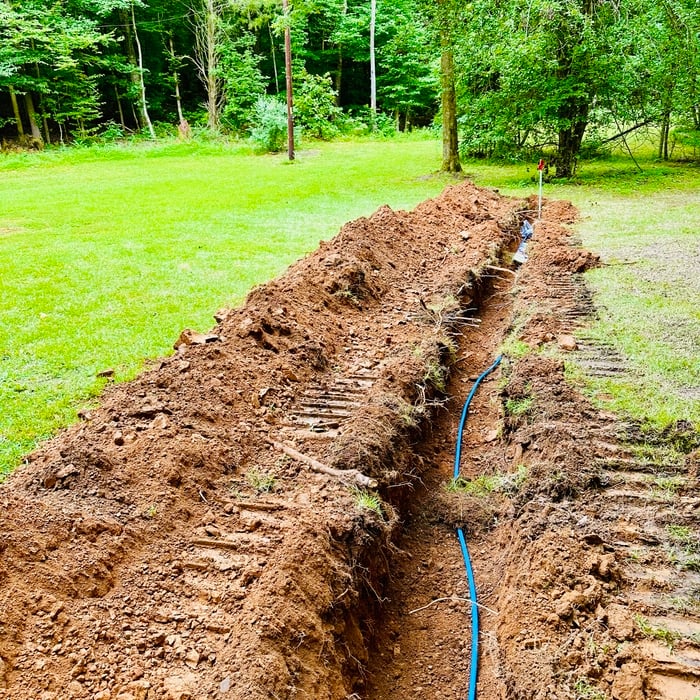
The best method for digging a trench depends on the scope of the project. For a short, shallow trench (less than 2 feet deep) in light, soft soil, digging by hand may be sufficient. However, digging by hand is labor-intensive, so consider the effort required. A machine trencher is the better option for longer trenches (over 100 feet), deeper ones, or when dealing with difficult soil conditions, such as rocky or hard ground, or obstructions like tree roots. A machine can save significant time and energy in these situations.

If you don’t wish to dig it out and convert it into a finished basement, you can still encapsulate your crawl space to protect it from damage for an average cost of $5,500. Finishing a crawl space beyond this isn’t really worthwhile, as the low ceilings mean you won’t be able to use the area as living space.

Septic drain lines (or leach lines) are typically buried between 18 and 36 inches underground, and should be at least 6 inches below the surface. These pipes are perforated and surrounded by filtering materials like sand or gravel. Burying the lines at this depth helps minimize odors and allows bacteria and other biological processes in the soil to effectively treat the wastewater. Burying lines too close to the surface can cause issues unless the soil is very compact and stable.

The Lexington, TN homeowners’ guide to excavation services

From average costs to expert advice, get all the answers you need to get your job done.