







Top-rated drywall pros.

Get matched with top drywall pros in Rochester, IN

Enter your zip and get matched with up to 5 pros

Need a pro for your drywall service project in Rochester, IN?

Select your specific project to find the pro for you.

TRUSTED BY ROCHESTER, IN HOMEOWNERS

  • Average homeowner rating star icon4.3
    Average homeowner rating
  • Verified reviews icon15
    Verified drywall services reviews

Find Drywall pros in Rochester

Avatar for Bonillas Master Touch
Bonillas Master Touch
5.0(
22
)
Drywall - InstallDrywall - Install - For BusinessDrywall - Repair+1 more

Serving Rochester, IN and surrounding areas

Approved

Super Service Award Winner

In business since 2024

Free estimates

Emergency services offered

"I had several quotes to finish my basement, I contacted Bonillas Master Touch and they gave me a reasonable quote and I decided to proceed with remodeling! They were very professional and knowledgeable definitely recommend!!!!"
Drywall Project
Drywall Project
Drywall Project
Drywall Project
Drywall Project

+68

Response time2 days
Response rate100%
Recommended by77%of homeowners
Avatar for Aquino & Sons Drywall LLC
Aquino & Sons Drywall LLC
5.0(
6
)
Drywall - InstallDrywall - Install - For BusinessDrywall - Repair+1 more

Serving Rochester, IN and surrounding areas

Approved

In business since 2019

Free estimates

Credit card accepted

Aquino & Sons Drywall LLC is proud to be locally owned and operated. We pride our company on reliability, great communication, integrity, and quality work. We are experts in our trade and will do our best to keep you as educated as we can on your particular task or project. Call on us today. We look forward to earning your business!

Recommended by60%of homeowners
Avatar for TKW Remodeling LLC
TKW Remodeling LLC
4.9(
11
)
Drywall - InstallDrywall - Install - For BusinessDrywall - Repair+1 more

Serving Rochester, IN and surrounding areas

Approved

In business since 2023

Free estimates

Credit card accepted

We take great pride in offering the best possible experience with our expertise, quality, and customer service. In order to understand the needs and expectations of our clients; we take great care to work and communicate with everyone in a professional manner. It is our mission to exceed our clients expectations by providing excellent workmanship and complete customer satisfaction, from the start of each project to its completion. Our reputation is based on service, safety, and quality, regardless of how large or small the job.

5 neighbors recently requested a quote

Recommended by27%of homeowners
...
Showing 1-10 of 89
Drywall questions, answered by experts

You should leave a gap between drywall sheets because they naturally expand and contract along with the building framing as temperature and humidity change. Most pro drywall installers leave a gap of about ⅛ inch between drywall sheets, allowing the sheets to expand, contract, and shift without cracking or becoming damaged. If you don’t leave enough gaps between slabs, the edges will press against each other when they expand, and the pressure can cause visible cracks.

Whether to repair or replace water-damaged plaster depends on the scale of the damage. For small, limited areas, you can often perform a repair yourself. If you choose to paint over small patches, ensure the surface is completely dry and apply a coat of antifungal primer first to prevent mold growth. However, simply painting or plastering over the damage is only a temporary solution that doesn't address the core problem. For more extensive or long-term damage, the plaster may be compromised, and there is a risk of mold. In these cases, it is recommended to remove the damaged section of plasterboard and replace it. You may consider hiring a professional for the repair, and it's worth noting that water damage is often covered by home insurance.

You should stagger drywall sheets to help prevent cracking. The joints between drywall sheets are the weak spots, so if you install drywall with seams aligned, you’ll create weak lines that run across the length of the wall and extend from floor to ceiling. But when you stagger drywall, the solid sections of panels will support the joints. This can prevent seams from cracking or separating due to fluctuating temperature and humidity, vibrations from movement inside the home, and gravity.

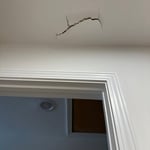
Your walls are likely cracking due to fluctuations in the temperature outside. Drywall tends to expand and contract when temperatures and humidity levels change, and this repeated movement can lead to cracks in your walls, particularly around door frames. If you have multiple diagonal cracks, you may want to have your foundation inspected, as cracks can also be a sign of a bigger issue.

Although they are used for similar tasks, spackle and joint compound are not the same. Joint compound, also known as drywall mud, consists of limestone and gypsum and is primarily used for large-scale projects like taping and finishing seams on new drywall. Spackle is composed of gypsum and binding agents, making it a thicker compound best suited for small wall repairs like filling nail holes or cracks, as it dries quickly and is easy to sand. For small repairs, either product can be suitable. However, you can use joint compound for small jobs in place of spackle, but you cannot use spackle for large-scale taping and mudding projects.

The Rochester, IN homeowners’ guide to drywall services

From average costs to expert advice, get all the answers you need to get your job done.