



Top-rated paving pros.

Get matched with top paving pros in Sanborn, IA

Enter your zip and get matched with up to 5 pros

Need a pro for your paving service project in Sanborn, IA?

Select your specific project to find the pro for you.

Find Paving pros in Sanborn

DA Excavation & Forestry
New to Angi
Gravel or Loose Fill Paving - Install, Spread or Scrape

Serving Sanborn, IA and surrounding areas

In business since 2019

Free estimates

Credit card accepted

DA Excavation & Forestry is committed to excellence in every aspect of our\nbusiness. We uphold a standard of integrity bound by fairness, honesty,\nand personal responsibility. Our distinction is the quality of service\nwe bring to our customers. Accurate knowledge of\nour trade combined with ability is what makes us true professionals.\nAbove all, we are watchful of our customers' interests and make their\nconcerns the basis of our business.

d and m painting and staining
New to Angi
Asphalt Paving - Repair or PatchAsphalt Paving - Repair or Patch - For Business

Serving Sanborn, IA and surrounding areas

In business since 1995

Free estimates

We�re a locally owned and operated company with 15+ years of industry experience. We value honesty and integrity, and stand behind our work. We specialize in both interior and exterior residential and commercial painting projects. We pride ourselves on the quality of our work as well as our commitment to outstanding results. We look forward to building long-term relationships with our clients and guarantee your satisfaction!

Mid Iowa Site Services, LLC
New to Angi
Gravel or Loose Fill Paving - Install, Spread or Scrape

Serving Sanborn, IA and surrounding areas

In business since 2016

Free estimates

With over 20 years of experience, Mid Iowa Site Services is the solution for all your demolition, excavation, and gravel needs. We take great pride in our extreme professionalism, timeliness and superior customer service on every job. We develop lasting relationship, so that the next time service is needed there's no question who to call. Satisfaction guaranteed! Call us today!\n

Response time3 hrs
Paving Services questions, answered by experts

An ideal driveway gradient is between 2% and 5%. Anything lower than 1% or higher than 15% can cause problems for your car or property. A driveway with less than a 1% slope increases your likelihood of flooding and water damage, while a driveway with a 15% grade or higher can be too steep for safe traveling.

While blacktop is a type of asphalt, the terms should not be used interchangeably, as not all asphalt qualifies as blacktop. The primary differences are in their composition, production process, and ideal applications. Blacktop contains more stone than other types of asphalt and is heated to a higher temperature during production—300°F or more—while hot-mix asphalt is heated to between 275°F and 300°F. The ratio of bitumen (a tar-like crude oil) is a key differentiator, though sources vary: some state blacktop has less bitumen, making it less durable, while others claim it has a higher ratio. Due to these differences, asphalt is generally more durable and better for high-traffic areas like highways and streets, while blacktop is more suitable for playgrounds and residential driveways. For a driveway project, it is best to consult a professional to determine the most appropriate material.

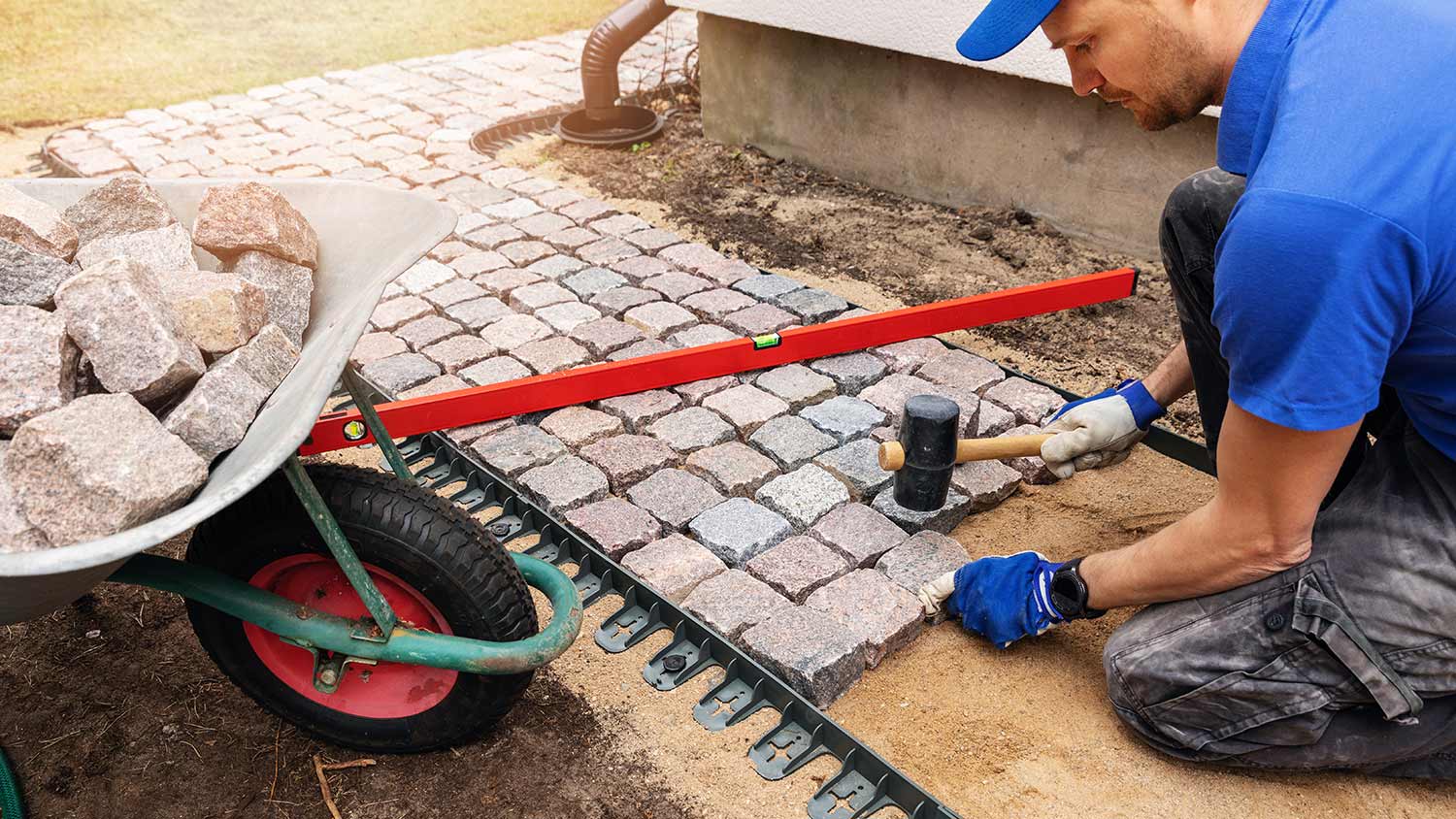
Whether you decide to DIY paver installation or want to hire a pro, it’s smart to understand the process. First, you’ll need to prepare the area by clearing away grass and dirt. Next, you’ll add the paver base of gravel and sand before laying the pavers on top. You may need to cut pavers to fit your space or the landscaping design and add edging stones.

You can pour concrete over asphalt if it’s in good condition, thick, stable, and well-compacted. Concrete is more durable than asphalt and can extend the lifetime of your driveway without having to pay frequent asphalt driveway repair costs or replace it completely. 

But this is best reserved as a temporary solution based on budget restraints, as asphalt requires more frequent repairs and assessments than concrete. Once that concrete top is poured, it’ll be harder to accurately understand what’s happening beneath that layer, which could lead to more issues.

While water-related pressure caused by poor drainage is one common cause of paver cracking, other factors can include ground movement beneath pavers, heavy loads and wear and tear over the pavers, and climates with constant freeze-thaw cycles. In general, pavers should be resealed every three to five years to prevent cracking.

The Sanborn, IA homeowners’ guide to paving services

From average costs to expert advice, get all the answers you need to get your job done.