






Top-rated structural engineers.

Get matched with top structural engineers in Waynesville, GA

Enter your zip and get matched with up to 5 pros

Need a pro for your structural engineering project in Waynesville, GA?

Select your specific project to find the pro for you.

Find Structural engineers in Waynesville

Avatar for Family Safe Southeast
Family Safe Southeast
5.0(
3
)

Serving Waynesville, GA and surrounding areas

In business since 2011

Free estimates

Credit card accepted

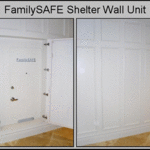
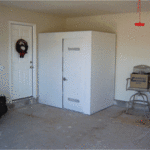
"Saw display at home and garden show.  Researched product and company, then ordered 4X4 shelter via telephone.  Company provided additional details about testing and certification IAW FEMA standards upon request.  Delivery and installation were on time and as promised."
.
.
.
Recommended by100%of homeowners
Structural Engineering questions, answered by experts

Yes, ceiling joists are typically load-bearing. However, their primary function is to support the weight of the ceiling and loads applied to it, like lighting fixtures and ceiling fans. They can also help support the roof, especially if they’re part of truss systems. Remember, the load-bearing capacity of ceiling joists depends on the material, size, and space between them. 

A freestanding brick wall that's only one brick thick can usually stand six to eight feet high. If you need a higher wall, it should be at least two bricks thick for adequate stability, and it might require a footing to support the added weight. Additionally, some areas have regulations and codes dictating how high a brick wall can be, so check with local code enforcers to ensure your proposed wall complies with any regulations.

The depth of any foundation style depends on your climate and how deep the frost line is, as building code requires that the footers of a foundation—which are built into a monolithic slab—sit at least a foot below the frost line. At the southern tip of Florida, for example, a monolithic slab foundation would only need to sit 12 inches under the soil at the widest parts. On some parts of the Canadian border, the frost line is 100 inches, which would mean a minimum of 112 inches, which is prohibitively deep for a monolithic slab.

Whether you’re building a new home or building an extension on your existing property, you will likely need both a structural engineer and an architect. A structural engineer will determine what loads your foundation and framing can safely handle, and an architect will draw plans according to those structural calculations to simplify the building process. You can start by contacting a structural engineer near you, as many work alongside architects and can get all of the prep work done at once.

Yes, an LVL beam is more affordable than the cost of a steel I-beam, totaling between $50 and $200 per linear foot as opposed to the $100 to $400 per linear foot you’d pay for a steel I-beam. Not only is the wood material more affordable than steel, but it’s also more similar to traditional wooden beams and doesn’t require as much retrofitting to connect joists.

The Waynesville, GA homeowners’ guide to structural engineering services

From average costs to expert advice, get all the answers you need to get your job done.

What do you need done? We’ll find top pros.
  • 🌱 "Mow a small front yard"
  • 🛠 "Fix a leaking pipe under the sink"
  • 🏠 "Repair shingles on an asphalt roof"