

•
Discover average lawn aeration cost, key price factors, and tips to save. Get a clear estimate for your yard and learn how to choose between DIY and hiring a pro.
Planting the seed of a simple DIY with a big payoff

Having the perfect lawn takes work, time, and money. A lush and flawless lawn is well worth it for some, but for others, near perfect with less work is just fine. Ready to do less, spend less, and achieve almost perfect results? Here’s how to overseed a lawn without aerating it beforehand.
Before you spend time and money overseeding your lawn, it’s worth considering what’s going on with your lawn. Are the bare patches and yellowing blades a result of pests, overwatering, or just bad luck?
While overseeding will lead to more growth in the short term, if there’s a long-term issue plaguing your lawn, it’s just a bandage on a bigger issue. Addressing bigger issues with the lawn before overseeding gives you a higher chance of success.
If you’re ready to overseed your lawn, move on to the first step.

Not all grass seeds are the same. Depending on where you live and what grass has already taken root on your lawn, you’ll want to pick the right seed to take root.
When purchasing your seed, it’s better to over-buy than under-buy. You won’t run into issues over spreading seeds during the overseeding process, but putting too little down could result in a patchy lawn.

Generally, you can overseed a lawn any time of the year, but you might want to pick a several-week period where you can avoid foot traffic on the newly seeded sections.
For some, depending on the size of the yard, this might mean overseeding in sections instead of doing the lawn all at once.

When you overseed without aerating your lawn, you’ll want your grass as short as possible to start. That means mowing it so it stands between 1 1/2 to 2 inches tall.
The low grass will give the seed the best chance of reaching the soil and taking root. Keeping the grass low also means it’ll be several weeks before you need to mow it again, cutting down on foot traffic.

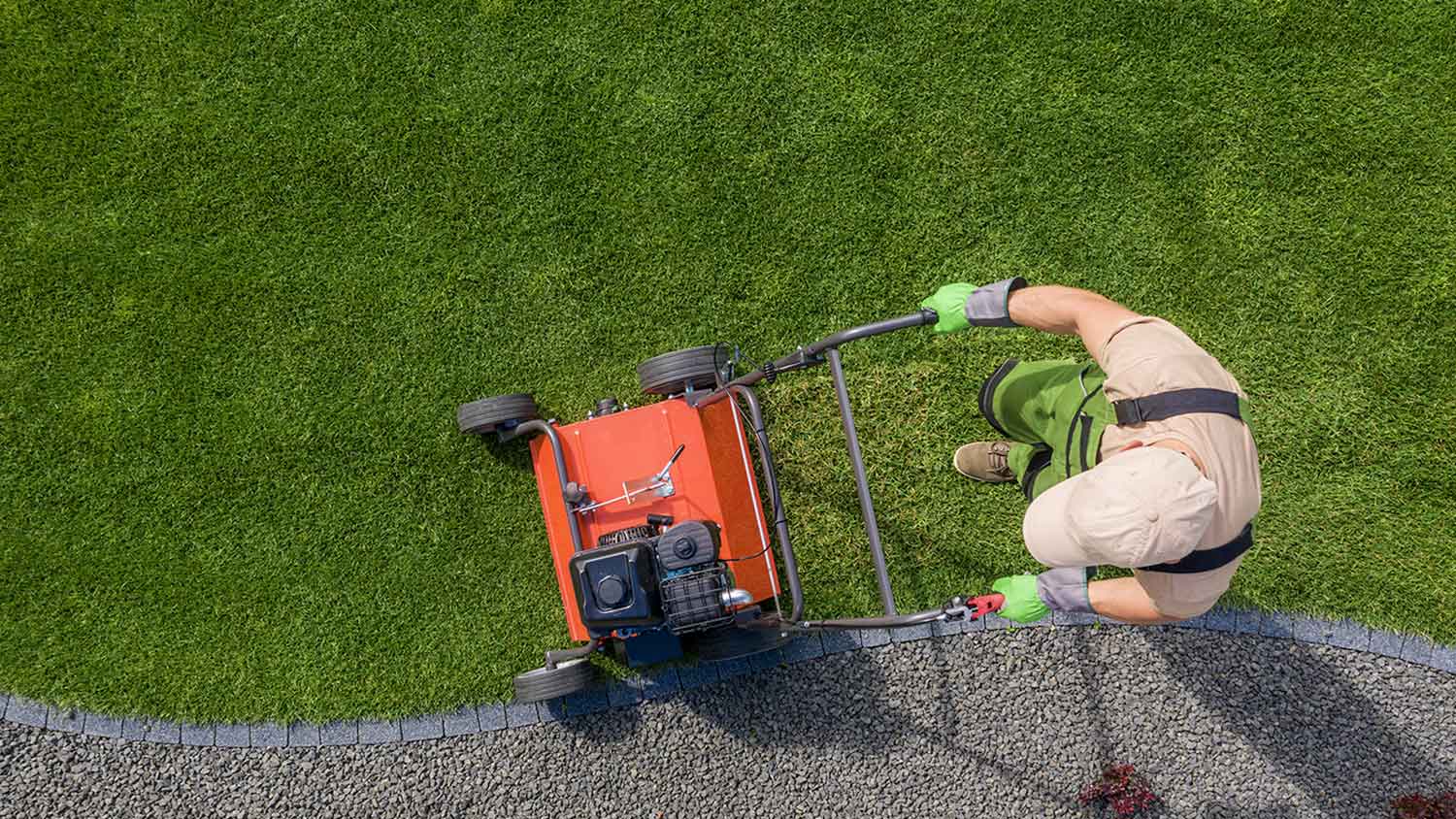
While you don’t need to aerate the lawn, you’ll need to rake or dethatch the freshly mowed grass. If you’re using a manual rake or dethatcher, just drag it along the lawn the same way you’d rake leaves. In the case of a motorized dethatcher, push the rake across the yard in a criss-cross pattern.
Dethatching your lawn will remove any dead grass, making it easy for new seed to take root.

Use your hands, a push spreader, or a hand spreader to distribute grass seed across your lawn, paying close attention to areas with bald patches or thinning grass. Spread half the seeds in one direction and the other half perpendicular to the previous direction to create a pattern. This can encourage fuller coverage.

Use a garden rake to comb over the areas you spread seeds in. This can help the seeds reach the soil and prevent them from being eaten by a bird or swept away during watering. Rake in all directions to avoid dragging seeds toward a single spot.

Using manufacturer’s guidelines, use a spreader to fertilize the overseeded portions of your lawn. You should use about 2 pounds of fertilizer for every 1,000 square feet of overseeded lawn.
Depending on the type of grass you have and your preferences, you can choose between an organic or synthetic fertilizer.

Now, it’s time to water and wait for your seeds to take root.
Aim to water your lawn two to three times a day. Water the overseeded areas in spurts, taking care not to overwater them. They’ll benefit from small watering sessions several times a day. This is when an irrigation system or a garden hose can come in handy.
During this time, avoid walking on the lawn whenever possible. Keep children and pets off the grass, and step gently on the area only if necessary.
You’ll likely need to stick to this watering routine for several weeks (up to four) until you see signs of the grass seed germinating.
While you can hire a professional landscaper to overseed your lawn without aerating, it’s unlikely that they offer that service. That’s because overseeding without aerating is technically skipping a step in the process. What’s more likely is a professional landscaper will want to include aerating in the treatment package.
On average, professional lawn aeration costs $75 to $225, with overseeding adding a charge of $100 to $160. Alternatively, if a landscaper did agree to overseed without aerating, they’d still need to dethatch your lawn, which costs between $160 and $225.
Whether you hire a pro or DIY, you’ll still have to water the lawn after, which might be the biggest time commitment. And if you choose to do it yourself, you could spend hours laboriously aerating your lawn, so you might want to find a lawn aeration pro near you if you’d rather spend your weekend relaxing.
They show up and they did take us on as a client which seems to be a problem with other lawn care providers. We have multiple properties and this one was located close to downtown and no one really wants to mess with it.
The worker came out when he was supposed to come. He informed me he would honor the Angie's List deal, but would not do any more work for me since my son in law owns lawn care company as well, even though they do not do the same type of work. He said he did not feel comfortable giving me...
 Bello Giardino LLC
E & L Lawn Care was super. They were very responsive before and after service. They were efficient and were able to complete the job within 1 day. I have had concern about one section of sod - the owner was pro-active and did a visit to evaluate. I have no doubt they will stand behind...
 E&L lawn care
From average costs to expert advice, get all the answers you need to get your job done.
Discover average lawn aeration cost, key price factors, and tips to save. Get a clear estimate for your yard and learn how to choose between DIY and hiring a pro.

When is it too late to aerate and overseed your lawn? It depends on your grass and soil types. Here’s what you need to know about aerating and overseeding.

Maintenance and aftercare are crucial for maximizing the benefits of lawn aeration. Find out what to do after aerating a lawn for long-lasting results.
When is the best time to aerate your lawn? It depends on the type of grass and soil you have—and more. Here’s how to know when to aerate your lawn.
The benefits of aerating a lawn include loosening compacted soil, better nutrient absorption, preventing water buildup, and promoting a stronger turf and root system.