
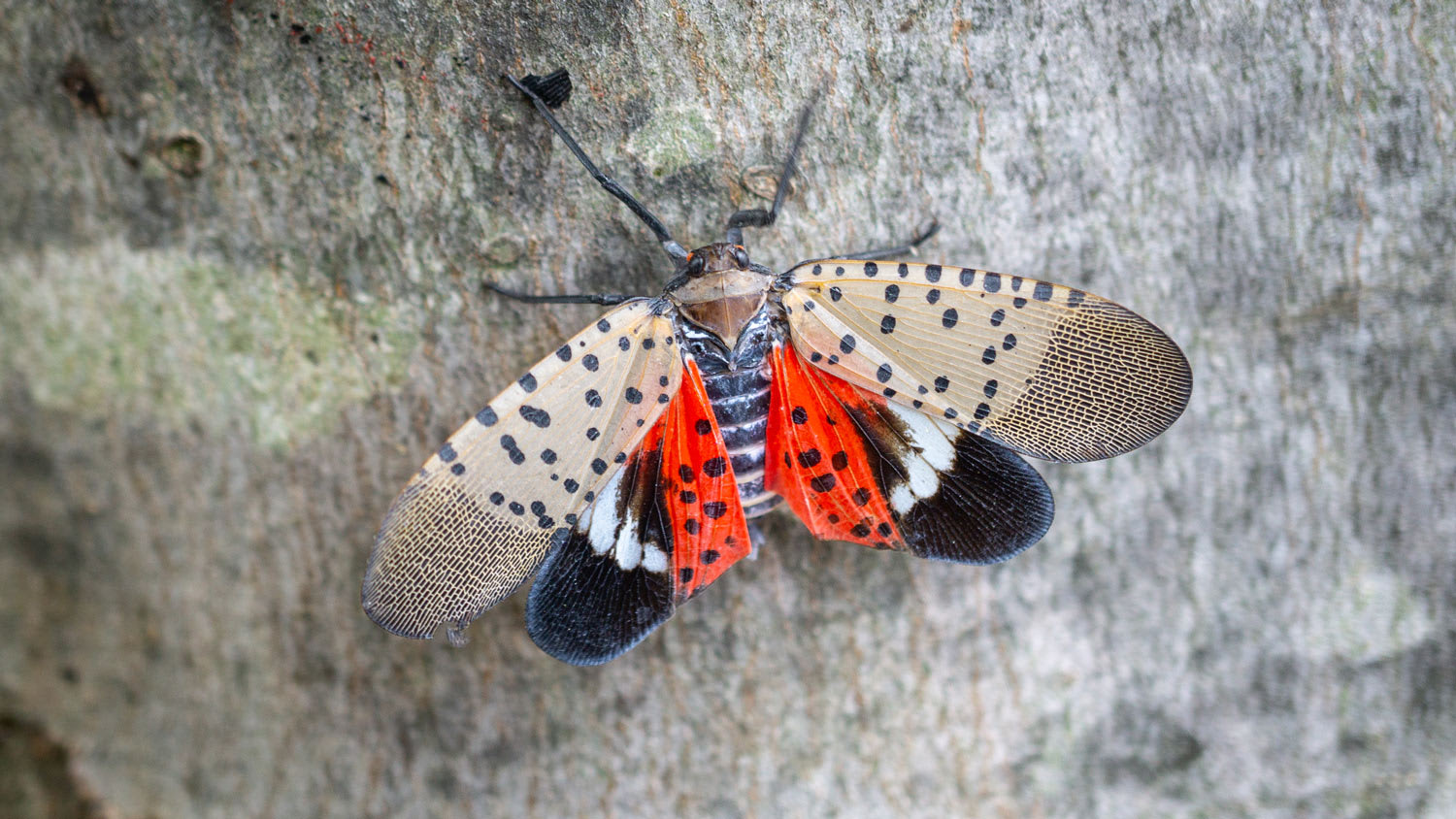
The invasive spotted lanternfly makes a mess and causes serious damage to the environment. So, how much does spotted lanternfly treatment cost?
Shoo fly, don't bother me—or my plants

Spotted lanternfly nymphs appear as small black bugs with white spots in early stages, then turn red with black patches as they mature.
Pest control services cost $200 to $600 on average, and addressing lanternfly infestations early helps protect your trees and plants from serious damage.
You can scrape egg masses from trees and outdoor surfaces in fall and spring, then place them on alcohol-soaked towels to prevent hatching.
Hiring a local exterminating professional provides reliable help with insecticide application and trap placement, keeping your yard protected from these invasive pests.
Spotted lanternflies are plant-hoppers native to Asia, but they were first spotted in the U.S. in 2014, according to the Animal and Plant Health Inspection Service. These pesky pests love the taste of plants, including agricultural crops and hardwood trees.
When they feed on plants too often, they can harm the plant, so it's best to get rid of spotted lanternflies if you find them in your yard. Learn everything you need to know about spotted lanternflies, including treatment, prevention, and signs to look out for.
The spotted lanternfly is a type of plant hopper native to India, Vietnam, and China. In 2014, the first instance of a spotted lanternfly was discovered in the U.S. in Berks County, Pennsylvania. Since then, the invasive species has been found in an increasing number of states, including New Jersey, Delaware, Maryland, and Ohio.
Spotted lanternflies have a healthy appetite for plants. In fact, they've been observed eating more than 70 plant species, including many agricultural crops and hardwood trees.
Lanternflies will eat the following trees, crops, and plants:
Trees of heaven
Grapevines
Black walnut trees
Willow trees
Sumac trees
Maple trees
Oak trees
Pine trees
Almonds
Apricots
Cherries
Apples
Hops
Grapes
Nectarines
Peaches
Plums
While lanternflies will eat a variety of foods, they’re particularly fond of walnuts, trees of heaven, and grapevines.
Spotted lanternflies typically lay their eggs in the fall. The eggs hatch in the spring, from late April to June. Spotted lanternflies can lay egg masses on a variety of surfaces, including trees, houses, rocks, and even outdoor equipment.
Each egg mass comprises around 30 to 50 individual eggs. After a lanternfly hatches in the spring, it experiences four nymphal stages, called instars, before reaching adulthood.
There are many reasons to control these pests. Since spotted lanternflies aren't native to the U.S., they can harm the ecosystem. Known to feed en masse on a large variety of plant species, lanternflies can harm hardwood trees, agricultural crops, and other plants, so they're not welcome guests in most yards.
Additionally, when spotted lanternflies feed on plant sap, they excrete the excess sap as liquid waste called honeydew. Honeydew attracts ants, wasps, and bees. It can also build up on the surface of plants, leading to sooty mold. Sooty mold doesn't harm plants outright, but it can block photosynthesis, ultimately deteriorating a plant's health.
Like most insects, spotted lanternflies look different depending on where they are in the life cycle.
Egg masses: Egg masses appear as a flat, gray-brown substance. They commonly appear on trees, but they're also found on rocks, small plants, fences, and outdoor furniture.
Early nymphs: Early nymphs, aka baby spotted lanternflies, feature small black bodies, relatively long legs, and bright white spots.
Late nymphs: Late nymphs, or adolescent spotted lanternflies, are about the size of a nickel with mostly red bodies and some black patches.
Adults: Adult spotted lanternflies have two sets of wings. Their hind wings have red patches, while their forewings are gray with black spots. Often, only the forewings are visible, which helps them camouflage against trees.

Several signs indicate you have spotted lanternflies in your yard, including sap streaks on trees, sooty mold, and an influx of bees and wasps.
When lanternflies feed on trees, they often leave sap streaks in their wake that are present on tree bark and sometimes have a fermented odor.
If you notice a sticky fluid around your plants' bases, you might have a lanternfly problem. After lanternflies feed, they excrete honeydew, which tends to accumulate on the base of plants and on the ground underneath infested plants.
Over time, the honeydew that lanternflies excrete builds up and can lead to sooty mold. Sooty mold appears as a dark gray or black powdery coating. You might find it on plants or on structures, such as fences and outdoor furniture.
In addition to mold growth, honeydew can lead to an influx of bees, wasps, ants, and other sugar-loving insects who like its sweet taste. If you're finding more of these insects in your yard than usual, it might be due to lanternflies.

Treatment for spotted lanternflies varies depending on their stage in the life cycle.
If you notice spotted lanternfly egg masses on any of your plants, trees, or other outdoor surfaces, you can simply scrape them away and put them on a napkin soaked in alcohol. Removing just one of these egg masses can help prevent 30 to 50 spotted lanternflies from hatching in your yard.
You can use circle traps to capture and eliminate spotted lanternflies after they hatch. Circle traps are modified funnels that you can purchase from the hardware store and apply to your trees.
These traps comprise netting that's wrapped and stapled around the tree, then attached to a funnel. The netting helps direct lanternfly nymphs into the funnel. Once in the funnel, the lanternflies can't escape.
Some people also use sticky rings around a tree as traps. However, this technique isn't generally recommended because these traps can capture and destroy all kinds of insects and critters, not just lanternflies.
You can use one of two types of insecticide treatments to kill spotted lanternflies: contact or systemic.
Contact insecticide kills pests on contact. You can spray it on any surface with suspected spotted lanternfly activity to kill them. However, it's not a preferred elimination method since insecticides can kill other organisms as well, including beneficial ones.
If you do decide to use it, you should avoid applying it to blooming plants. This will help protect pollinators, like bees, which are very helpful for the ecosystem.
Systemic insecticides are designed to move through a plant's vascular system, ultimately killing spotted lanternflies when they feed on the plant. You can apply systemic insecticide by spraying the affected tree trunk or through trunk injection, depending on the type.
Some systemic insecticides can also be applied through soil drenching or injection. Since these insecticides have harsh substances that can potentially damage your trees, it's best to hire a pro for the job.
In fact, regardless of which insecticide type you choose, it's a good idea to hire a pest control company. Insecticides often contain compounds, like dichlorodiphenyltrichloroethane (DDT), that can harm you and the environment if improperly applied. A local pro will know how to apply insecticide as safely as possible. Pest control services cost $200 to $600, on average.
Although there's no way to completely stop spotted lanternflies from making their way into your yard, there are several easy things you can do to help keep them out.
Unfortunately, spotted lanternflies aren't very picky eaters. They're known to feed on over 70 plant species. But you can avoid having their favorite foods in your yard.
If possible, limit the number of trees of heaven, grapevines, black walnut trees, and willow, sumac, and maple trees you have in your yard. You should also regularly monitor these trees for signs of spotted lanternflies.
One of the best things you can do to prevent spotted lanternflies in your yard is regular monitoring. Since they lay eggs in the fall, begin inspecting for egg masses during September and continue inspecting until the spring when they hatch.
If you find any egg masses, scrape them away and put them on an alcohol-soaked towel and call a local exterminator to help treat or eliminate the chances of an infestation.
A reliable team for moves across state. My switch to a new place needed careful lifting through tight hallways. The movers checked the doorway first, then carried heavier pieces with slow, controlled movements. Their patience helped prevent damage, and I?d choose them again.
This company does it right. Firstly, I want to say that Landan was a joy to work with. He was so kind, transparent, and had everything under control. His entire team showed up ready to work and they were all very respectful of the fact that we were in an office space. A little backstory – we...
 Krumlauf Floors
I had FabClean 614 clean my apartment, and she did an outstanding job. She was so professional and efficient. My apartment looks absolutely spotless every surface, every corner, all cleaned to perfection. Definitely highly recommend FabClean 614 if you're looking for top-notch cleaning...
 Fab Clean 614
Raven and crew does absolutely fantastic job. They are very professional if any concerns were to occur with any of her work she always took responsibility and finished out with a great job. I have worked with her business for a year and have always been satisfied. Very trusted business and...
 Creations of Transformation LLC
I would recommend this company to anyone! He showed up on time, was friendly, completed a very difficult repair on our dryer vent cover, was responsive, and pricing was extremely fair and competitive. I would have him back to do any of our repairs or cleanings without hesitation!
 U.S.A. Dryer Vent, LLC
Best cleaning I've had at my property
Ace Fireplace Services' chimney sweep service is truly exceptional. They used advanced technology to ensure a thorough cleaning process, and my chimney has never looked better. I highly recommend their services.
 Ace Fireplace Services
This company went above and beyond with their work, chimney sweeps are usually pretty messy, but the clean up was spot on.!! Josh explained every thing that he was doing, and the things that he was checking to make sure the chimney was safe for me and my family. He was very professional,...
 Supreme brick & chimney
Good workers and they do a good job.
 Mira Construction
Mary Cleaning Service is fantastic! The entire team is professional and pay a great deal of attention to detail. They do such a thorough job of cleaning my house. I would definitely recommend!
From average costs to expert advice, get all the answers you need to get your job done.
The invasive spotted lanternfly makes a mess and causes serious damage to the environment. So, how much does spotted lanternfly treatment cost?

A pest control expert can help you get rid of lanternflies, but there are DIY removal steps you can take yourself first.

Falling asleep to the purring of your favorite feline is great, but the dream quickly turns to a nightmare when you feel those biting fleas. So how do you get rid of those dreadful cat fleas for good?

Pantry moths multiply fast, so time is of the essence. Find out how to get rid of pantry moths and eradicate the pests taking over your kitchen.
Learning how to get rid of carpenter bees naturally is important for the environment, ecosystem, and the structure of your home. Use this guide for easy DIY tips.

Left unchecked, indoor or outdoor cricket problems can become a nuisance. Here's how to get rid of crickets in the house with five different effective methods.