

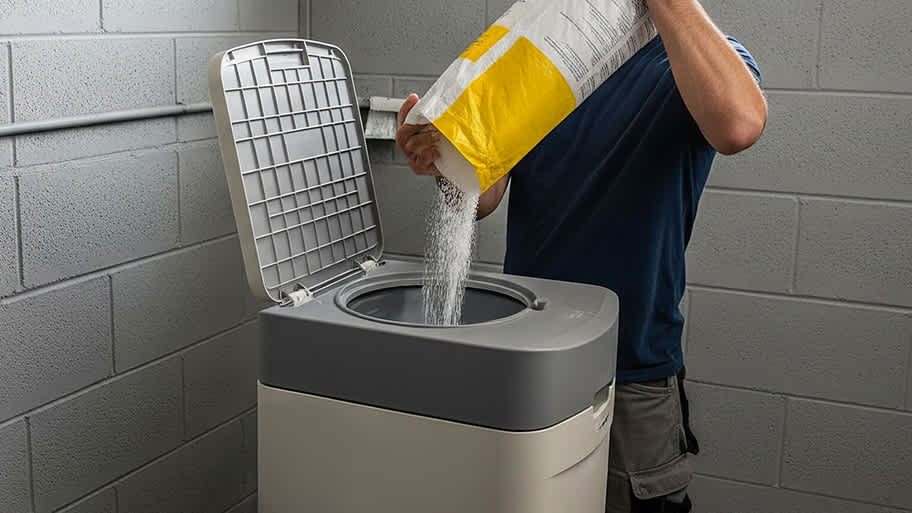
How much a water softener costs depends on your home’s size, and the system’s type and capacity. Our expert guide explores all the price factors.
Water softener service costs depend on your project and location. Check with a local pro for your specific job.

Water softener repair costs range from $162 to $985 for your project, based on system type.
Whole-house systems require more labor than undersink filters, so your repair takes longer and involves more parts.
You should account for brine tank or resin bead replacement in your budget, which adds $150 to $700.
Hiring a local water softener repair professional protects your plumbing from water damage and extends your system's lifespan with expert repairs.
In 2026, the national average cost to repair a water softener is $559, based on 8,441 verified projects from Angi Pros. Most homeowners pay between $162 and $985, with the spread driven by system type, the extent of the repair, and the parts required. Budget extra if your brine tank or resin beads need replacing, which can add $150 to $700 to your total.
Several factors influence what you'll pay to repair a water softener, from the type of system you have to the specific components that need attention. Understanding these variables helps you budget accurately and avoid surprises when your pro delivers a quote.
The type of water softener you have drives most of your repair costs. Simple undersink filters are inexpensive to fix (averaging $200) while complex, whole-house systems require more labor and specialized parts, averaging $300 for typical repairs. The size of the water softener also plays a role, as larger systems involve more labor.
The table below breaks down how repair costs compare across the most common types of water softeners:
| Water Softener Type | Average Repair Cost in 2026 | Average Repair Cost in 2026 |
|---|---|---|
| Reverse Osmosis | $300 | $45–$450 |
| Undersink | $200 | $150–$300 |
| Whole-House | $300 | $50–$800 |
Repairing a reverse osmosis system costs $45 to $450, making it one of the more affordable water softener repair types. These systems filter water through a membrane to remove calcium, magnesium, and other impurities, and most repairs take one to three hours to complete. Plumbers generally charge $45 to $150 per hour for this work, so the total cost depends largely on how long the repair takes.
Repairing an undersink filter costs $150 to $300, but it's worth comparing that figure with the cost of a full replacement before committing to a repair. These are relatively inexpensive water filters installed under a single fixture, filtering water before it reaches a dedicated faucet. Since a full system replacement typically costs $50 to $500, replacing the whole unit often makes more financial sense than repairing an older or heavily worn filter.
Repairing a water softener in a whole-house water system can cost anywhere from $50 to $800, depending on the specific problem. These systems are more complex than undersink filters or reverse osmosis units, which means repairs take longer and often involve more components. Minor fixes, like replacing a hose or a small part, may run just $5 to $50, while a leak repair costs $150 to $300.

The specific component that needs repair or replacement is a key driver of your total water softener repair cost. Most repairs involve addressing one or more individual parts, and costs vary significantly depending on which component is affected. The table below breaks down the average cost of repairing various water softener components:
| Component Needing Replacement | Typical Cost Range in 2026 |
|---|---|
| Brine tank | $125–$700 |
| Resin beads | $200–$400 |
| Filter | $25–$500 |
| Entire System | $1,000–$6,000 |
Replacing a brine tank costs $125 to $700, making it one of the more significant component repairs you may need to make. Brine tanks hold a concentrated salt or potassium solution that helps your system filter water for drinking. If your tank is cracked, corroded, or otherwise damaged, replacement is the most reliable fix.
Replacing resin beads costs $200 to $400, making it a mid-range repair that restores your system's ability to soften water effectively. These polystyrene beads carry a negative charge that attracts and removes positively charged minerals like calcium and magnesium as water flows through the tank. Over time, the beads become oversaturated with those minerals and lose their effectiveness, necessitating replacement.
Replacing a multistage filter costs $25 to $500, with the wide range reflecting differences in filter complexity and the number of stages involved. These filters use multiple layers of filter material to treat water in successive stages, and replacing them restores full filtration performance. The specific materials and configuration of your system will determine where your cost falls within that range.
Full water softener replacement costs $1,000 to $6,000, which is significantly more than a standalone repair but can be the smarter long-term investment. Water softeners typically last 10 to 15 years, so if your system is a decade old and experiencing problems, replacement may save you from repeated repair costs down the road. Paying for multiple repairs on an aging system can quickly exceed the cost of a new installation.
Labor is a significant part of your water softener repair budget, with plumbers charging $45 to $150 per hour for this type of work. Most repairs take one to three hours to complete, though more complex problems can extend that timeline. In addition to labor, you'll also need to account for the cost of any parts or materials required to fix the issue.
Hiring a pro to repair your water softener means paying $45 to $150 per hour in labor, while a DIY approach limits your costs to tools and materials — such as a replacement hose for $5 to $50. That said, water softener repairs can be complex, particularly when the system is connected to a whole-house water treatment setup. Unless you have solid plumbing expertise, it's best to hire a local water softener repair specialist to avoid the risk of causing further damage.
Repairing a water softener isn’t a simple DIY job. Here’s why it’s best to hire an experienced pro for the job:
DIY repairs can lead to water damage, system failure, and costly problems.
Experienced pros have the specialized tools and expertise to repair water softeners without causing further damage.
Professionals know how to safely work with water lines, valves, and electrical components.
Reputable pros offer service guarantees for added peace of mind.
Experts can complete repairs quickly, protecting your plumbing and extending your system's lifespan.
If you want to assist with the repair process, focus on smaller tasks such as:
Removing furniture, rugs, and decor from the area around your water softener
Cleaning the surrounding area and clearing obstacles so your pro has easy access
Checking and refilling the salt tank under your pro’s guidance
Handing your pro tools as needed while they work
Be ready to explain the type, location, and severity of damage to your pro.
Explain which component is affected, such as the brine tank, resin beads, or filter.
Let your pro know about any plumbing or accessibility concerns that could affect the repair's complexity.
Ask about potential add-ons such as smart controls, bypass valves, or filtration systems.
Home is the most important place on earth, which is why Angi has helped more than 150 million homeowners transform their houses into homes they adore. To help homeowners with their next project, Angi provides readers with the most accurate cost data and upholds strict editorial standards. We’ve surveyed thousands of real Angi customers about their project costs to develop the pricing data you see, so you can make the best decisions for you and your home. We pair this data with research from reputable sources, including the U.S. Bureau of Labor Statistics, academic journals, market studies, and interviews with industry experts—all to ensure our prices reflect real-world projects.
Want to help us improve our cost data? Send us a recent project quote to [email protected]. Quotes and personal information will not be shared publicly.
If you’re good people wanting to do business with good people, hire Matt. He is a consummate professional and utterly competent. He installed a water heater in my home at a price that beat competitors by hundreds of dollars with a promise to support the unit for its life (even after its 6 yr...
 Greene's Plumbing Services
As usual with ECO, tech Jordan was outstanding, very professional, very knowledgeable, and very thorough with repairs made to tankless water heaters. Very highly recommend ECO!!!
 Eco Plumbers, Electricians, and HVAC Technicians
Did a great job replacing the ice maker and water regulator on my refrigerator. He was quick and thorough, very friendly and professional. If I needed a heart transplant I'd want him to do it!!!
We had a gutter blockage that was causing water to sheet down the side of the house and ultimately it started to come in at a window (need mortar people next). Called around 7:30am, and he responded by 8am. He was able to come out the same morning and do a look over and clean out. He also...
Scott checked our large crawl space for mold and water infiltration and recommended a viable solution. The crew was efficient and they cleaned up well after the job. The job was expensive but I am confident that I won't have to deal with the problem again. Highly recommend.
 AdvantaClean of Dublin
They were the most through inspecting the water system in my house. Even going the extra mile to get the water professionally tested for contamination.
 Hague Water Conditioning, Inc.
It went very well. The drain is absorbing all the access water. I had other estimates a year earlier and Hughes was right on. I will use them, again.
 Hughes Construction Co
Very well. Have already used them again to fix hot water heater
 Service Olympians
The Paul Davis team was very professional and went the extra mile to take care of my water damage. The work was very high quality and done in a timely manner. I would highly recommend their services.
 Paul Davis Restoration
Honesty is hard to find in business today. GBR met me today at a 3 story building regarding my being told that I needed to tuckpoint the brick because of water leaks. The owners took the time to evaluate the situation and advised me that I did not need their service at all. They pointed me...
 GBR Masonry Inc
From average costs to expert advice, get all the answers you need to get your job done.
How much a water softener costs depends on your home’s size, and the system’s type and capacity. Our expert guide explores all the price factors.

Water softeners tend to wear out after 15 years, but what if you need major repairs sooner? Find out when to invest in a new unit or water softener repair.

Water softeners work to remove unwanted minerals from hard water through a filtration and recharge cycle. Keep reading to learn how a water softener works.
Your water softener works overtime to keep your water safe. Use this guide on how to check your water heater for damage or poor performance.

Having an issue with your water softener? Learn the parts of a water softener and how they work together to treat hard water with this guide.
Water softeners can face several problems during their life spans, including blockages, timer problems, and more. Read on to learn about water softener problems.