

The cost of a structural engineer is easily justifiable given the value they bring to the table. Use this guide to see what hiring your professional will total in Baltimore, MD.
Structural engineering costs depend on your project and location. Check with a local pro for your specific job.

Structural engineer costs in Washington, D.C., rise with $850 to $1,400 for inspections, complex load evaluations, and tight rowhome site conditions.
Permit fees of $75 to $1,200 or more, PE stamps of $250 to $750, and strict D.C. codes increase project pricing.
Foundation damage evaluations costing $1,000 to $2,000 and storm-related assessments up to $2,000 elevate total engineering costs.
As a higher-cost-of-living metro with dense urban housing, homeowners in Washington, D.C., should plan carefully when hiring a structural engineer. Structural engineering costs in Washington, D.C. average $534, with most projects ranging from $347 to $745 depending on scope and complexity. Rowhouses in neighborhoods like Capitol Hill, Petworth, and Shaw often require detailed load evaluations, foundation checks, or beam sizing when renovating.
High permitting volumes and strict local building codes can also influence pricing and timelines. Whether you're planning a remodel, repairing settlement issues, or submitting stamped plans, here’s what to expect when budgeting for this project.
Structural engineer cost factors in Washington, D.C. emerge from fee structure, project complexity, inspection type, and required plans, especially in older rowhomes, where evaluating signs of structural damage across Washington, DC, demands added expertise and time.
When hiring a structural engineer in Washington, D.C., you will pay per project, per hour, or per square foot. If your engineer charges by the project, they may either charge a flat fee or a percentage of the entire renovation cost or the cost to build a house. The type of billing depends on the professional and the exact scope of work requested.
| Price Structure | Average Cost |
|---|---|
| Per project (fee) | $3,000–$10,000 |
| Per project (%) | 1.5%–10% |
| Per hour | $90–$300 |
| Per square foot | $3–$12 |
The cost of a structural engineer for a home inspection will also vary based on the complexity of your project. If you’re just building an add-on to your existing home, your engineer will have minimal work to do to ensure the addition is safe.
If you’re instead altering your roof structure, replacing standard beams with more supportive steel I-beams to open up your space, or removing load-bearing walls, your engineer will have more work to do and will charge more accordingly. Custom new construction projects are the most involved and will be the most expensive.

When working with a structural engineer, an inspection is the first step—and may also be the only step, depending on why you’re hiring them. A structural engineer charges a flat fee for inspections, including checks during the sale of a home. The cost of a structural report sits at $850, but prices can range from $600 to $1,200, depending on the size and complexity of your home.
Your structural engineer inspection cost will likely reach $1,500 or more if you’re having your professional perform a foundation inspection for foundational cracks, bowing foundation walls, wavy rooflines, or sagging or squeaky floors.
| Type of Inspection | Average Cost |
|---|---|
| Beams/joists/trusses | $500–$800 |
| Buying or selling a home | $900–$1,200 |
| Foundation damage | $1,000–$2,000 |
| Home remodel | $1,200–$3,000 |
| Load-bearing walls | $500–$900 |
| New construction | $800–$1,500 |
| Storm damage | $1,000–$2,000 |
Engineer plans are the drawings that detail the construction project, and in the case of new construction, they’re the plans that an architect and builder will work off of to construct your home safely.
The engineer plans themselves, and the process to produce them will cost you anywhere from $1,000 or more, depending on the scope of the project. The cost can be much higher for more complex, large-scale projects, sometimes reaching 45% of the engineering budget. It’s a good idea to budget an additional $300 to $700 for revisions in case you want to make changes after the first round of drafting. Additional revisions after that point will cost the same amount.
Below, we've included some average pricing for standard drawings you might request from a structural engineer:
| Drawing Type | Average Cost |
|---|---|
| Commercial construction | $10,000–$150,000 |
| Home add-on or bump-out | $3,000–$8,000 |
| Major home renovation | $3,000–$10,000 |
| New construction | $4,000–$15,000 |
| Outbuilding construction | $1,000–$12,000 |
Additional structural engineering costs in Washington, D.C., can vary widely depending on project scope, permitting requirements, and the region’s higher labor rates. From PE stamps to local taxes and DOB permits, homeowners should expect several city-specific fees beyond the base inspection or engineering service.
Labor rates in Washington, D.C. are higher than the national average due to the city’s dense housing stock, older rowhomes, and high demand for licensed professionals. A professional structural engineer inspection in Washington, D.C. for a full home review often costs $850 to $1,400, reflecting the added time for navigating tight urban sites and permit reviews.
In Washington, D.C., the cost of obtaining the necessary sealed drawings and engineer stamps is built into the project fee, with home consultation and permit-set stamp fees sitting at $750 in the D.C. area. Because the sealed drawings must satisfy both D.C. building code and historic-preservation criteria, the stamp component adds modestly to the overall fee.
Structural permits in Washington, D.C. are handled through the Department of Buildings (DOB), and homeowners are responsible for these fees, not the engineer. Permit costs vary widely by scope: minor structural changes may run $75 to $150, while major renovations, additions, or load-bearing modifications can require permits ranging from $300 to $1,200 or more.
Washington, D.C. applies a 6% sales tax to many professional services, including certain engineering activities, meaning homeowners may see this added to their final invoice depending on how the engineering firm classifies the service. While not all structural engineering work is taxable, most residential consulting and inspection services fall within the billable categories.
Tipping isn’t customary for structural engineers in Washington, D.C., but some homeowners choose a small gratuity when a site visit involves after-hours scheduling or expedited turnaround. Expect any “tip” to be symbolic (e.g., $20 to $50) rather than a meaningful portion of the fee. Most professionals prefer that appreciation be expressed through prompt payment and referrals rather than cash tips.
Hiring a structural engineer in Washington, D.C. doesn’t generate direct return on investment (ROI) on its own; your return depends entirely on the project completed after their assessment. For example, when a homeowner brings in an engineer for a home addition in Washington, D.C., the project may yield an ROI of 20% to 50% depending on design, neighborhood, and permitting requirements. If you’re hiring a structural engineer for a pre-purchase inspection or to assess post-storm soil or settlement issues, the financial return is smaller, though the peace of mind and risk reduction can still be substantial.
Home is the most important place on earth, which is why Angi has helped more than 150 million homeowners transform their houses into homes they adore. To help homeowners with their next project, Angi provides readers with the most accurate cost data and upholds strict editorial standards. We survey real Angi customers about their project costs to develop the pricing data you see, so you can make the best decisions for you and your home. We pair this data with research from reputable sources, including the U.S. Bureau of Labor Statistics, academic journals, market studies, and interviews with industry experts—all to ensure our prices reflect real-world projects.
Want to help us improve our cost data? Send us a recent project quote to [email protected]. Quotes and personal information will not be shared publicly.
We needed a structural engineer to come inspect our basement as part of a pending sale. We had a rather short turn around and Omid came to the rescue. He responded right away and was able to come on short notice. He was very knowledgeable and good at explaining things simply. Omid was able to...
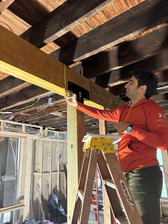 OGV Structural Engineering, LLC
So, I had this block wall that needed some fixing, and McMillan Contracting totally saved the day. They knew exactly what they were doing when it came to repairing block walls. They fixed all the structural problems and made sure the wall looked good too. Highly Satisfied!!
 James McMillan Contracting
Perdo Y. did an excellent job rebuilding our front stairway. Got the job done quickly, efficiently, and it was very structurally sound.
 JW Home Improvement
Please be careful when hiring this company. I had Mr. Hall construct a metal frame (four 4x4 posts with four 1x1 rails connected to the top of each post) for my roof top deck at the cost of $2300. The structure only lasted 6 months when a wind storm left the structure unusable. The welds he...
We hired Mina to do a complete assessment of our new home. During the initial home inspection, we had noticed several stairstep cracks in the basement walls, and had recently also been noticing cracks above the door frames in the plaster. As we are certainly not experts in structural...
 Kiro Engineering LLC
I am still waiting for them to get it right and fix the issue . The structure foundation is not completed, Failed inspection for 4 to 5 times. The walls and the floors cannot be completed my kitchen and bathroom because its not secure. They started the job September 2020 and its already May...
 JES Foundation Repair
I have dealt with many architects before and gotten what I thought was good service. However after dealing with Eustilus Architecture I now have a new bar by which to judge others. Whether it be dealing with me on my time frame, which was late at night lots of time due to my work schedule, or...
 Eustilus Architecture
Brian arrived on time. He was knowledgable and took the time to explain everything in detail. We discussed potential solutions, including some proposals that we had previously received. He helps us chose the most practical solution based on the age of the house (100+), the location, and our...
 Deska Foundation Repair and Basement Waterproofing
Pittsburgh Design and Engineering Services is hands-down THE company you need to use for any and all structural engineering needs. I placed a house under contract that had foundation issues and was both nervous and concerned about what the repairs might entail. Firas, the owner, responded to...
 Pittsburgh Design & Engineering Services, LLC
We had a small (3' x 3') balcony off the back of our Capitol Hill (DC) row home. The wood was rotting and failing anchors were leaking water into our walls. Ace was a competitive price and workmanship was excellent. They also rebuilt the balcony in a way that minimized the number of...
 Ace Deck & Fence
From average costs to expert advice, get all the answers you need to get your job done.
The cost of a structural engineer is easily justifiable given the value they bring to the table. Use this guide to see what hiring your professional will total in Baltimore, MD.

Find out the average beam installation cost in Baltimore, MD. Learn what you can expect to pay for local structural support services and plan your budget.
Find out the average beam installation cost in Washington, D.C. Learn what you can expect to pay for structural support and plan your renovation budget today.
Spotting deep foundation cracks or sagging floors? Learn about structural engineering costs, serious warning signs, and how to hire the right local pro.

Identify potentially serious problems with your foundation with an inspection from a structural engineer.