


Interested in renting or buying a shipping container? Here's what to know about various cost factors that determine the final price.
Moving costs depend on your project and location. Check with a local pro for your specific job.

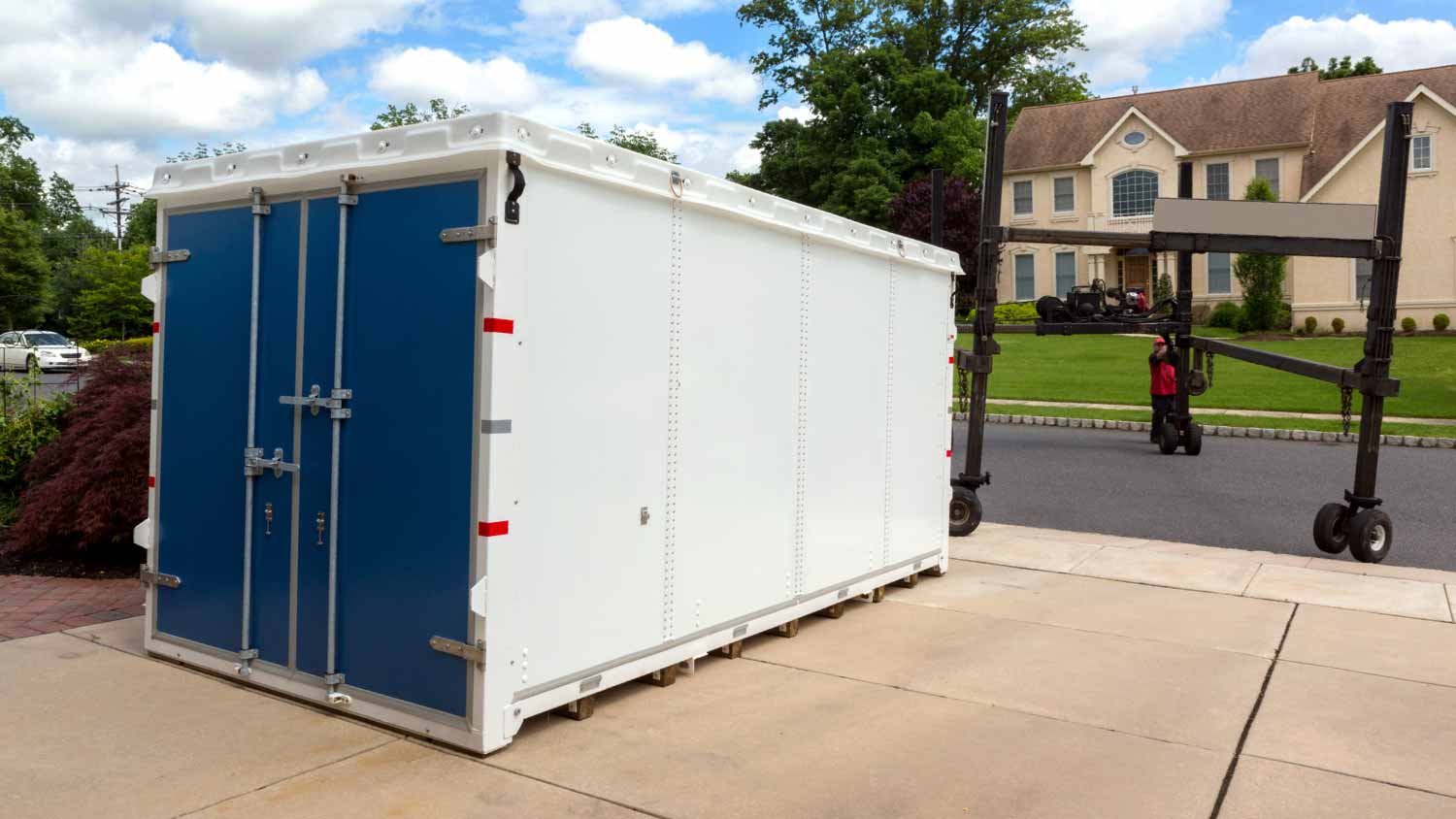
Shipping a moving container costs between $2,000 and $5,000, and your distance and container size set your total.
Your total rises if you exceed company weight limits, so sort heavy furniture and appliances before packing.
Your budget should include customs duties and port fees from $150 to $500 for international move paperwork.
Hiring a local packing unpacking professional protects your belongings, saves time, and helps you feel organized on moving day.
In 2026, the national average cost to ship a moving container is $3,000. Most homeowners spend between $2,000 and $5,000, with distance traveled and container size being the biggest factors in determining your total. Budget for extras like customs duties and port fees from $150 to $500 if you're planning an international move.

The following table shows the differences in cost for domestic and international shipping:
| Shipping Type | Average Cost in 2026 |
|---|---|
| Domestic | $3,000 |
| International | $4,150 |
There are many variables to consider when shipping a moving container, including whether you’re making an international move or a domestic long-distance move. The weight of your cargo also affects your pricing, so you should only pack the essentials. Of course, the specific details of your move will ultimately determine the price, but these are average figures to reference.
For a domestic move, you can expect to pay between $1.00 and $4.00 per mile, depending on the container size you select. Providers like PODS, U-Pack, U-Box, and 1-800-PACK-RAT each offer their own container dimensions, with standard sizes ranging from 7 to 27 feet.
Most international moves rely on 20- and 40-foot containers, and pricing varies considerably by route, with an average of $4,150. To illustrate how destination affects cost, the figures below show average shipping rates from Shanghai, China, to major U.S. cities.
Breaking domestic shipping costs down by distance, you'll spend an average of $2.50 per mile overall, though shorter moves carry a higher per-mile rate even as their total cost stays lower. Costs vary significantly depending on the mileage involved, as the table below shows:
| Mileage | Average Cost per Mile in 2026 |
|---|---|
| 100 miles | $16.50 |
| 475 miles | $5.60 |
| 1,025 miles | $3.10 |
| 1,750 miles | $1.60 |
| 1,850 miles | $2.10 |
| 2,050 miles | $1.70 |
When shipping an entire household, moving container companies size your quote by the number of bedrooms you're moving, with costs between $2,000 and $5,000.
The costs in the table below reflect moves between 100 and 2,050 miles and shows average shipping costs by home size so you can plan your budget accordingly:
| Home Size | Average Cost in 2026 |
|---|---|
| One bedroom | $2,000 |
| Two bedrooms | $2,600 |
| Three bedrooms | $3,200 |
| Four bedrooms | $3,900 |
| Five bedrooms | $5,000 |

The size of the container you choose and whether you're shipping domestically or internationally are the two primary factors that determine your total cost. The breakdown below shows different costs by container size:
| Container Size | Average Cost in 2026 |
|---|---|
| 20 foot, New York City | $7,000 |
| 40 foot, New York City | $9,000 |
| 20 foot, Los Angeles | $6,000 |
| 40 foot, Los Angeles | $8,000 |
You can expect to pay between $1.00 and $4.00 per mile for a domestic move that uses a typical moving container. Container companies like POD, U-Pack, U-Box, and 1-800-PACK-RAT have their own sizes. Standard container sizes include:
7 foot
10 foot
12 foot
16 foot
20 foot
27 foot
Keep in mind that a 20-foot container has roughly 25 to 28 cubic meters of space, and it holds the boxed contents of a three-bedroom house.
Although there are many container sizes, most people use 20- and 40-foot containers for an international move.
To get an idea of popular international routes and pricing, take a look at the average costs for service from Shanghai, China, to multiple cities in the U.S.:
Shipping to New York City
20 foot: $7,000
40 foot: $9,000
Shipping to Los Angeles
20 foot: $6,000
40 foot: $8,000
Beyond distance and container size, heavier loads, peak moving seasons, and optional add-on services can all push the cost of shipping a moving container higher.
Most moving container companies enforce weight limits, and exceeding them triggers extra fees, with heavy items like furniture and appliances being the most common culprits. Checking the weight limit before you pack and offloading items you no longer need is the most straightforward way to avoid those charges.
Container shipping prices are driven by supply and demand and can shift dramatically over time, as illustrated by the Freightos Baltic Index, which tracked the global weighted average cost for a 40-foot container at about $9,700 in March 2022 and under $3,400 by February 2024.
Moving during peak periods, particularly summer or around holidays, will cost more, while booking during the off-season or mid-month can help you secure a better rate. Weekends also tend to run pricier than weekdays, so a mid-week move is worth considering if your schedule allows.
Difficult-to-access locations, such as narrow streets or remote areas, can result in higher delivery fees, and less common shipping routes may also add to your total cost.
Hiring someone to help with packing and loading is a significant time-saver, though it will add to your overall cost. Some companies also offer partial packing services, where pros handle only furniture or fragile items while you manage the rest, which can reduce labor costs compared to full-service packing.
If fees do apply, expect to pay 5% to 25% of your belongings' declared value, plus administrative costs typically ranging from $50 to $500. Hiring a customs broker to manage the process costs between $500 and $2,500, but can help you avoid unexpected charges by ensuring all regulations are handled correctly.
Customs duties and port fees can reach several thousand dollars depending on your destination, though many countries waive duty fees when you provide proper documentation proving the items are personal belongings.
Most of the process of shipping a container is handled by moving pros because shipping falls under national and international laws. By hiring a moving company near you, you’ll save time and reduce the risk of damaging your items. Plus, the pros can take a lot of stress out of a big move.
Moving is a stressful process, but having pro movers help can alleviate stress. Here are several benefits to leaving this job to the pros:
Movers have the best understanding of how much can fit into shipping containers, so they’ll know exactly what size you need.
The pros can quickly pack and unpack your items.
Pros have the skills and experience to pack items securely, so there’s less risk of damage.
Moving companies carry insurance to cover any accidents, like lost or damaged items.
If you hire pros for packing, they’ll bring all of the boxes, packing paper, and bubble wrap necessary for the job at hand.
Moving heavy items is difficult, even with a few friends to help. Pros know how to move heavy and awkwardly shaped items safely so that you can avoid injuries.
Leaving packing to the pros gives you more time to focus on paperwork and other moving logistics, ultimately saving you some stress.
When it comes to moving by shipping a container, most of the work has to be handled by pros. However, there are a few tasks you can take on yourself:
Pack items in boxes yourself rather than leaving it to the movers.
Unpack the items upon arrival.
Dispose of or donate unwanted items before movers arrive.
Here are a few suggestions to help you save money on moving container costs. Don’t be shy, ask the container company you’re working with for additional ideas.
Discard Unused Items: The number one piece of advice for saving money on moving is to purge as much as possible before your move to maximize space in your container. You don’t want to pay to transport items you don't love or use.
Ship Your Container During the Off-Season: There are prime moving seasons in the U.S and abroad, typically during the summer months. You’ll likely pay more for high-season moving because fewer containers are available, especially internationally. If you have the option to move during the off-season, there may be room for negotiation with your shipping container company.
Book a Less-Than-Container Load (LCL): If there’s a chance your items won’t fill an entire container, you might pay less for international shipping because you’ll share the container with other customers. Not all companies offer this service, and a LCL might not benefit you if full-container load (FCL) costs are similar. There’s more risk involved with an LCL because multiple employees handle your shipment to accommodate other customers’ deliveries.
Pack Items Yourself: Many moving companies offer additional services to help you pack and load belongings. You can save on some of the cost by packing up your items yourself or only pay for the company to pack and load fragile items while you handle the rest.
Ready to shop around for the right shipping container moving company? Check out these top-rated companies, and be sure to request price quotes from at least three before making a final decision.
PODS
UHaul
UPack
Zippy Shell
1-800-PACK-RAT
You can also find local moving companies through Angi, who can offer a quote and help with every step of the move.
Provide estimates on the amount you’ll be shipping, such as a list of large objects or the square footage of your home.
Ask about weight limits and get estimates on whether the amount of items you own will exceed those limits.
If you have room in your budget, ask about the cost of add-ons, like packing and unpacking services.
Inquire about duties, administrative fees, and port fees and how they could impact the moving cost.
Discuss timelines for when the movers will arrive to load your items and how long it will take the items to ship from point A to point B.
Home is the most important place on earth, which is why Angi has helped more than 150 million homeowners transform their houses into homes they adore. To help homeowners with their next project, Angi provides readers with the most accurate cost data and upholds strict editorial standards. We extensively research project costs to develop the pricing data you see, so you can make the best decisions for you and your home. We rely on reputable sources, including the U.S. Bureau of Labor Statistics, academic journals, market studies, and interviews with industry experts—all to ensure our prices reflect real-world projects.
Want to help us improve our cost data? Send us a recent project quote to [email protected]. Quotes and personal information will not be shared publicly.
I recently moved to another state and chose United Trust Van Lines after comparing several companies. Their team was punctual, professional, and extremely careful with my belongings. I was especially impressed with how they handled my home office setup and fragile items. Everything arrived on...
 United Trust Van Lines, LLC
Showed up on time and cleaned carpets well, but didn?t move furniture.
 Voda Cleaning & Restoration of Columbus
A reliable team for moves across state. My switch to a new place needed careful lifting through tight hallways. The movers checked the doorway first, then carried heavier pieces with slow, controlled movements. Their patience helped prevent damage, and I?d choose them again.
**Would rate a 0 if i could** NEVER USE THIS COMPANY!!!!! They shattered my tv console and dresser, lost a mirror, and never finished the move. The broken furniture cost me over $600 to replace. They left me with 6+ hours of personal labor moving my 1BR apartment, when I was quoted a FULL...
 All My Sons Moving & Storage
I could not have moved without the help of Jen Stover! I was in my house for nearly 20 years, so the thought of clearing it out while working full time was overwhelming. Jen takes great joy in sorting and organizing while asking the hard questions with patience and compassion. Jen is...
 Go and Stow Home Organizing
Couldn't have been a worse experience. 3 of my belongings were lost and 5 belongings were damaged. My furniture was clearly dragged across the ground. The movers couldn't move the furniture I paid extra heavy weight fees for so I had to help them move my own furniture. The manager gave me...
 US Interstate and Rail
Excellent experience for me! They helped me a lot with my move. very reasonable price. Good communication with the office manager is excellent.
 Goodview Moving and Storage
I was concerned about my possessions safety throughout the move but Bridge View Van Lines took all necessary security measures to make sure everything arrived in mint shape I am really appreciative of their effort and commitment They made my long distance move seem simple
 Bridgeview Van Lines
This moving company is the best in Columbus, Ohio! They rescued me when my movers didnâ t show up. Do not ever use Plane Movers! They never showed up for my move, claiming that I never signed the contract. They didnâ t call me to follow up, communication was awful. The people that work for...
 All My Sons Moving & Storage
Ozie and Tyquese were great and worked fast. It was a good move
 All My Sons Moving & Storage
From average costs to expert advice, get all the answers you need to get your job done.
Interested in renting or buying a shipping container? Here's what to know about various cost factors that determine the final price.

The average shipping container rental cost varies based on factors like size and rental duration. Find out how to budget for renting a shipping container.

How much does a container home cost? It depends on the number of containers you use. This guide will help map out potential expenses for your project.

Shipping container homes are an alternative living space and construction method. Learn more about what a container home is and their top benefits and drawbacks.
Moving house doesn’t have to weigh you down if you plan well. Learn how to transport a shipping container long-distance safely and effectively.

Container homes are trending as an eco-friendly, affordable path to homeownership. Here are the pros and cons of container homes before you commit.