
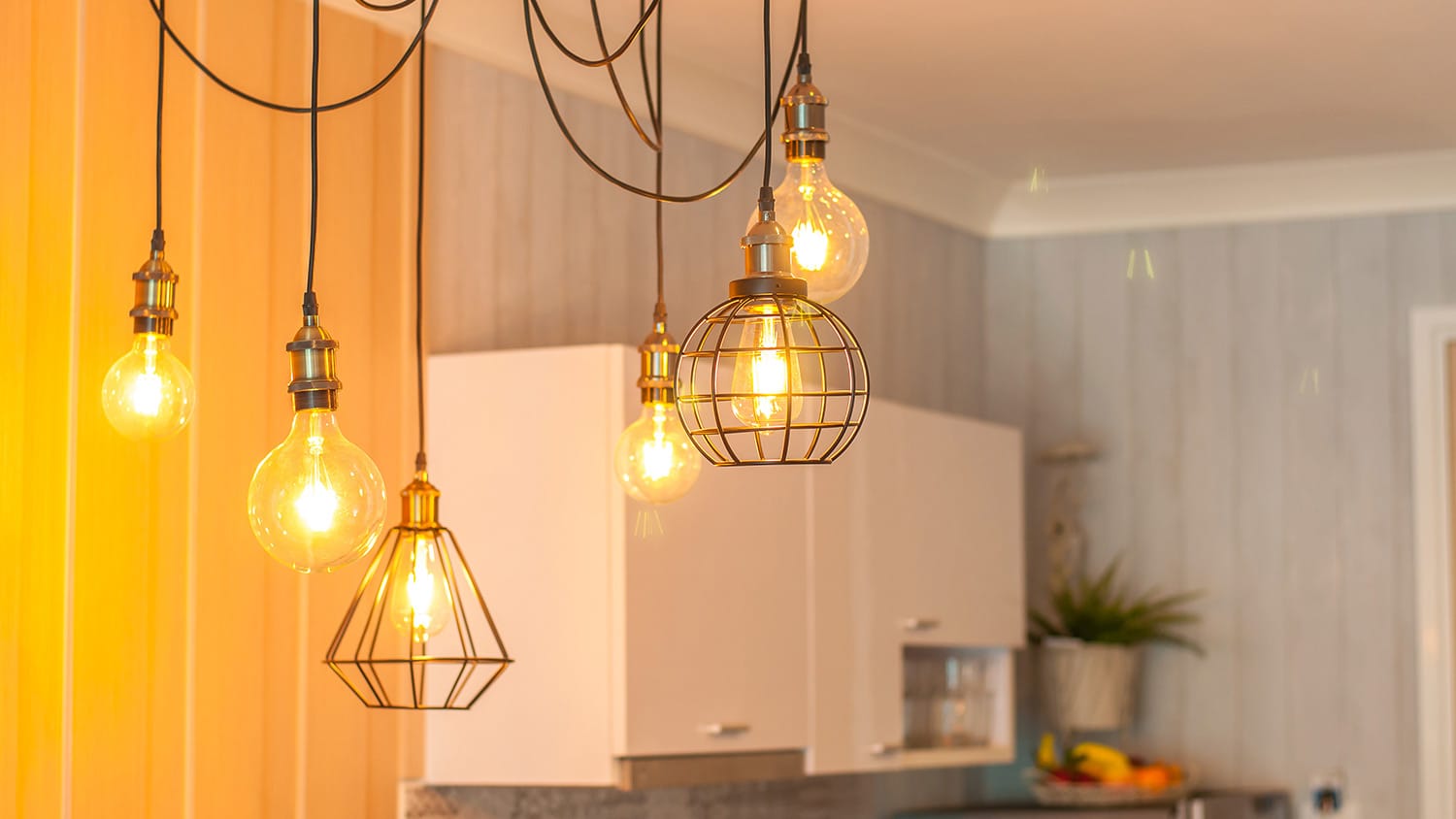
Compare the best energy-efficient light bulbs and see why LEDs cut energy use and save the average U.S. home about $225 a year on lighting.
Reducing energy consumption from your light bulbs is a bright idea

Understanding home light bulb wattage helps you choose efficient lighting, as bulbs range from seven watts for LEDs to 100 watts for incandescents.
Your monthly lighting costs vary significantly by bulb type, ranging from $0.19 for LED bulbs to $1.61 for incandescent bulbs when used eight hours daily.
Switching to LED bulbs reduces your energy consumption and costs, as they use only seven watts compared to 60 watts for traditional incandescent bulbs.
Hiring a local electrical professional provides expert guidance on energy-saving lighting upgrades and ensures proper installation for your home's electrical system.
Knowing how many watts a light bulb uses may seem trivial. It’s an essential for your home, but one light bulb costs very little to operate. However, modern homes contain a multitude of light bulbs, with at least one in every room, including the shed and garage—and that multitude can add up quickly. Understanding light bulb wattage and how to reduce the power they use can drastically lower your home's energy consumption and your monthly bill.
If you’re not sure what you’re looking for, comparing different types of light bulbs can get very confusing. Lumens, temperature, watts, lifespan, and efficiency percentages can all run together, and choosing the best ones for your home becomes not much more than a guessing game. Here's what it all means.
Wattage measures how much electricity a bulb uses. For example, 60W incandescent bulbs use more energy than 9W LED bulbs.
Lumens measure a light bulb's brightness or the amount of light it gives off. Large spaces require more lumens than small spaces to achieve the same light saturation.
Temperature describes the color of light coming from a bulb, measured in degrees of kelvin (K). 2,700 K is a typical temperature for soft-white 60W incandescent bulbs. 5,000 K is close to daylight-white color. The color temperature of a light bulb doesn't significantly affect its energy consumption.
Watt-Hours, or Wh, expresses the amount of energy used by an appliance. To determine Wh, multiply the wattage of your light bulb by the number of hours that light is on in a day. A 7W LED bulb that runs for 3 hours per day uses 21Wh.
Kilowatt-Hours, or kWh, is used more often to measure energy usage for your monthly electric bill. It is determined by dividing the number of watt-hours an appliance uses by 1,000. For example, that 7W LED bulb running for 3 hours per day uses 0.021 kWh daily or 0.63 kWh per month.
The type of light bulb and its size determine how much electricity it uses. Household light bulbs consume anywhere from seven to 100 watts depending on the type, with LEDs being the most energy efficient. It's important to note that a light bulb's wattage rating is average and not an absolute amount.
The table below shows how much energy different kinds of light bulbs require in watts to achieve the same brightness.
| Bulb Type | Average Watts per 800 lumens |
|---|---|
| Incandescent | 50–60W |
| Halogen | 40–45W |
| CFL | 13–16W |
| LED | 7–13W |

While operating one light bulb for a few hours a day won't break the bank, having numerous bulbs illuminated around the house for long periods can run up energy costs quickly. Your utility company calculates your home's electricity bill using a price per kilowatt-hour. According to the U.S. Energy Information Administration, the average cost of a kWh is just over $0.11.
The type of light bulbs you use significantly affects your monthly energy costs. Take a look at these different types that you may have in your home.
Incandescent light bulbs are the most costly to operate because much of their energy turns into heat instead of light. Incandescent bulbs also have the shortest lifespan of the varieties, meaning you must replace them more often. A 60W incandescent light bulb operating for eight hours per day at $0.11/kWh costs an average of $19.27 per year or about $1.61 monthly.
There are several types of halogen bulbs on the market. They last longer than incandescents and are more energy efficient. A halogen bulb requires around 43W to produce the same light as a 60W incandescent bulb. To run one for eight hours per day at $0.11/kWh costs $13.81 yearly and $1.15 monthly.
Compact fluorescent light bulbs, or CFLs, are even more efficient and can produce light equivalent to a 60W incandescent using only 14W. The annual operating cost for eight hours per day at $0.11/kWh is $4.50 or $0.37 per month.
LED, or Light Emitting Diode, light bulbs last a long time, produce very little heat, and use little electricity. To achieve light volumes equal to a 60W incandescent bulb, LEDs use as few as 7W. Operating one of these bulbs eight hours a day at $0.11/kWh will cost just $0.19 monthly or about $2.25 over a year.
When calculating the cost of running the lights in your house, the first thing you need to know is how much your utility company charges you per kWh. Then figure out how many lights you operate on average, their wattages, and how many hours your family has them turned on per day.
The easiest way to do the calculations is to determine each light bulb's average kWh per day and then add up the results. Remember that some light fixtures might use more than one light bulb.
Use this formula to calculate the cost of running your individual bulbs, then add up each bulb’s cost to determine how much all the lights in your home are costing you each month.

The best way to reduce the cost of using your light bulbs is to switch incandescent, halogen, and CFL bulbs to LED lighting. However, replacing all of your bulbs at once could get costly, and it'll take a while for them to pay for themselves through lower energy bills.
In the meantime, allow as much natural light into your home as possible, avoid using dark lamp shades to reduce the need for more lights, and turn off the lights when you’re not in the room. If you tend to forget to turn off the lights behind you when you go off to bed, think about installing a motion sensor instead.
If you're considering remodeling your home and looking for energy-saving ideas, talk with your local electrician about new ways to incorporate lighting into your home using LEDs.
Custom Paint Jobs LLC gave our office a fresh new look. Clients love it!
 Custom Paint Jobs, LLC
Best painters in the Greater Columbus, Ohio area. Quality of work second to none and customer service is head above shoulders than everyone else. I cant wait to work on another project with Silvio and Team!
The Mosby team went above and beyond for my project. They not only installed my light fixture; they also worked through an old, wonky, and as it turns out incorrect wiring issue from the work of prior contractors. Professional, thorough, conscientious, and kind. Five star experience. Thank you!
 Mosby Electric
We had a 20+ year old landscape lighting system that needed replacement. Midwest Lightscapes worked with us to design a much improved lighting system, lighting the exterior of the house and the back yard. Installation of the 45 light system took one and one-half days, and went very smoothly....
 Midwest Lightscapes
Jeff was a consummate professional. Responsive, courteous, and focused on meeting our needs. I had a small project of installing and replacing two ceiling light fixtures. He responded to my Home Advisory inquiry within 24 hours and in a span of two weeks our light fixtures were installed. ...
For several months I was looking for somebody to tile a wall in my master bath and move lighting fixtures, and could not find anybody who was responsive. I contacted Rowe through Home Advisor and within days they came by to assess the job and provide an estimate. The cost was very...
 Rowe House Development
A team of 2 spent 5 hours, cleaning top to bottom (removed all light fixture and cleaned.... impressive!!!)
 Luzia's Cleaning
It went very well. I was able to select the color blocks I wanted and where they would be placed in the window. All of the employees were very pleasant and patient. The guys who installed the window arrived promptly, did their job, and there was nothing for me to clean up. The window looks...
 Innovate Home Org - Columbus Glass Block
The initial quoted price from a walk-through seemed high, but we discussed that the quote represented worst case scenario (re-wiring to two floors) and we were excited about the opportunity to have the work done in a timely manner with closing for fire safety reasons, etc. When the job was...
Charlie recommended a separate fan with new lighting to clear steam from the room better. Several weeks ago I contacted Charlie via email to ask about pricing and scheduling, after one follow up he did reply with cost and said it would be about two weeks before he could do the work. I replied...
 Settle Muter Electric
From average costs to expert advice, get all the answers you need to get your job done.
Compare the best energy-efficient light bulbs and see why LEDs cut energy use and save the average U.S. home about $225 a year on lighting.

Lighting aisle feeling overwhelming? This article explains the different types of light bulbs, watts, lumens, shapes, sizes, colors, and more.
Explore incandescent light bulbs vs. LEDs, their average costs, and how to choose the best light bulb for your home with this light bulb comparison guide.

Save money, use less energy, and accent your decor with the focused, decorative, or subtle light styles available from different types of LED light bulbs.

Use mercury-free halogen bulbs to brighten up your interior and exterior. Read on to discover which halogen light bulb types are best for your home.
Explore the world of fluorescent light bulb types! From cost considerations to applications, dive into the pros and cons of four popular options.