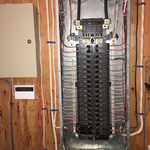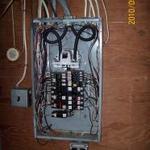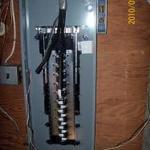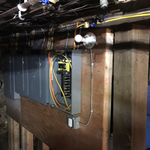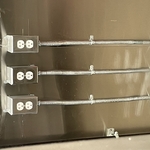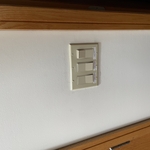



"Travis came to look at the problem on a Tuesday morning. When I explained to him that lights in the house were flickering he became concerned and put my job on the top of his list. Once he arrived he immediately diagnosed the problem as many of the circuits in the box had deteriorated due to moisture in the line. He fixed the bad circuit in question and showed me the problem and explained that due to the age, oxidation, and rust that I may have future issues with the remaining circuits. I decided to replace the entire circuit panel and circuits as well as have a new meter with new wiring and drip lines installed on the exterior of the house, as the old meter was also corroded and detaching from the siding.. Travis returned early the following day at the exact hour we had agreed upon and worked a full eight hours to complete the entire job. His work is exemplary: very neat and methodical and whenever I had a question he would answer it in detail. His work was completed within the 2 days and came to approximately 10 hours in total. He supplied all the necessary materials and had everything he needed on hand in his truck.. I recommend him very highly as a skilled and experienced electrician located in Berkshire County."
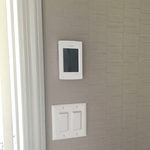
"Colin is an excellent licensed electrician ..He is completing several projects for us and we couldn’t be happier .. As stated in other reviews : prompt - courteous and extremely knowledgeable and very professional."
Licensed and Insured Master Electrician.\nTaking on small jobs, panel changes, code compliance and troubleshooting. 40 years in trade with a diverse background.
Levi is a Master Electrician with over 10 years of experience in the electrical trade. He has primarily worked in high-end residential and custom homes, bringing strong expertise in electrical layout, lighting design, and coordination with insulation and building systems. Levi is highly knowledgeable in all aspects of residential electrical work, from rough-in to finish, and is committed to safe, code-compliant, and high-quality installations.
"Dominic removed old wiring and electric fixtures in my cabin. He installed all new wiring, inside and outside lights, and designated outlets for items like a microwave oven and future hot water heater. My contractor was impressed with the quality of Dominic's electrical rough-in. After the insulation and sheetrock were completed, he returned to add all the fixtures, switchplates, smoke detector, etc. Everything looks great. I've used Dominic a couple of times, and he does a neat, professional job, always responsive to the customer's needs."
"my wife and i were very happy the boys were very polite they showed up when they said and wes did everything he promised and even charged me $75 less then what he said because everything went so smooth"
\nRockys Electric LLC is a family-owned and operated electrical company established in 2023, located in West Rutland. They offer a variety of services including heat pump installation, residential wiring, troubleshooting, commercial wiring, generator installation, service upgrades, panel swap outs, and automotive wiring harnesses. The company prides itself on a quick response time and provides free estimates within one hour of travel to West Rutland.
The cost to install a whole-house generator averages $5,200, with a typical price range of $1,500 to $8,900. However, total costs can vary from $400 for a small portable unit to over $18,000 for a large-capacity system. The most significant cost factor is the generator's size and capacity, but other variables include the brand, fuel type, and labor for assembly and installation.
Generator costs can be broken down by type:
Portable or Emergency Backup Generators (1kW–7.5kW): $500 to $2,000
Partial-Home Generators (9kW–20kW): $2,000 to $6,500
Whole-House Generators (22kW–48kW): $5,000 to $18,000
To avoid paying for more power than you need, consider hiring an electrician to calculate the electrical load for your essential appliances. It is also recommended to get at least three quotes to find the best deal for your specific needs and budget.
Carbon monoxide emissions aren’t only dangerous to human life, but they also harm our planet. While natural gas generators emit lower levels of CO than other fuel sources, there are still ways to reduce emission levels. For example, shop around for an eco-friendly generator that complies with current emission standards. Also, make sure your generator is serviced regularly to avoid CO buildup.
Sizing a generator is a careful process that requires calculating the electrical load of your entire house. You have to take into account every device you want to use and their wattage requirements, plus the wattage needed to start them, and look for a generator that can safely run all that at around 80% capacity.
In more practical terms, a small home can run on a 10,000-watt generator (and if you only want to power a few key appliances, much less than that). A mid-sized home may need something between 15,000 and 22,000 watts. Larger homes require 25,000 watts or more.
In many cases, yes. There are models called dual-fuel generators and fuel switches, but only between certain types of fuel. For example, with the right setup you can convert a generator from natural gas to propane. Some allow switching between diesel and gasoline. There are even tri-fuel generators available in some cases, which adds a large layer of security if you are worried about fuel availability in times of crisis. Always check your generator capabilities and manual instructions before trying to switch fuels. Some generators can use another fuel but may need a fuel conversion kit to prep them first.
These advanced generators use a key fob or a smartphone app to remotely start, which is ideal for getting power back on immediately without venturing outside. This feature is more common on whole home generators, but you may be able to find it on large portable generators, too.
The Rupert, VT homeowners’ guide to generator installs
From average costs to expert advice, get all the answers you need to get your job done.
Natural gas generators are whole-home standby generators that are connected to your home’s natural gas line. The average cost for a natural gas generator is $12,000.
Generators should give you peace of mind, but you’ll only get that if your installer knows what they’re doing. Learn how to hire a pro and what red flags to look for.
Thinking about a generator installation? Learn about backup power options, costs to expect, and how to hire the right local pro to keep your home running.