






Top-rated deck staining pros.

Best deck staining pros near Hartsville, SC

Enter your zip and get matched with up to 5 pros

Need a pro for your deck staining project in Hartsville, SC?

Select your specific project to find the pro for you.

TRUSTED BY HARTSVILLE, SC HOMEOWNERS

  • Average homeowner rating star icon4.7
    Average homeowner rating
  • Verified reviews icon15
    Verified deck staining services reviews

Top-Rated Deck staining pros in Hartsville - Updated Nov 2026

Justin Mackey Painting
5.0(
2
)
Exterior Home or Structure - Paint or Stain: Medium

Serving Hartsville, SC and surrounding areas

Approved

In business since 2023

Free estimates

Emergency services offered

Justin Mackey Painting is committed to excellence in every aspect of our business. We uphold a standard of integrity bound by fairness, honesty, and personal responsibility. Our distinction is the quality of service we bring to our customers. Accurate knowledge of our trade combined with ability is what makes us true professionals. Above all, we are watchful of our customers' interests, and make their concerns the basis of our business.
Avatar for Mike's Painting & Pressure Washing
Mike's Painting & Pressure Washing
4.7(
28
)
Exterior Home or Structure - Paint or StainExterior Home or Structure - Paint or Stain: LargeExterior Home or Structure - Paint or Stain: Medium

Serving Hartsville, SC and surrounding areas

In business since 1996

Emergency services offered

Credit card accepted

"

We recently purchased a 2nd home on Lake James with an exterior that is 100% cedar.  The exterior was in serious need of cleaning and re-staining.  It had not been maintained; and, had a significant amount of mold staining and several areas of the trim had the original finish peeling off.

We contracted with Mike and Crystal to prep and re-stain the exterior of our home.  Throughout the process, Mike demonstrated thoroughness, competency and responsibility.  Mike and Crystal took personal responsibility to ensure they delivered a quality product.  Mike kept his commitments and did not compromise his work product even when faced with the stripping process taking more time than he expected.  He completed the project per the schedule he committed.

Mike demonstrated a high attention to detail in the finishing process and ensured the project was completed to my satisfaction.  The home looks beautiful...we could not be happier.

I solicited bids from several paint contractors and evaluated several before selecting Mike.  His pricing was very competitive versus several other contractors; but, I never observed where Mike cut corners.

I would definitely recommend MIke's Painting and will plan to use Mike again when we have painting needs.


"
Additional Photos
Additional Photos
Additional Photos
Additional Photos
Additional Photos

+161

Recommended by91%of homeowners
Showing 1-10 of 48
Deck Staining FAQs, answered by experts

You’ll need to wait until the surface is completely dry, which can take anywhere from 24 to 48 hours under optimal conditions. The waiting period depends on several factors, including the type of siding and the weather conditions. Trying to paint before the surface is completely dry can trap moisture under the paint, leading to bubbling, blistering, and mold growth.

Limewash and whitewash are two techniques used to give brick a light, matte finish, but they differ in composition, application, and permanence. The best choice depends on your aesthetic goals and the specific surface.

Composition

  • Limewash: A natural and environmentally friendly option made from limestone, water, and sometimes pigments. It is breathable and soaks into porous surfaces like brick.

  • Whitewash: Traditionally made from lime, water, chalk, and binders, but a similar look can be achieved with watered-down white paint. It is paint-based and sits on top of the surface.

Appearance and Finish

  • Limewash: Provides a natural, textured appearance that allows the brick's character to show through. It offers a more traditional finish.

  • Whitewash: Creates a softer, more opaque finish, often used for a rustic or shabby-chic style.

Application and Permanence

  • Limewash: Is semi-permanent and can be removed, making it a good choice if you might want to change the look in the future. It requires more skill to apply and cannot be used on previously painted brick.

  • Whitewash: Is a more permanent solution. It is more forgiving to apply and can be used on painted brick. However, because it sits on the surface, it can trap moisture.

Ultimately, if you want a breathable, natural, and reversible finish for unpainted brick, limewash is a great option. If you need a more permanent, opaque coating that can be applied over painted surfaces, whitewash is the better choice. Whitewashing may also be more economical, costing approximately $1.40 to $4.20 per square foot.

Staining or sealing a cedar deck or fence is highly recommended to extend its lifespan and protect it from the elements. While cedar is naturally resistant to mold and mildew, it is not impervious to damage from moisture, sun exposure, splintering, fading, and rot over time. Applying a protective finish creates a shield that preserves the wood's strength and appearance, potentially extending its life by five to 10 years.

When choosing a finish, it's helpful to understand the difference between a sealer and a stain. A sealer sits on top of the wood, whereas a combination stain and sealer soaks into the top layer. Because it penetrates the wood, a stain generally offers better protection against UV damage and rot and lasts significantly longer. For the best results that also preserve the wood's natural color, consider using a near-translucent stain.

To maintain protection, plan on reapplying the stain or sealer every two to three years, either as a DIY project or by hiring a professional.

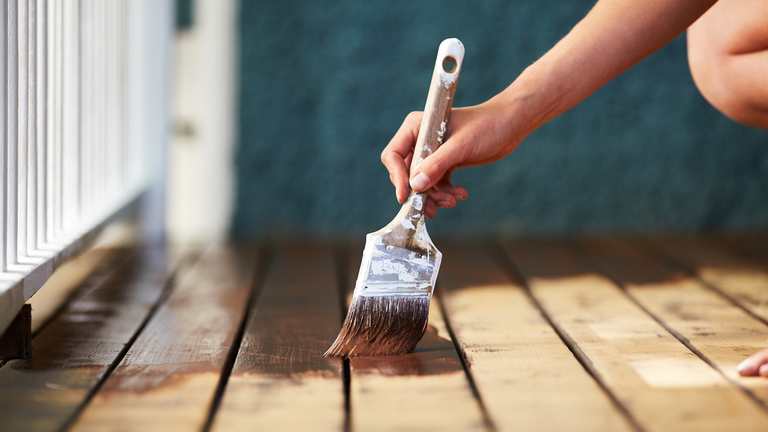
Whether to brush or roll stain on wood depends on the project and your preference. Brushing is ideal for smaller, intricate areas and offers more control over the application, ensuring thorough coverage and penetration into the wood's grain. 

Conversely, rolling is efficient for more extensive, flat surfaces and can save time. However, it is not always the best fit for textured or uneven wood. Some projects may benefit from combining both methods, using a brush for detail work and a roller for broader areas. Ultimately, the choice between brushing and rolling depends on the specific requirements of your staining project.

You can paint over old paint on a concrete porch. For the best results, you should first clean the surface and remove as much paint as you can. A power washer is helpful here, but you’ll also want to scrape as much of the old paint away as possible. Then you should prime the porch before repainting it.

The Hartsville, SC homeowners’ guide to deck staining services

From average costs to expert advice, get all the answers you need to get your job done.