Aaron's Landscaping is a family owned and operated business founded in 2009, whose owners have over 25 years experience in the area of lawn care and maintenance. We specialize in professional lawn care and landscaping services, and our commitment to you is 100% guaranteed customer satisfaction. Call us today for a free estimate!
Book Construction, LLC is a locally owned and operated company that values honesty and integrity in all aspects of our business. Our dedicated team of professionals have over 20 years of hands on experience, to provide innovative ideas and suggestions tailored to your projects. Our services are customized to your individual needs, paying close attention to the details of each project that we are involved with. Please feel free to contact us today!
AG Built Construction Co. is a small, family‑driven crew offering reliable construction and renovation work. We bring hard work, honesty, and hands‑on skill to every project and treat each job like its our own
Spencer Enterprises is committed to excellence in every aspect of our business. We uphold a standard of integrity bound by fairness, honesty, and personal responsibility. Our distinction is the quality of service we bring to our customers. Accurate knowledge of our trade combined with ability is what makes us true professionals. Above all, we are watchful of our customers' interests, and make their concerns the basis of our business.
\n
Whitsel's Excavating and Landscaping, LLC is committed to excellence in every aspect of our business. We uphold a standard of integrity bound by fairness, honesty and personal responsibility. Our distinction is the quality of service we bring to our customers. Accurate knowledge of our trade combined with ability is what makes us true professionals. Above all, we are watchful of our customer's interests and make their concerns the basis of our business. Please give us a call today!
"We had a shed pad installed for our new shed. Bob really worked to make sure we understood the different types of pads we could get as well as the ground leveling process. He was the only contractor we talked to that put the pad in the ground (excavating some dirt) so that it didn't just sit on top. As an added bonus, he swiped away a patch of really thick ivy that we've been struggling with. When scheduling the pad, he did delay the installation due to weather issues, showing real concern that if we didn't delay at least a day, the installation would be less than the professional level he likes to leave with. I left for the morning to go to work and when I came home, the pad was ready for a shed. Bob shows a concern for his homeowner's well being in all matters and is very knowledgable. I fully recomend him to anyone seeking a similar install, and will consider Rock-a-fella's when ever I have a gravelly/patio/deck need in the future. "
DBA Inside Eco Inc. General Contractor. Over 15 Employees, 30 combined years of experience, check out our website and call for special promotions and discounts. Additional contact: Gino Nalashi.
We're a locally owned and operated company that values honesty and integrity in all aspects of our business. We offer a variety of excavation services that are customizable to each individual project. We pride ourselves on the quality of our work as well as our commitment to outstanding results. We look forward to building lasting relationships with our clients and guarantee your satisfaction!
Drilled wells have a pipe sticking up that’s covered in a plastic or metal casing. On the other hand, a dug well will look like a big hole in the ground and is more similar to what you’d see in a fantasy or Western movie. If you want to be sure, contact the city for documentation on your property’s construction and excavation history.
We recommend removing the stump, and grinding is a popular way to do it. You can also dig out small stumps or stumps that have fully decayed instead of grinding them. However, don’t try using acids or fire for killing a tree stump, which is a fire hazard and illegal in many areas.
Leaving the stump alone invites eventual problems, including attracting termites, mold, and fungi.
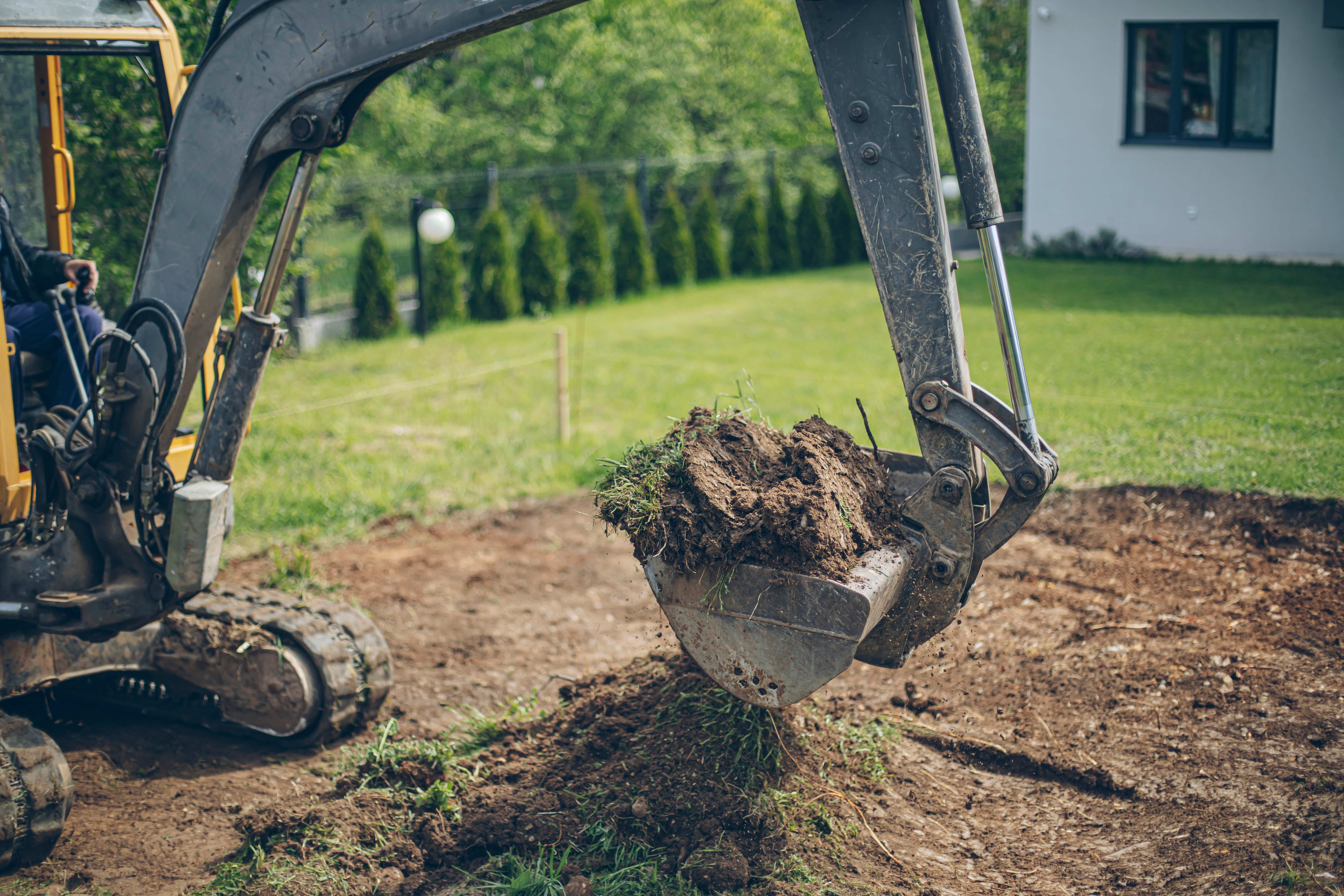
Prior to excavation, you should prepare the dig site and call 311 before you sign anything.
To get your site ready for excavation, you should move anything in the area that isn’t affixed to the land. You can save money on the excavation by removing hardscaping, including walkways, decks, concrete patios, and paver patios.
Before you carry out any digging, you should call 311 to confirm that there are no utility lines running through your excavation site. Skipping this step could lead to severe injury and property damage if your excavator hits a water, sewage, or gas line.
You do not have to dig footers for a deck as long as it meets local code and holds up to weather in your area. If you live somewhere that experiences high winds and earthquakes, you may need to dig for your deck posts. Deck blocks, post anchors with base plates, and helical pile systems are the three no-dig deck post options you can choose from if local code permits.
Yes, trenchers can go through gravel. Gravel is made up of smaller, softer rocks that certain trenchers are able to cut through. Just be sure to use a rock wheel trencher or chain trencher, both of which are made to cut through rocky landscapes and gravel pathways without dulling the teeth or chain.
The Orbisonia, PA homeowners’ guide to excavation services
From average costs to expert advice, get all the answers you need to get your job done.
Excavation costs $1,500 to $6,300 for most residential projects—but it depends on factors like the size of the area. This guide will help you plan a budget.
You can't have an in-ground pool without digging into the ground. How much does pool excavation cost, and can you take it on yourself? Our guide explains.
Picking the right pro can make or break your project. Learn how to hire an excavation pro with the qualifications and skillset to do the job efficiently.