

Top-rated driveway sealcoating pros.

Get matched with top driveway sealcoating pros in Sutton, NE

Enter your zip and get matched with up to 5 pros

Need a pro for your driveway sealcoating project in Sutton, NE?

Select your specific project to find the pro for you.

Find Driveway sealcoating pros in Sutton

Lovell ashalt
New to Angi
Asphalt SealingAsphalt Sealing- For Business

Serving Sutton, NE and surrounding areas

In business since 1978

Free estimates

Emergency services offered

Ben Lovells Ashalt Sealing is committed to excellence in every aspect of our business. We uphold a standard of integrity bound by fairness, honesty, and personal responsibility. Our distinction is the quality of service we bring to our customers. Accurate knowledge of our trade combined with ability is what makes us true professionals. Above all, we are watchful of our customers' interests, and make their concerns the basis of our business.

Driveway Sealcoating questions, answered by experts

When comparing installation costs, asphalt is often less expensive upfront than concrete. Asphalt prices typically range from $7 to $15 per square foot, while concrete can range from $3 to $18 per square foot. However, long-term costs should also be considered. Concrete driveways generally last longer (up to twice as long) and require less maintenance, which can make them more affordable over their lifespan. While asphalt has a lower installation cost and is easier to repair, it requires more frequent maintenance, such as sealing, which can add up over time. Therefore, while concrete is more expensive initially, its durability may offset the cost in the long run.

No. You cannot use asphalt products on concrete driveways. To seal a concrete driveway, use acrylic, epoxy, polyurethane, silane, siloxane, and silicate sealers or deep penetration sealers made specifically for concrete. Meanwhile, asphalt sealers contain refined coal tar (asphalt emulsion), water, sand, clay, polymers, and additives and are incompatible with concrete’s surface texture and higher density.

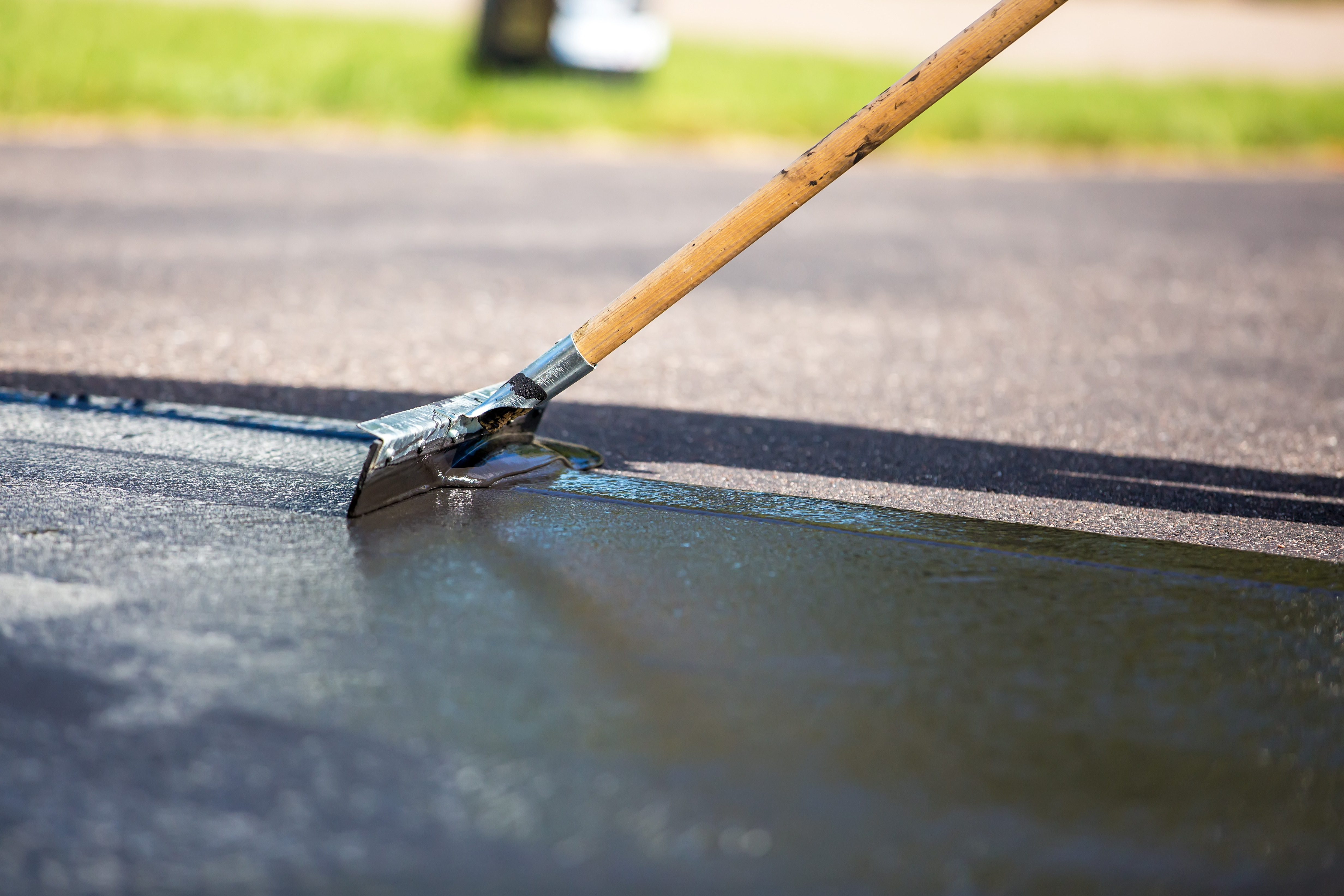
Professionals restore the surface to a fresh, attractive finish by applying a new, even sealant layer.

Instead of a set number of types, asphalt comes in variations designed for different needs. Some are categorized by temperature—hot mix, warm mix, and cold mix. Others are sorted by composition, like dense-graded, gap-graded (such as Stone Matrix Asphalt), porous, and mastic asphalt. There are also modified versions with added compounds like polymers, rubber, or emulsions. Instead of focusing on a number, it may be more useful to understand how contractors customize asphalt for durability, climate, and traffic conditions.

When asphalt cures, it typically changes from a very dark black hue to a lighter, more matte gray color. Cured asphalt also won’t be tacky or sticky to the touch or emit any odors from the asphalt mix. Additionally, the surface of fully cured asphalt won’t deform under any pressure.

The Sutton, NE homeowners’ guide to driveway sealcoating

From average costs to expert advice, get all the answers you need to get your job done.