Great Northern Power LLC is a locally owned and operated company that values honesty and integrity in all aspects of our business. Our dedicated team of professionals have over 12 years of hands on experience, to provide innovative ideas and suggestions tailored to your projects. Our services are customized to your individual needs, paying close attention to the details of each project that we are involved with. Please feel free to contact us today!
With more than 45 years of experience, Town & Country Electric is dedicated to providing our customers with the best quality at a great price. We are here to build relationships with our customers and communities and to provide our employees with a great place to work. We look forward to working with you!\n
Natural gas and electricity rates vary significantly based on location, and pricing can change over time, too. It’s possible that in locations where natural gas is particularly inexpensive, it will cost less than grid-based electricity will. However, you should also factor in the generator’s initial costs and maintenance needs, as well as its noise level and if it can comfortably power all your home appliances.
If you’re wondering if you can use your electric vehicle as a backup battery, it depends on whether your EV is compatible with bidirectional charging. This technology allows energy to flow both ways, enabling vehicle-to-home (V2H) backup power, vehicle-to-load (V2L) for appliances and camping, and vehicle-to-grid (V2G) to support the power grid. Compatible EVs convert stored DC energy into usable AC power, helping reduce energy costs and enhance grid stability while providing emergency backup power.
If your home already has a grinder pump and you’re still noticing issues (like frequently clogged toilets and sinks), it could be time to upgrade your grinder pump. Start by checking your existing horsepower. If there are four or fewer people living in your home, using a 1/2-horsepower grinder pump should be sufficient. Larger households should consider investing in a 1-horsepower grinder pump to maximize wastewater removal efforts.
It might seem counterintuitive, but installing a generator transfer switch will save you money in the long run. While you’ll have to pay between $400 and $2,500 to have the transfer switch installed, you’ll recoup that amount later on when you don’t have to pay for expensive repairs to your appliances, devices, and electrical system that may have burned out, overloaded, or stopped working due to a sudden loss of power or an incorrect hook up of a generator to your home.
Sizing a generator is a careful process that requires calculating the electrical load of your entire house. You have to take into account every device you want to use and their wattage requirements, plus the wattage needed to start them, and look for a generator that can safely run all that at around 80% capacity.
In more practical terms, a small home can run on a 10,000-watt generator (and if you only want to power a few key appliances, much less than that). A mid-sized home may need something between 15,000 and 22,000 watts. Larger homes require 25,000 watts or more.
The Stanford, MT homeowners’ guide to generator installs
From average costs to expert advice, get all the answers you need to get your job done.
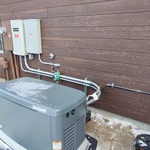
Natural gas generators are whole-home standby generators that are connected to your home’s natural gas line. The average cost for a natural gas generator is $12,000.
Generators should give you peace of mind, but you’ll only get that if your installer knows what they’re doing. Learn how to hire a pro and what red flags to look for.
Thinking about a generator installation? Learn about backup power options, costs to expect, and how to hire the right local pro to keep your home running.