



Top-rated arborists.

Get matched with top arborists in Wilson, KS

Enter your zip and get matched with up to 5 pros

Need a pro for your arboricultural service project in Wilson, KS?

Select your specific project to find the pro for you.

Find Arborists in Wilson

Avatar for Jack's Stump Be Gone
Jack's Stump Be Gone
New to Angi

Serving Wilson, KS and surrounding areas

Approved

In business since 2022

Free estimates

Offers commercial services

Jacks Stump Be Gone is committed to excellence in every aspect of our business. We uphold a standard of integrity bound by fairness, honesty, and personal responsibility. Our distinction is the quality of service we bring to our customers. Accurate knowledge of our trade combined with ability is what makes us true professionals. Above all, we are watchful of our customers' interests and make their concerns the basis of our business.

Response time2 days
Avatar for Complete Home Landscaping
Complete Home Landscaping
5.0(
2
)

Serving Wilson, KS and surrounding areas

In business since 2023

Free estimates

Credit card accepted

"Tyler did an excellent job Spring cleaning my landscaping beds! Mulch removal and replacement, cutting pampas grass, trimming bushes and plants. He repaired and replaced broken sprinkler heads as well. He communicated when he would be there and how long the job would take and followed up the day before to confirm. Great job at a fair price! Will definitely be contacting Complete Home Landscaping for future work and projects!"
Response time5 hrs
Response rate100%
Recommended by100%of homeowners

Avatar for Fluent Solar
Fluent Solar
5.0(
2
)

Serving Wilson, KS and surrounding areas

In business since 2016

Free estimates

Emergency services offered

"When I first contacted solar installers, they asked for two items: address of my property a digital copy of my utility bill From my address they can survey the property using Google Maps. They use the satellite view to assess whether I have enough area on my roof to install an adequate number of solar panels, and whether the roof is unobstructed most of the day (by other buildings, trees, etc). Using my electric bill, they can assess my monthly payment and electricity usage. Once they size a system for me, they can then estimate my monthly savings. If this savings meets or exceeds the payment I will make for financing the solar panels, they consider the project to be economically worthwhile, and move forward with a proposal. Once a proposal was ready a sales rep from our installer visited my home, told us what we could expect and asked us to sign papers. Once signed, they were able to schedule installation, which was completed in under two months. The financing we signed was designed to avoid out-of-pocket costs. Payments were waived for the first three months, anticipating that the solar panels would not be ready before then. We were allowed to hold the full balance for up to 15 months, then the finance company expected a large payment approximately equal to the federal tax credit. Then monthly payments would continue to apply to both interest and principal, with the intent that monthly payments would not exceed the savings in electric power. It was structured as a 15-year loan, although we paid ours in full after 2 years, since the interest rate was fairly high (nearly 6%). On installation day a crew of 4 men arrived with a truck. They prepared my roof for mounting hardware, dug a trench for electrical conduit (needed for DC wiring from my detached garage), mounted the power inverter on the outside wall of my home, installed panels, wired up everything and tested. The whole installation needed about six hours to complete. Post installation, the company scheduled a city inspection. An electrical inspection and building inspection were both needed to verify the installation complied with building codes. The last step was for our electrical company to visit, test the system, install a new power meter, and begin our net metering service. In our state, we are credited for excess power that flows into the grid at the same rate as power we use from the grid. So we pay only for the “net” power we use (this is commonly known as “net metering”). Our monthly utility bill shows our inflow, outflow, how much we pay for our net usage (if any), or if we generate excess power for the month, how much we bank for later use. In the first full year, the system generated about 5,000 kWh of electricity, worth about $750 at typical electrical rates in our region. We paid $20k for the system, of which a third was refunded to us on our federal taxes (applying a credit for new solar generation capacity), so we financed around $13k. It would take 17 years to break even, assuming the system does not lose efficiency. However the solar panels add to the home’s value, so we would probably replace much of our investment if we choose to sell the home in 5–10 years. At our latitude, winter days are short (about 8 hours at the solstice) and the sun is at a lower angle in the sky, limiting daily generation to about 8 kWh when sunny. But in the summer, our days are nearly 16 hours, and we see close to 30 kWh generated on a sunny day. Fortunately peak generation also corresponds to our peak usage (due to air conditioning) so we pay little electricity in summer months. Here is a monthly breakdown I estimated for 2018 based on actual meter readings: In May we had an excess of power (before the days became hot enough for A/C). September was our peak usage. Our electricity costs for the year were under $600. In summary: Was the project a financial slam-dunk? Not really. In the long term it will pay for itself, but the savings are not enormous. Would we do it again? Absolutely, it feels good to have clean, renewable power at home, that we can generate ourselves, and be at least partly free from the electrical grid."
Solar Panels Project
Mike & Mary's Solar Panels Project
Solar Panels Project

+24

Recommended by100%of homeowners
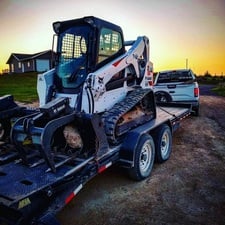
Walker's Landscaping and Maintenance
New to Angi

Serving Wilson, KS and surrounding areas

In business since 2010

Free estimates

We are a locally owned and operated company that values honesty and integrity in all aspects of our business. We offer a variety of lawn care and landscaping services that are customizable to each individual property. We pride ourselves on the quality of our work as well as our commitment to outstanding results. We look forward to building lasting relationships with our clients and guarantee your satisfaction!

Showing 1-10 of 23
Arborists questions, answered by experts

Tree experts don’t advise against digging through tree roots, but instead encourage caution and consultation with a local arborist to make sure you don’t damage the tree’s structure or interrupt its water or nutrient intake. An arborist can recommend specific practices when digging and help prune the roots or dig a trench for utilities with a tool that can remove soil without touching the tree’s roots.

If you want to take your tree-planting hobby beyond your outdoor space, here are a few great ways to do it:

  • Encourage your neighbors to participate in the Arbor Day Foundation’s Tree City USA program, which has a four-step framework that helps communities grow and maintain their own tree cover.

  • Support businesses that plant trees. 

  • Lobby your local government to plant more trees around your community.

  • Donate to a tree-planting charity.

No, you cannot throw branches from your neighbor’s tree back into their yard, nor can you discard leaves or other plant matter that originated from their yard back over there if it happens to land in your yard. You are responsible for cleaning up plant matter that made its way into your yard.

Licensing requirements for arborists, also known as tree surgeons, vary by state and municipality. Many areas require a license, which often involves specialized education and experience. Even if not mandated, it's wise to hire a licensed professional as they tend to have more experience. Beyond licensing, look for certifications from organizations like the International Society of Arboriculture (ISA) or the Tree Care Industry Association (TCIA), as this indicates a higher level of expertise. Certified arborists must typically pass a comprehensive exam. Always confirm that the arborist has a business license and is fully insured to protect yourself from liability. Seeking positive recommendations from local homeowners is also a good step in finding a qualified professional.

Ideally, you’ll have a good enough relationship with your neighbors that you can kindly mention this task in regular conversation. However, every neighbor (and neighborhood) is different. Your best bet will always be to ask directly and nicely, offering to contribute to the tree trimming efforts if you’d like. However, if you are bothered by the tree and your neighbor is unwilling to cut it, you can involve the help of the homeowners’ association or local authorities, if applicable.

The Wilson, KS homeowners’ guide to arboricultural services

From average costs to expert advice, get all the answers you need to get your job done.