Here at Scharnhorst Home Inspection & Radon Measurement, we take pride in our work and our goal is to inspect your home like it is our own. Call us today for all of your home inspection and radon needs and we will get you results as soon as possible.
"They were on time, the radon mitigation system installation was done efficiently, and the work space was left neat and clean when the installation was finished. The tech and customer service staff were knowledgeable and patient and answered all my questions. Overall, a very good experience."
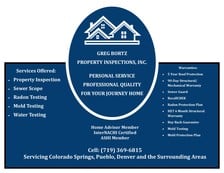
Serving Colorado Springs and Denver, Greg Bortz Property Inspections, Inc., is the solution to all of your property inspection needs. We take great pride in our extreme professionalism, timeliness, and superior customer service on every job. We make sure to develop a lasting relationship, so that the next time service is needed, there will be no question on who to call. Satisfaction guaranteed!
Thank you for your interest in Meadows All about Inspections, LLC. In business since 1999, we serve the entire state of Colorado with quality home inspections and indoor air quality testing. We are FHA inspection certified. \nPlease give us a call today for a fair inspection. We give free estimates, but will charge a small trip charge over 35 miles.\n
Radon Detection and Reduction questions, answered by experts
No level of radon is technically safe, but since it is naturally present everywhere, it is impossible to avoid entirely. The average radon level in homes across the United States is 1.3 picocuries per liter (pCi/L). The Environmental Protection Agency (EPA) recommends taking action to reduce radon levels if your home's test results are between 2 and 4 pCi/L or higher.
Radon is a cancer-causing radioactive gas that poses serious health risks, infiltrating homes through foundation cracks and unnoticed spaces.
While DIY testing is possible, abatement generally requires professional installation to ensure efficacy and meet safety standards.
The natural breakdown of uranium in soil, rock, and water can cause radon to appear in a home. The gas seeps into homes through cracks in foundations, walls, or floors, as well as through gaps around pipes or construction joints. Radon levels are influenced by soil composition, building materials, and ventilation. Poorly sealed or airtight homes can trap radon, allowing it to accumulate.
Mitigation reduces radon levels, protecting your health and complying with safety standards.
The Saguache, CO homeowners’ guide to radon detection and reduction services
From average costs to expert advice, get all the answers you need to get your job done.
Get clear answers on how much radon remediation costs, including average prices, key cost factors, and tips to save money on your home’s radon mitigation.
Find out what impacts radon testing costs, including average prices for DIY kits and professional services, so you can protect your home and budget confidently.
Radon is a gas that you can't see or smell and is harmful to your health. If your home has radon, you need to know who installs radon mitigation systems.
Knowing how to test for radon will keep your home free and safe from this odorless gas—you just have to decide whether to do it yourself or hire a pro.