
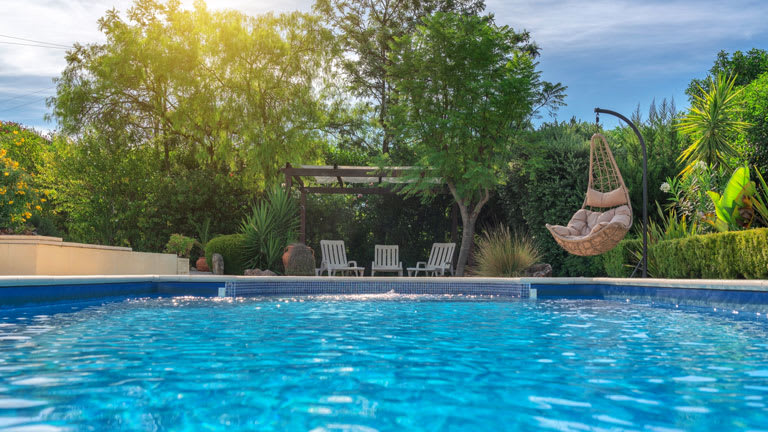
Installing a pool heater ensures that your pool gets used as much as possible, but is the pool heater cost worth it? Let’s find out.
Cool pools aren’t all that cool

Pool heater sizing calculators help you match BTU output to your pool's gallons, surface area, and average depth for proper heating performance.
Your pool's climate exposure affects heater sizing, as wind and cold temperatures require higher BTUs to maintain your desired swimming temperature efficiently.
Calculating your pool volume in gallons by multiplying surface area, average depth, and 7.48 gives you the foundation for determining proper heater size.
Hiring a local pool heater service professional provides reliable guidance on BTU requirements and heater type selection based on your pool's specific needs.
There’s nothing like a refreshing dip into your pool, but diving into a cold pool can be an unwelcome shock. A pool heater lets you comfortably use your pool even in chilly weather, as long as it’s the right size. We’ll walk you through how to determine what size pool heater you need to keep your pool at the right temperature every time you jump in.
Pool heaters come in a wide range of sizes, from 30,000 BTUs all the way up to 400,000 BTUs. The size heater you’ll need depends on many factors, from the size of your pool to your ideal temperature. Different types of pool heaters will come in different sizes, and gas heaters will have different recommended BTUs than electric heaters, so you may want to consult with a local pool heater installer to find the right option for your pool.
| Pool Volume (Gallons) | Average BTU Range Needed (Gas Heater) |
|---|---|
| 10,000 | 40,000–60,000 |
| 15,000 | 60,000–90,000 |
| 20,000 | 80,000–120,000 |
| 25,000 | 100,000–150,000 |
| 30,000 | 120,000–180,000 |
When figuring out what size pool heater you need, it helps to understand how pool heaters are measured. All pool heaters are measured using British Thermal Units (BTUs), a unit that measures energy. One BTU represents the amount of energy needed to increase the temperature of 1 pound of water by 1 degree Fahrenheit.
If a pool heater has a high number of BTUs, it can heat a larger pool than a heater with a lower number of BTUs.
Your first step in figuring out the right heater for your pool is to calculate your pool's surface area. The larger your pool's surface area, the easier it is for heat to escape, which means a large pool requires a large heater.
All you need to do to calculate the surface area is multiply the length of the pool by the width. So, if you have a pool that's 15 feet wide and 20 feet long, then your pool's surface area is 300 square feet.
Once you calculate your pool's surface area, you need to calculate its average depth. To find your pool's average depth, all you need to do is determine the depth of the shallowest part and the deepest part, then add those two numbers together and divide them by two.
For example, if your pool is 3 feet deep at its shallowest and 12 feet deep at its deepest, then your pool's average volume is 7.5 cubic feet, since 3 + 12 = 15 and 15/2 = 7.5.
To find the number of BTUs you need in a pool heater, you then need to calculate your pool's volume in gallons. You can find this number by first multiplying your pool's surface area by its average depth. This number will result in your pool's average cubic feet. In order to convert cubic feet to gallons, you then need to multiply the number of cubic feet by 7.48.
For example, if your pool's surface area is 300 and its average depth is 7.5, then its volume in cubic feet is 2,250 because 300 x 7.5 = 2,250. To convert this number to gallons, simply multiply it by 7.48. In this case, 7.48 x 2,250 = 16,830, so the pool holds approximately 16,830 gallons.
You can use a specific formula based on the shape of your pool:
| Pool Shape | Formula for Pool Water Volume (Gallons) |
|---|---|
| Rectangular | Length x Width x Depth x 7.5 |
| Round or circular | Diameter x Diameter x Depth x 5.9 |
| Oval | Length x Width x Depth x 5.9 |
Now that you know your pool's approximate volume in gallons, you can figure out how many BTUs you'll need in a pool heater. But first, you should consider your location's average temperature during a given season.
As you might imagine, your pool heater will need to work harder (i.e. need more BTUs) to heat your pool during cooler weather than warmer weather, so always purchase a heater for the coldest months you'll be using the pool.
The following calculations are based on approximately how many BTUs you'd need to heat your pool to 80 degrees Fahrenheit in 24 hours during different outdoor temperatures.
To find the number of BTUs needed to heat a pool to 80 degrees Fahrenheit on a typical 70-degree day, you should multiply your pool's number of gallons by four.
So, a 15,000-gallon pool will need a pool heater size that can accommodate at least 60,000 BTUs to heat it during a 70-degree day because 15,000 x 4 = 60,000.
You can find the BTUs needed to heat your pool on a 60-degree day by multiplying your pool's gallons by five.
For example, a 15,000-gallon pool will need a pool heater with at least 75,000 BTUs.
If you want to keep your pool warm during a 50-degree day, then you should multiply its gallons by six to find the minimum BTUs you'll need in a pool heater.
For instance, a 15,000-gallon pool will need a heater with 90,000 BTUs.

The calculations above are a great start, but there are several additional factors you'll want to consider in order to find the perfect size heater for your needs. You can also talk to a local pool heater repair professional or pool electrician for more help deciding on the right heater for you.
If you live somewhere that's particularly cold or windy, your pool heater will have to work harder to heat your pool than it would in more temperate climates. In this case, you'll want to get a heater with more than the minimum number of recommended BTUs.
So, if you live in a very windy area and the minimum recommended BTUs for your pool's size during an average 70-degree day is 60,000, then you probably want a heater with at least 75,000 BTUs to account for the extra wind.
Some people like their pool to feel like bathwater, while others prefer it to be much colder. Knowing how warm you want your pool to be during different seasons will help you determine just how much power you need in a heater.
If you love that bathwater feeling, opt for a heater with a high number of BTUs, which will heat your pool to your desired temperature faster than one with lower BTUs.
For most people, a comfortable swimming temperature ranges between 78 to 82 degrees Fahrenheit. If installing a heater, talk to your electrician or pool contractor about how this may impact your electrical bill.

There are several kinds of heaters to choose from, including gas, electric, and solar heaters, and how each pool heater works can vary. Most gas heaters can heat pools faster than electric and solar heaters, but each type has its pros and cons, so you should consider factors like your budget, lifestyle, and personal preferences before committing to a heater.
Pool heaters with a high number of BTUs can heat your pool faster than heaters with lower BTUs. If you only use your pool occasionally, then a heater with lower BTUs that you can turn on a couple of days before you plan to use it is probably fine.
However, if you frequently use your pool, particularly during cooler seasons like spring and fall, then you might want a heater that can work a little faster, in which case you should lean toward the higher BTUs recommended for your pool's size and locale.
Depending on the type of pool you have, you may need to adjust the size of your pool heater. Aboveground pools lose heat faster than in-ground pools, so you'll want to lean toward the higher end of the recommended BTU spectrum if you have an aboveground pool.
The wrong size pool heater can make a big difference in efficiency. An oversized pool heater is less of a worry than one that isn’t big enough, but it’s best to consult with a professional to find out if you should switch yours out for a different size. A heater that’s too small will need to run more often and will be less efficient than one that’s the right size, putting extra wear on the equipment, leading you to have to call someone to repair your pool heater, so it’s probably a good idea to make sure your heater is the right size.
If you’re good people wanting to do business with good people, hire Matt. He is a consummate professional and utterly competent. He installed a water heater in my home at a price that beat competitors by hundreds of dollars with a promise to support the unit for its life (even after its 6 yr...
 Greene's Plumbing Services
Joseph did a great job with the staircase and trim. Timely and efficient, clear communication about the work, very fair pricing. For the stairs in particular, done very skillfully in an old house (1893) in a tight spiral, and very creative with how to do the handrail. Did a nice job with...
 Vouis Trim Carpentry L.L.C.
This company does it right. Firstly, I want to say that Landan was a joy to work with. He was so kind, transparent, and had everything under control. His entire team showed up ready to work and they were all very respectful of the fact that we were in an office space. A little backstory – we...
 Krumlauf Floors
Professional Team, smooth to communication chain and schedule flexibility. Follows proper construction procedure and completes task on time.
 Pegasus Concrete
Very professional, knowledgeable and helpful! Completed the install on time and as expected.
 Ward's Services
Cole has been handling plumbing and general contracting for our four properties over the past three years, and he’s always done a great job. Most recently, he installed a sink and countertop in our retail store where none existed before, and it turned out exactly how we needed. He’s...
 ANB Renovations LLC
Excellent, Prompt, Courteous Service!!! They were super friendly and quite personable. I felt very comfortable with the gentlemen that did the installation. They installed it exactly where I asked them to and they did an excellent job!! I loved their service so much.
 Tether House
I hired windows depot USA of central to install new windows in house in Oshawa. Ilya was very professional from the start, not only did he offered a great price, he also made sure the installation was on time. I am very satisfied with final outcome. The windows look great and the overall...
 Window Depot USA of Central Ohio
The guys did an outstanding job and we had a great experience with CarifaTile. I appreciated that Joe reviewed the quotes with me and set expectations prior to the install. The crews showed up as scheduled and always left the areas clean upon leaving the house. We will definitely use...
 CarifaTile
Did an amazing job transforming my yard. Also installed sod in places, would recommend to everyone.
 Cardinal Landscaping & Construction LLC
From average costs to expert advice, get all the answers you need to get your job done.
Installing a pool heater ensures that your pool gets used as much as possible, but is the pool heater cost worth it? Let’s find out.
Pool heater problems could point to many issues, some of which you can troubleshoot. Find out repair costs for heat pumps, natural gas, and solar pool heaters.
Discover the cost to install a solar pool heater, including average prices, key cost factors, and tips to save on your project.
Thinking about a pool heater installation? Learn about project scope, costs to expect, and how to hire the right local pro for your backyard oasis.

While the fall is usually the most popular time for homeowners to get a pool heater, here’s why you should consider doing it in the spring instead.
The number of people, flow rate, and water temperature in your home will help you calculate what size tankless water heater you need. This guide walks you through it.