





Top-rated driveway gate pros.

Get matched with top driveway gate pros in Hardwick, VT

Enter your zip and get matched with up to 5 pros

Need a pro for your driveway gate service project in Hardwick, VT?

Select your specific project to find the pro for you.

Find Driveway gate pros in Hardwick

Grace telecom and electrical
New to Angi
Gate for Driveway or Security - Install or Replace

Serving Hardwick, VT and surrounding areas

In business since 2025

Free estimates

Credit card accepted

We take great pride in our experience, expertise, quality, and customer service that we provide to meet the consumers' needs. It is our mission to provide excellent workmanship, and complete customer satisfaction from start to completion of a project. In order to understand the needs, and expectations of our customers, we take great care to work, and communicate with every customer in a professional manner. Our reputation is based on service, safety, and quality, regardless of how large or small the job.

Driveway Gates questions, answered by experts

Screen doors (sometimes called barrier doors) and security doors serve different primary functions. A screen door's main purpose is to allow airflow and keep pests out, featuring a lightweight frame and a mesh screen. A security door, however, is a heavy-duty structure designed to prevent unauthorized entry. Security doors are installed with permanent screws into the home's walls and are often equipped with deadbolts or other heavy-duty locking mechanisms for enhanced protection against intruders.

Ideally, a gate should be able to swing both in and out. However, if it can only open in one direction, it is generally best for it to swing inward. This is often the safest option, especially for deck gates near steps, as you'll want the gate to swing away from the stairs. An inward swing also prevents the gate from opening into a public space, like a sidewalk, and can be more convenient when carrying heavy items like a wheelbarrow into a garden.

There are exceptions, however. The layout of your property may require a different approach. For example, if your property is on a slope, the gate may not be able to swing inward. You should also ensure the gate can open fully without colliding with any objects or blocking access to other areas. For a backyard garden gate where public access isn't a concern, the direction it swings is largely a matter of personal preference. Finally, always check your local building codes, as they may have specific requirements for which way a gate must swing.

When building an outdoor or deck gate, it's crucial to use durable wood that can withstand harsh weather conditions like sunlight, rain, wind, and snow. Redwood and cedar are excellent choices as they naturally resist decay. While redwood is considered more elegant, cedar is a more affordable option. Other suitable woods include oak and pressure-treated pine, which is specifically treated to resist rot. Although some softwoods like pine are popular, untreated softwoods such as pine and spruce should generally be avoided for outdoor projects because they are susceptible to damage from water, rot, and the sun. Ultimately, it's wise to consider your local climate when selecting the right wood for your gate.

The best direction for a gate to swing depends on its location and purpose, but swinging inward is the general rule. An inward swing is often considered safer, prevents the gate from opening into public spaces like a sidewalk, and may be required by local building codes.

There are exceptions and specific considerations. If your property is on a slope, an inward swing might not be possible. For a deck gate, it's safest to have it swing away from any steps. In a backyard, the direction can be a matter of preference, though an inward swing can be helpful when carrying heavy items like a wheelbarrow into a garden.

Regardless of direction, ensure the gate can open fully without hitting any objects or blocking spaces. While an inward swing is standard, a gate that can swing both in and out offers the most flexibility if your setup allows for it.

The cost to install a gate varies widely, with a typical range between $1,500 and $7,000. The average cost is around $3,500. However, the final price can be as low as $200 for a simple gate or as high as $12,000 for a large, automated security gate.

Key factors that determine the installation cost include:

  • Gate Material: This is a primary cost factor. Chain-link and vinyl are the most affordable, while wood and PVC are mid-range options. Wrought iron, aluminum, and other metals are the most expensive materials.

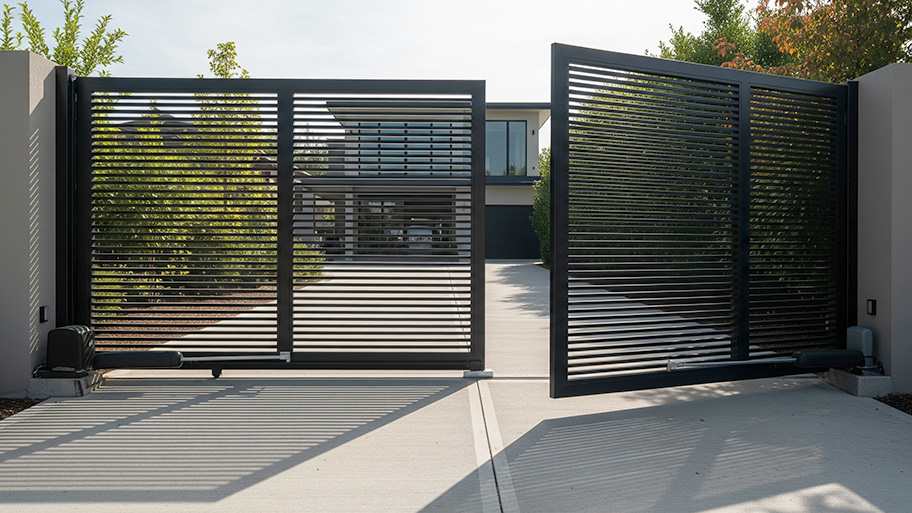
  • Automation: Automated gates are significantly more expensive than manual ones because they require motors, sensors, controls, and electrical installation.

  • Size and Type: The dimensions and style of the gate (e.g., swinging vs. sliding) will impact the price.

  • Security Level: Gates with advanced security features will increase the overall cost.

The Hardwick, VT homeowners’ guide to driveway gate services

From average costs to expert advice, get all the answers you need to get your job done.