




Top-rated generator install pros.

Get matched with top generator install pros in Williamson, NY

Enter your zip and get matched with up to 5 pros

Need a pro for your generator install project in Williamson, NY?

Select your specific project to find the pro for you.

Find Generator install pros in Williamson

John Betlem Heating & Cooling Inc - Electrical
4.7(
157
)

Serving Williamson, NY and surrounding areas

Approved (Corporate)

In business since 1941

Free estimates

Emergency services offered

John Betlem Heating & Cooling is a 3rd generation company founded in 1941. They provide Residential HVAC, Electrical and Insulation Services to Rochester, NY and the surrounding towns. John?s slogan that still holds true today is to do ?whatever it takes? to satisfy customers.\n\nJohn Betlem is a premier family operated solutions provider, passionately committed to the health, safety, and comfort for all they serve.

84 neighbors recently requested a quote
Recommended by91%of homeowners
Avatar for T-Mark Plumbing, Heating, Cooling & Electric
T-Mark Plumbing, Heating, Cooling & Electric
4.5(
643
)

Serving Williamson, NY and surrounding areas

Approved

In business since 1992

Free estimates

Credit card accepted

T-Mark Plumbing, Heating, Cooling & Electric was founded over 25 years ago to provide friendly, efficient service to residents and businesses across Buffalo and Western New York. The largest family-owned and operated business in WNY that understands the challenge and frustrations that can occur with plumbing, HVAC, and electrical emergencies. Community voted the # 1 company in 716 and available 24 hours a day 7 days a week. Our day one focus has never changed: 100% customer satisfaction. We take the time, every time, to ensure our customers are left happy and satisfied with not only the quality of our work, but with the entire T-Mark experience.

Multi-Unit Install
13 neighbors recently requested a quote
Recommended by90%of homeowners
A & A Electric
4.7(
13
)

Serving Williamson, NY and surrounding areas

Approved

In business since 1972

Free estimates

Customers say: Quick response

"Anthony was very attentive to my project on an old building. He sought out a safe and viable solution to change out an old fuse box and relocate with a new breaker box. He was quick with a response to my request, inspection and quickly gave a solution with a quote. Once I accepted, he scheduled my work right away. He was also prompt on the day of installation and did the work professionally and quickly. I recommend A & A Electric and I would even recommend Anthony to my family and friends. - Pastor Jeff"
Response time5 hrs
Recommended by91%of homeowners
Showing 1-10 of 24
Generator Install questions, answered by experts

Yes, installing a generator usually increases your property value because buyers are getting the added peace of mind knowing they’ll be able to maintain power through blackouts. In most cases, you should see close to a 100% return on investment (ROI). Keep in mind that home generators usually need a permanent foundation, and installing a concrete slab will likely raise your property taxes slightly.

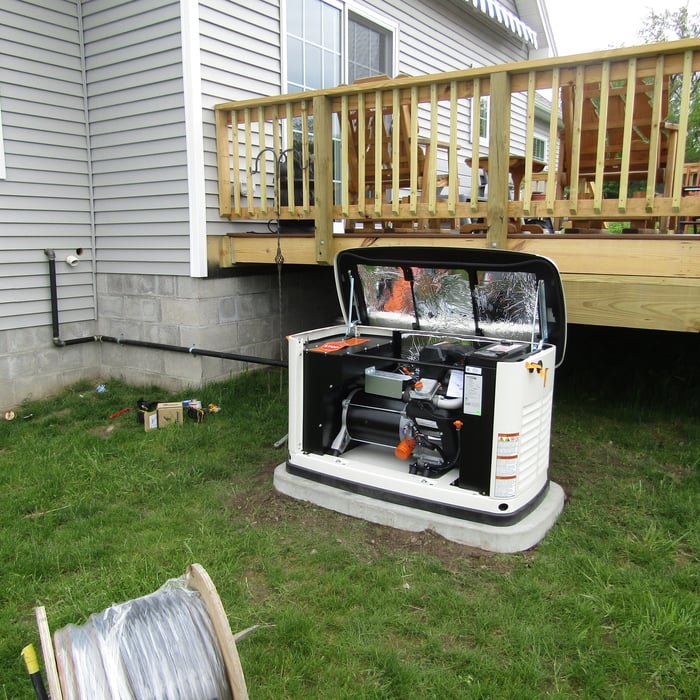
Whole-house generators need to be installed on level ground several feet away from walls and other objects. Because they tap into the electrical system directly, they usually need to be close to your home electrical panel for a transfer switch installation. It also helps with installation if they are near to a gas line or propane tank installation.

If you’re wondering if you can use your electric vehicle as a backup battery, it depends on whether your EV is compatible with bidirectional charging. This technology allows energy to flow both ways, enabling vehicle-to-home (V2H) backup power, vehicle-to-load (V2L) for appliances and camping, and vehicle-to-grid (V2G) to support the power grid. Compatible EVs convert stored DC energy into usable AC power, helping reduce energy costs and enhance grid stability while providing emergency backup power.

Here’s what you can run with different wattages and types of generators:

Portable generator:

  • 2,000 watts can handle a large appliance like a freezer or refrigerator, plus a few smaller items like phones or computer chargers. 

  • 4,000 watts will keep two large appliances operating and a few smaller devices.

  • 8,000 watts should power most essential appliances and other devices, including a sump pump, well pump, or your dishwasher.

Partial to whole-house generator:

  • 20,000 watts and above will make it seem like your home’s power is still on.

To determine the right size generator for your house, you should calculate the total wattage of the appliances and devices you want to power during an outage. List all essential items, note their start-up wattages, and add them together.

Here are some typical wattage requirements for common appliances:

  • Refrigerator: 600 watts

  • Large dehumidifier: 700 watts

  • Large window air conditioner: 1,400 watts

  • Water heater: 3,000 to 4,500 watts

  • Electric furnace: 5,000 to 25,000 watts

A 7,500-watt generator might be sufficient for essentials like a refrigerator, freezer, well pump, and lighting circuits. However, for high-demand items like a water heater or furnace, a whole-home generator is a better choice. A portable generator may be enough if you only need to power a few critical items.

While home square footage can offer a rough estimate, it is not always a reliable indicator. For reference, here are some typical generator sizes based on square footage:

  • 1,000 sq ft: 6–9 kW

  • 1,500 sq ft: 7–10 kW

  • 2,000 sq ft: 10–14 kW

  • 2,500 sq ft: 12–16 kW

  • 3,000 sq ft: 16–20 kW+

For the most accurate sizing, consult a professional who can calculate your home's peak and average power consumption and recommend the optimal generator.

The Williamson, NY homeowners’ guide to generator installs

From average costs to expert advice, get all the answers you need to get your job done.