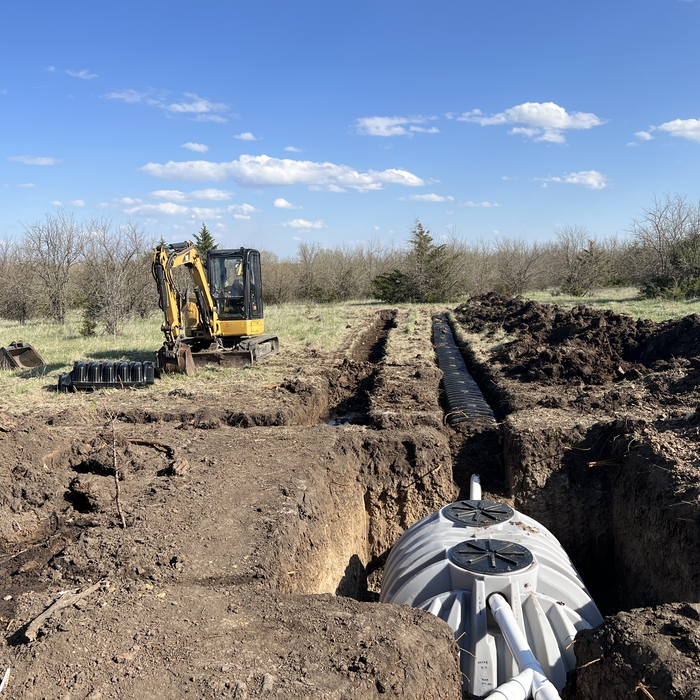
"He showed up on the day that was scheduled. Great communication, Excellent workmanship. Goes above and beyond to make the customer happy. I highly recommend PB land management for your work."
I started Cornerstone Dirt Construction in 2013 after working in the dirt construction business for almost eight years running dozers, excavators, motor graders, skid steers, and hauling rock. At Cornerstone I strive to bring integrity, precision, and reliability to every project no matter how big or small. Let Cornerstone Dirt Construction take on your next project with Christian values and family first peace of mind
"Wagner Dirtworks is very knowledgeable in their specific field of work! It was great to have them out and build a fence for us. They did quick and high quality work. Would very much recommend!"
My name is Oakley I started this company 3 years ago at the age of 20 because I knew a lot of people who wanted land cleared and there was a demand and nobody really did it so my objective is always too build a great relationship with the customer and get the job done right.
Johnston Excavation has been the excavation business for over 40 years. We are able to handle all your excavation, building site preparations, and tree removal requests. Contact Johnston Excavation for professional and fair services!
Most states do not require excavation companies to hold specific licenses, but many require at least a contractor’s license. Additionally, heavy equipment operators require a special commercial equipment license to operate machinery required for excavation. You can use Angi’s contractor licensing tool to confirm that an excavation company you’re considering hiring is fully licensed. You should also make sure that the excavation team is fully insured before allowing them to work on your property.
If you’re planning to dig on your property, you’ll need to check for underground utility lines. Call the national call-before-you-dig 811 number. Once connected to an operator, you can schedule a site visit to mark underground lines. This way, you won’t accidentally dig into pipes and can cause major (read: costly) issues.
Yes. A metal detector is one of the quickest and easiest ways to find your septic tank. However, metal detectors can be too expensive (costing upward of $300 in some cases), and not everyone has a metal detector just lying around. If that’s the case for you, you can also take a long metal rod and poke it into the ground at regular intervals until you hit something—likely your septic tank lid.
Professional installers often include a deep layer of crushed gravel under permeable pavers to allow more runoff to soak through into the soil below. Many installations will include multiple layers of gravel, with coarser aggregate at the base and finer aggregate that sits on top of that bottom layer. Above the gravel, you’ll often find coarse sand that helps reduce paver shifting over time. Some permeable paver designs include a water collection system set into the gravel layer to route runoff to a safe area for disposal.
The cost to repair a crawl space runs between $1,500 and $15,000, depending on the extent of the damage. Major flooding or water repairs can cost up to $10,000 for removal and repairs. If you simply need to clean your crawl space, expect to pay between $2,000 and $6,000 for a major cleanout. Replacing a crawl space beam due to rot or damage can cost between $1,500 and $5,000, while removing and replacing damaged insulation costs between $1,000 and $4,000.
The Clyde, KS homeowners’ guide to excavation services
From average costs to expert advice, get all the answers you need to get your job done.
Excavation costs $1,500 to $6,300 for most residential projects—but it depends on factors like the size of the area. This guide will help you plan a budget.
You can't have an in-ground pool without digging into the ground. How much does pool excavation cost, and can you take it on yourself? Our guide explains.