

The cost of a radon mitigation system in St. Louis, MO, depends mostly on the type of system being installed. Use this guide to learn about your options.
Biohazard remediation costs depend on your project and location. Check with a local pro for your specific job.

The average cost for a professional radon testing service in St. Louis, MO, is $432 for most homeowners.
The total square footage of your home and the specific testing method you choose determine your final price.
Purchasing a reusable digital radon monitor for ongoing readings adds between $100 and $240 to your total expenses.
Hiring a radon testing pro in St. Louis, MO to do testing keeps you and your household safe from radon.
This article was created using automation technology and produced in accordance with our AI policy, which includes editorial quality standards.
Radon testing in St. Louis, MO, runs $432 on average, and costs range from $174 to $691. Your total price depends on the size of your home and whether you choose a short-term or long-term testing method. Before scheduling a radon test, understanding the cost helps you plan a project that keeps your household safe and fits your budget.
Homeowners in St. Louis, MO, rely on certified radon testing professionals to accurately measure indoor air quality and identify potential gas hazards. The final price for this service depends heavily on the testing method, the size of the property, and the specific equipment used to complete the assessment.
The specific testing method you select dictates the baseline price of the assessment. Active digital monitors and passive charcoal kits require different analysis processes, directly impacting the final bill. In St. Louis, MO, the unpredictable four-season climate requires accurate testing methods to capture fluctuations in radon levels during extreme weather shifts. Choosing a DIY short-term kit costs $10 to $40 per test, making it a budget-friendly starting point. For more precise results, hiring a professional averages $145 to $670 per test. Overall, homeowners pay an average of $432 for comprehensive radon testing services. Many homeowners bundle this service with a standard home inspection to ensure complete safety.
| Test Type | Description | Local Average Cost | National Average Cost |
|---|---|---|---|
| DIY short-term | Charcoal or liquid scintillation kits are used for 2–7 days | $10–$40 | $10–$40 |
| DIY long-term | Alpha track or electret kits used for 90+ days | $25–$60 | $25–$60 |
| DIY digital | Electronic monitors for ongoing readings | $100–$240 | $100–$250 |
| Professional | A certified pro uses an active or passive device | $145–$670 | $150–$700 |
The total square footage and layout of your property determine how many testing devices are necessary to get an accurate reading. Sprawling multi-level properties require additional monitors to cover every distinct living zone. Testing a small home of 1,200 square feet in St. Louis, MO, ranges from $145 to $290 per project. If you own a large home over 4,000 square feet, expect to pay $480 to $670 per project to cover multiple levels and foundation types. The humid and stormy climate of the Ohio Valley region forces residents to keep windows tightly sealed, making thorough multi-level testing critical for accurate readings. Across all home sizes, most residents spend between $174 and $691 for complete testing. Proper sizing of the test area is just as critical as scheduling an annual HVAC inspection to maintain safe indoor air.
| Home Size/Type | Description | Local Average Cost | National Average Cost |
|---|---|---|---|
| Small home (1,200 sq. ft.) | Single kit, single level | $145–$290 | $150–$300 |
| Medium home (2,500 sq. ft.) | Two kits or multi-level testing | $290–$480 | $300–$500 |
| Large home (4,000+ sq. ft.) | Multiple kits, multi-unit or multi-level | $480–$670 | $500–$700 |
Testing your home at regular intervals ensures long-term safety and affects your lifetime maintenance budget. Establishing a consistent testing schedule prevents undetected spikes in harmful gas levels. Environmental experts recommend testing properties in St. Louis, MO, every two to five years. The extreme heat waves and severe ice storms in the region cause foundation shifts and soil changes, which alter how radon enters a structure over time. Frequent testing adds to your overall household maintenance expenses, much like routine HVAC maintenance costs, but provides essential data for your family's health. Testing immediately after completing a basement remodel or installing a mitigation system guarantees that the new layout remains secure.
The physical components and technology used to detect radon gas drive a significant portion of the material expenses. Reusable electronic devices carry higher upfront price tags compared to disposable passive kits. Purchasing a disposable charcoal canister costs $10 to $30 per kit. Investing in a reusable digital monitor requires a higher initial payment of $100 to $240 per device, plus future calibration fees. In St. Louis, MO, heavy spring flooding and high humidity impact the storage and deployment of sensitive testing materials, making professional-grade equipment highly reliable. If these materials detect dangerous levels, you will need to review radon mitigation costs to resolve the issue permanently.
| Material/Kit Type | Description | Local Average Cost | National Average Cost |
|---|---|---|---|
| Charcoal canister | Disposable, short-term DIY kit | $10–$30 | $10–$30 |
| Alpha track detector | Long-term DIY kit, measures over months | $25–$60 | $25–$60 |
| Digital monitor | Electronic, reusable, needs calibration | $100–$240 | $100–$250 |
| Pro-grade equipment | Used by certified testers, higher accuracy | Included in service | Included in service |
Hiring a certified technician involves labor rates that cover equipment setup, sample collection, and laboratory analysis. Professional expertise guarantees accurate placement and official documentation for real estate transactions. Certified testers in St. Louis, MO, charge a flat fee for the entire testing process rather than an hourly rate. The intense tornado and storm seasons in the Midwest create high demand for structural and environmental assessments, which drives up local labor rates during peak real estate months. Technicians factor travel time, specialized training, and laboratory processing fees into their final service quotes. Homeowners often schedule this service alongside a mold inspection to address all potential indoor air hazards at once.
Gratuity is not a standard expectation for environmental testing professionals. Technicians and inspectors operate as specialized contractors who build their full compensation into the service fee. When a technician completes an assessment in St. Louis, MO, you do not need to add a tip to the final invoice. The extreme weather conditions in the area make their job demanding, but their rates fully cover the labor and expertise required. Leaving a positive review or referring the company to neighbors serves as the best way to reward exceptional service.
Hiring a professional for accurate indoor air quality assessments in St. Louis, MO, ensures your home is safe from dangerous gas. Most homeowners pay $174 to $691 per project for comprehensive services. While many local inspectors charge a flat fee, some contractors bill $30 to $75 per hour for setup and analysis. When budgeting for your final invoice in St. Louis, MO, remember to account for the local 9.68% sales tax applied to materials.
Hiring radon testing professionals in St. Louis, MO ensures your home remains safe while providing excellent long-term value and saving you time. A certified expert handles the entire process, giving you peace of mind about your indoor air quality.
Experts possess highly calibrated continuous radon monitors to detect exact fluctuation levels over time.
They identify the best testing locations in your home to ensure accurate, actionable results.
Professionals understand local soil conditions to provide specific mitigation recommendations if levels are high.
Home is the most important place on earth, which is why Angi has helped more than 150 million homeowners transform their houses into homes they adore. To help homeowners with their next project, Angi provides readers with the most accurate cost data and upholds strict editorial standards. We’ve surveyed thousands of real Angi customers about their project costs to develop the pricing data you see, so you can make the best decisions for you and your home. We pair this data with research from reputable sources, including the U.S. Bureau of Labor Statistics, academic journals, market studies, and interviews with industry experts—all to ensure our prices reflect real-world projects.
Want to help us improve our cost data? Send us a recent project quote to [email protected]. Quotes and personal information will not be shared publicly.
I rehab houses and Isela does my after construction cleaning. She is very thorough and responsible. I’m very happy with her work. I completely recommend her.
 Solis Cleaning Services
Highly recommend! I had a sewer backup caused by the water companies contractor. Their insurance sent a crew and made a mess. I called Allied, and Will came out and was very honest and helpful. He worked with the insurance company and advocated for me to have the mold and asbestos removed the...
 Allied Environmental
Pride Restoration was hired on September 4, 2022 after a house fire. I will say the mitigation work that they performed was excellent, but as someone else has noted, was largely performed by contract help. We stopped by a couple of times and both times it appeared to be break time. But...
 Pride Cleaning & Restoration, Inc.
Mr. Smith was very professional with explaining what I needed as far my repair and service. His arrival time was on point which is very important to me. He also explained what I will possibly need to do in the near future regarding my system. I would highly recommend this company to my...
 G.O.A.T heating and cooling
Great! Ronan was pleasant and professional. He did a thorough check. Found some problems that needed remediation and they are already scheduled to work on that tomorrow. I am glad the problems were found before the weather turns hot. What’s more, I believe he may have discovered the...
 Anton's Plumbing, Heating/Cooling & Energy Experts
A very efficient and friendly intervention, thank you CVM Enterprise.
 CVM Enterprises, Inc.
Very detailed in regards to the process and what it would entail. Stellar professionalism from the Business Development Representative, their office manager and the Technician who completed the Mold Remediation. The technician was focused and gave us updates regarding what he was doing. We...
 Advantaclean of Madison County
We hired Kyle for move in carpet cleaning. We paid extra for deodorizing services. Since he has been gone we have noticed a new mildew smell that was not in our home before. We tried to mitigate it ourselves but were unable to. We left Kyle a voicemail explaining the situation and asked for...
I am updating my review for Lagunas since they came back and fixed the issues on the roof. 1. Poor messy work on caulking - Fixed. 2. Uneven shingle cutting near porch - Fixed 3. Strange material that was poorly cut and caulked in the *valley* near the front of porch - Fixed 4. They forgot...
 Lagunas Interstate Construction
18 months ago there had been a one-time incident of water infiltration in one small area of a finished section/office area of our basement that, when remediating, had been haphazardly torn up in an effort to completely remove the moisture as well as allow insurance adjuster to determine cause...
 Rapid Dry
From average costs to expert advice, get all the answers you need to get your job done.
The cost of a radon mitigation system in St. Louis, MO, depends mostly on the type of system being installed. Use this guide to learn about your options.

Find out the average indoor air quality testing cost in St. Louis, MO. Learn what you can expect to pay to check your home for mold, radon, and other hazards.

Find out what impacts radon testing costs, including average prices for DIY kits and professional services, so you can protect your home and budget confidently.
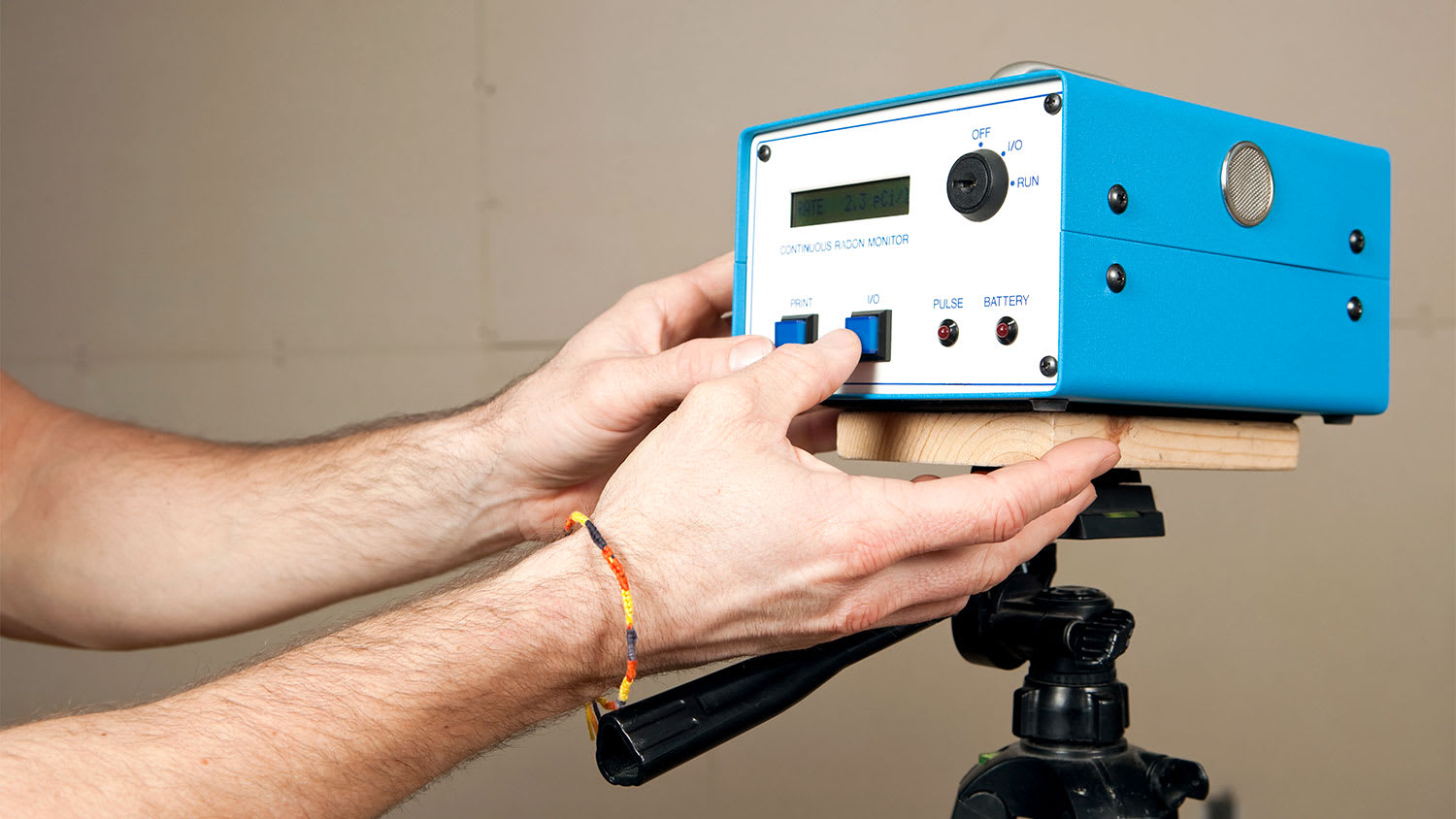
Learn how to hire a qualified radon testing pro for your home. Find certified professionals, understand costs, and get expert tips to protect your family.

Knowing how to test for radon will keep your home free and safe from this odorless gas—you just have to decide whether to do it yourself or hire a pro.

Radon is a gas that you can't see or smell and is harmful to your health. If your home has radon, you need to know who installs radon mitigation systems.