
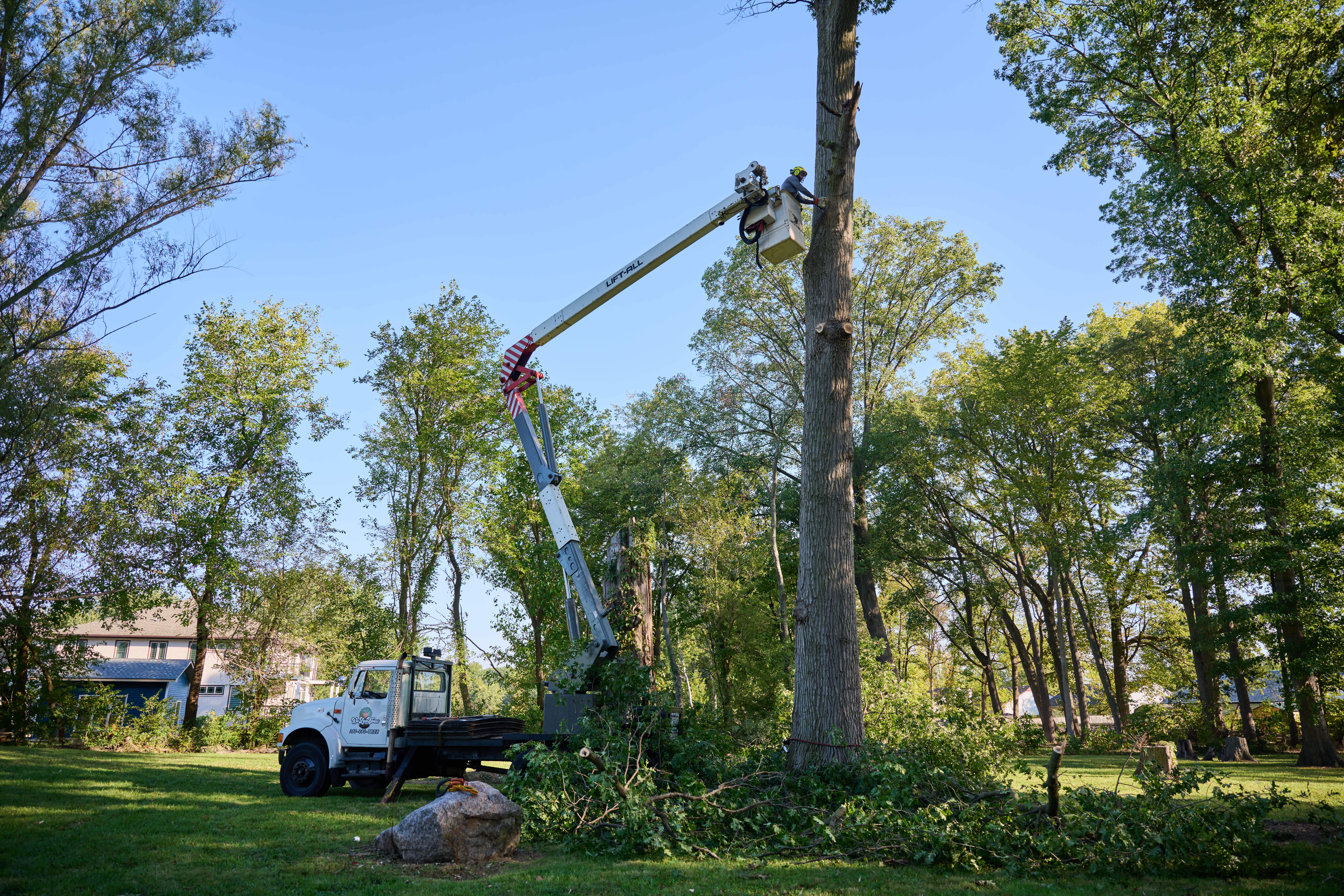
The most significant factor in tree removal costs is the amount of debris. Read on to learn more about the average tree debris removal costs in Columbus, OH.
Tree service costs depend on your project and location. Check with a local pro for your specific job.

The size and age of a tree often have the biggest impact on removal costs in Columbus, since taller trees require more equipment and longer work times.
Many neighborhoods in central Ohio have mature shade trees that can grow large over time, which can increase the complexity of removal projects.
Trees growing close to structures, driveways, or utility lines may require careful sectional cutting rather than a full drop removal.
Storm damage from strong winds or heavy snow in Ohio can sometimes lead to urgent tree removal services.
Additional services like stump grinding, hauling debris, or cutting logs into firewood may increase the overall cost.
Tree removal costs in Columbus, Ohio average about $716, though most projects typically fall between $191 and $1,910 depending on the size of the tree and the difficulty of the removal.
Smaller trees that are easy to access may cost around $143, while removing large or hazardous trees—especially those located near homes, garages, or power lines—can reach $9,550 or more.
The final cost can vary based on factors such as tree height, species, and accessibility. Getting estimates from local tree service professionals is the best way to determine the price for your specific project.
Several variables can influence the total cost of removing a tree in Columbus, Ohio. Tree height, species, and the location of the tree on your property all play a role in determining how complex the removal process will be.
Homes throughout Columbus may feature a mix of mature landscaping and large shade trees, particularly in older neighborhoods. When trees grow close to buildings or other landscaping features, crews may need specialized equipment or additional labor to safely remove them.
A tree's size affects several main tree removal cost factors—how long it takes to cut down, the accessibility to higher branches, and possible interference from other trees, power lines, or structures. For example, take a look at the primary tree removal price ranges by size:
| Tree Size | Average Cost |
|---|---|
| Up to 30 feet | $150–$430 |
| 30–60 feet | $430–$1,200 |
| 60–80 feet | $770–$1,500 |
| Over 80 feet | $960–$2,000 |
The price tends to increase once the tree grows over 80 feet high. At this stage, your team will need to bring in a crane to access its branches, which will cost about $500, including the truck rental and additional staff.
Also, keep in mind that trees get wider with age, making the diameter of their trunk more difficult and take longer to cut. In many species, branches and root systems also expand quite far in either direction, adding up to a possible multi-day project to safely remove the tree from the area without affecting other utilities.

Some trees can grow to a very stately 100 feet tall or more. American ash, bur oak, and maple are considered to be more difficult to remove than others, and therefore, removing them costs more. Here are the costs for various types of tree removal:
| Type of Tree | Average Removal Cost | Important Details |
|---|---|---|
| Oak | $200–$2,000 | Some states forbid the removal of these heritage trees |
| Japanese Knotweed | $2,000–$10,000 | Highly invasive shrub, some states prohibit their possession |
| Aspen | $1,000–$1,800 | Enormous poplar tree, have complex root systems |
| Pine | $250–$1,500 | Older pine trees may have a tap root buried in the soil, requiring specialist removal |
| Palm | $650–$1,500 | Extremely heavy, expensive to remove |
| Maple | $250–$2,000 | Can grow 100 feet high and have large branches |
| Ash | $250–$1,800 | Striking leaf colors in Autumn, can reach 80 feet in height |
| Cedar | $250–$1,500 | False cedars are common in North America while “true” cedars are native to places with high altitudes |
Most of the time, you aren’t going to want to keep the tree stump after the tree is removed. Removing a tree can also leave behind a trail of branches, bark, leaves, and the tree itself. The company might haul away your tree for about $70, put it through a chipper for an average cost of $95, or split it into firewood for your home at about $70.
The placement of a tree on your property can also affect removal costs. Trees located near homes, fences, sheds, or overhead power lines require more careful planning and safety precautions.
In parts of Columbus with established landscaping, trees may grow near sidewalks, driveways, or neighboring structures. When this happens, crews typically remove the tree piece by piece rather than cutting it down in one section.
Yards with limited access—such as fenced properties or narrow side yards—may also increase labor time.
The professional tree removal process requires trained crews and specialized tools to safely remove large branches and trunks. The process typically involves cutting the tree in stages, lowering heavy sections to the ground, and clearing debris from the site.
Depending on the size and location of the tree, contractors may use equipment such as climbing gear, chainsaws, bucket trucks, or cranes to complete the job safely.
Labor costs can vary depending on the complexity of the project, the number of workers required, and the equipment needed to complete the removal. Hiring experienced tree service professionals in Columbus can help ensure the work is done safely while protecting nearby structures and landscaping.
Taking down dead or deteriorating trees can enhance a property’s overall condition. In Columbus, removing trees that pose safety risks or interfere with landscaping may improve curb appeal and create a safer outdoor space. While the return on investment depends on many factors, maintaining healthy trees and removing unsafe ones can make a property more attractive to potential buyers.
To help homeowners plan their next project, Angi provides readers with carefully researched cost data and upholds strict editorial standards. We start with national average project costs, which we collect by analyzing competitor information, retailer material costs, and input from professional contractors. We then apply local price index data to calculate location-specific estimates that reflect what homeowners typically pay in their local area. To do that, we use data from the U.S. Bureau of Economic Analysis (BEA), including its Regional Price Parities (RPPs), which measure price differences across cities. This helps us account for differences in labor, materials, and overall cost of living, so estimates in higher- or lower-cost areas better reflect real-world local pricing.
Every estimate undergoes a thorough editorial review to verify accuracy, consistency, and alignment with observed market conditions.
Want to help us improve our cost data? Send us a recent project quote to [email protected]. Quotes and personal information will not be shared publicly.
The job was completed professionally and completed without delay or damage as a result of their removal service. They were polite professionals and very competent in completing the task. It was completed much sooner than I had anticipated and with great care. I would highly recommend this...
A&A Tree Service was amazing. They went above & beyond the work they quoted. They was professional and at the same time very down to earth. They also informed and showed me of some tree service I will be needing eventually. These guys are on top of it. I will be using them again. Thank you...
 A&A Tree Service
I hired FF Tree Service to remove trees from storm damage. Very congenial and easy to work with. Fair pricing and efficiency. Good honest people.
 FF Tree Service
I had a huge tree in my back yard right above my pool. I needed it removed asap because the leaves were falling into my pool. I called and they came out the same day for an estimate. After we agreed on the price that day, they did it the same day. They were super friendly and got the job...
Very professional knew exactly what and how it was to be done. I would definitely recommend them for any tree service needs!! Amazing work fast an very efficient!
 Top Knotch Tree Care
The company is amazing!! They were professional, timely and competent. They were able to cut back a very larger tree without any damage to my landscaping, fence or lawn. They also did a great job cleaning up the dead branches and hauling everything away ! I would highly recommend this...
 River Rock Tree Service
I highly recommend Grant's Tree Service. Paul was professional and friendly. The estimate was very reasonable and the job was completed in the time Paul stated. The workers were courteous and friendly also. They worked hard for two days clearing two very tall trees. They were respectful of...
 Grants Tree Service
Thank you so much for your great service. what a wonderful job of cleanup you did on my 2 trees. I will not hesitate to recommend your business to others.
I was very impressed with 1 tree service.it was the first time i used this company, and I was a little leery in that I had another company stop by after there was a wind storm and I had a large limb hanging from the tree. The salesman said they were in the area doing work for a neighbor and...
 The 1 Tree Service
We had a tree fall on our house and van parked in the driveway after a wind storm. Charter Oaks responded to our request for help quickly and effortlessly. They quickly sent us quotes via email and were here the next day to remove the tree. When they were done, we were very impressed with the...
 Charter Oaks Tree & Landscaping Co Inc
From average costs to expert advice, get all the answers you need to get your job done.
The most significant factor in tree removal costs is the amount of debris. Read on to learn more about the average tree debris removal costs in Columbus, OH.
Find out the average leaf removal cost in Columbus, OH. Learn what you can expect to pay for local yard clean-up services and get your lawn ready for winter.

Discover the average tree trimming cost in Columbus, OH, key price factors, and tips to save so you can plan your tree care budget with confidence.

If you discover a wasp nest near your home, you’ll want to remove it ASAP. Learn about wasp nest removal costs in Columbus, OH in this guide.
Find the average snow removal cost in Columbus, OH. Learn what you can expect to pay for local snow plowing services to keep your driveway clear this winter.
Find out the average bat removal cost in Columbus, OH. Learn what you can expect to pay for local wildlife control services to keep your home safe.