



Top-rated deck staining pros.

Best deck staining pros near Washington Island, WI

Enter your zip and get matched with up to 5 pros

Need a pro for your deck staining project in Washington Island, WI?

Select your specific project to find the pro for you.

Top-Rated Deck staining pros in Washington Island - Updated Nov 2026

PACKERLAND'S BEST PAINTERS
5.0(
3
)
Exterior Home or Structure - Paint or StainExterior Home or Structure - Paint or Stain: LargeExterior Home or Structure - Paint or Stain: Medium

Serving Washington Island, WI and surrounding areas

In business since 1999

Free estimates

"I left a message with Steve describing the work we needed. He took the time to call back, and left a message explaining that finishing cabinets wasn't their specialty, and left a recommendation. I really appreciated that he took the time to help me get connected to the right person for the job --- this, I think, demonstrates good character."
Recommended by100%of homeowners
Hip & Ridge Construction
4.5(
6
)
Exterior Home or Structure - Paint or StainExterior Home or Structure - Paint or Stain: LargeExterior Home or Structure - Paint or Stain: Medium

Serving Washington Island, WI and surrounding areas

In business since 2011

Free estimates

Credit card accepted

"The roofers were extremely professional and nice. They found that the previous roofers did not put flashing around the skylights. All of the wood around them was rotten. They had to take all six skylights out to replace the wood. They did it with minimal dust inside. They took the time to put extra ice and snow barriers around the skylights. They went above and beyond. I would recommend Brian and his crew to anyone. Todd from Hip and Ridge Construction is friendly, professional and honest."
Recommended by100%of homeowners
Showing 1-10 of 20
Deck Staining FAQs, answered by experts

Yes, it's a good idea to sand the wall with fine-grit sandpaper after spackling, especially if you plan on painting. You can do this by hand or using a sander, but the idea is to ensure the spackle is flush with the wall. Sanding will give your wall a smooth, uniform finish and help your paint and wallpaper stay put.

Limewash and whitewash are two techniques used to give brick a light, matte finish, but they differ in composition, application, and permanence. The best choice depends on your aesthetic goals and the specific surface.

Composition

  • Limewash: A natural and environmentally friendly option made from limestone, water, and sometimes pigments. It is breathable and soaks into porous surfaces like brick.

  • Whitewash: Traditionally made from lime, water, chalk, and binders, but a similar look can be achieved with watered-down white paint. It is paint-based and sits on top of the surface.

Appearance and Finish

  • Limewash: Provides a natural, textured appearance that allows the brick's character to show through. It offers a more traditional finish.

  • Whitewash: Creates a softer, more opaque finish, often used for a rustic or shabby-chic style.

Application and Permanence

  • Limewash: Is semi-permanent and can be removed, making it a good choice if you might want to change the look in the future. It requires more skill to apply and cannot be used on previously painted brick.

  • Whitewash: Is a more permanent solution. It is more forgiving to apply and can be used on painted brick. However, because it sits on the surface, it can trap moisture.

Ultimately, if you want a breathable, natural, and reversible finish for unpainted brick, limewash is a great option. If you need a more permanent, opaque coating that can be applied over painted surfaces, whitewash is the better choice. Whitewashing may also be more economical, costing approximately $1.40 to $4.20 per square foot.

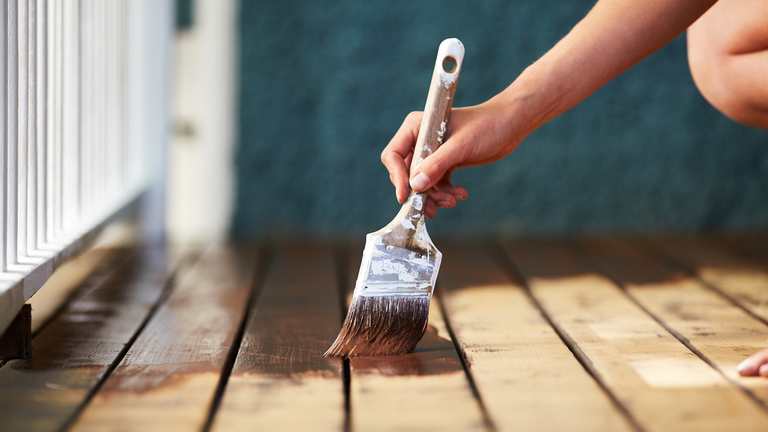
Whether to brush or roll stain on wood depends on the project and your preference. Brushing is ideal for smaller, intricate areas and offers more control over the application, ensuring thorough coverage and penetration into the wood's grain. 

Conversely, rolling is efficient for more extensive, flat surfaces and can save time. However, it is not always the best fit for textured or uneven wood. Some projects may benefit from combining both methods, using a brush for detail work and a roller for broader areas. Ultimately, the choice between brushing and rolling depends on the specific requirements of your staining project.

Wood stains last anywhere from two to five years, depending on exposure to the elements, your local climate, the type of stain, and the surface it’s on. For instance, vertical surfaces last longer than horizontal surfaces. Some types of woods, like dense hardwoods, will require a recoat yearly, as they are too dense for the stain to absorb. In any event, apply a recoat every 2 to 4 years. As for storage, a can of unopened stain can last up to 5 years, though results may vary.

Always wait until the morning dew has dried before you stain your deck. The stain needs a fully dry surface to sink into.

The Washington Island, WI homeowners’ guide to deck staining services

From average costs to expert advice, get all the answers you need to get your job done.