
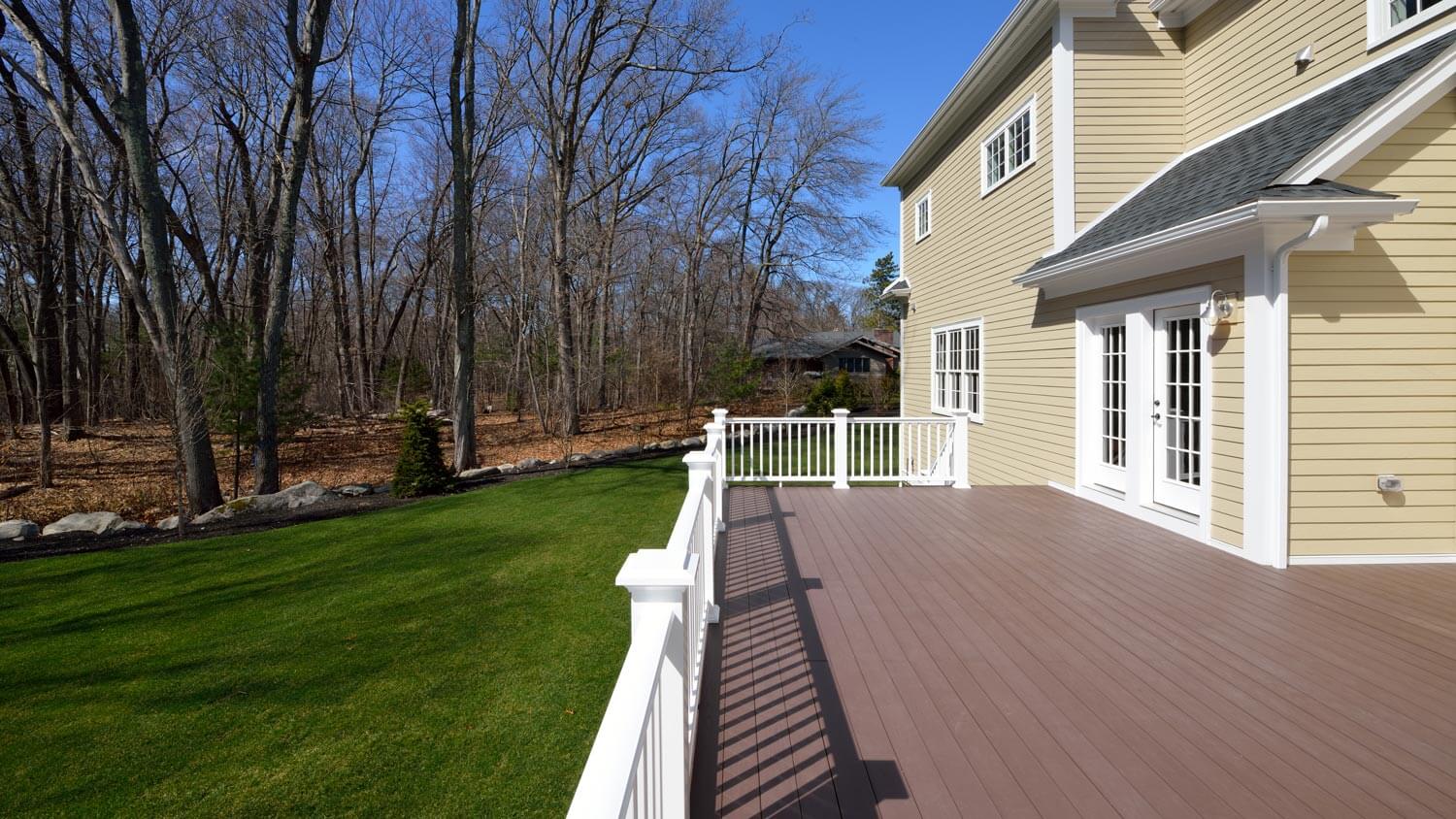
Building a composite deck can increase your home’s appeal and value. Composite decking costs depend on the size of your deck, the materials, labor, and more.
Design the deck of your dreams

PVC decking is pure plastic, while composite decking blends plastic with wood fibers, giving your deck a more natural wood look.
Composite and PVC decking are both low-maintenance options, so you spend less time sealing, sanding, or staining your deck boards.
PVC decking lasts 30 to 50 years compared to composite's 25-year life span, making it more durable for your outdoor space.
Hiring a local deck building professional helps you compare materials and handle installation details, so your new deck meets local code.
If your home renovation plans include building or upgrading a deck, one of your first tasks will be choosing a flooring material. While you could opt for a classic wooden deck, there are also lower-maintenance and longer-lasting alternatives to consider, such as polyvinyl chloride (PVC) and composite decking. To help you decide, let’s compare PVC versus composite decking, including how they compare in key categories like price and durability. And don’t forget that you can always reach out to a local pro for more specific advice and pricing in your area.
When it comes to PVC decking versus composite decking, the main difference is how they’re made. While PVC is pure plastic, composite decking includes a blend of plastic and wood. Since PVC doesn’t contain any natural materials, it holds up better against mold and water damage. It’s also lighter-weight and more durable but tends to be slightly pricier than composite decking.
Also known as synthetic decking, PVC decking is a durable, low-maintenance deck material made of hard plastic. It’s available in various colors and patterns, which often look like natural wood. PVC decking is also 100% recyclable and can be repurposed years later.
| Pros | Cons |
|---|---|
| Mold-resistant and insect-proof | More expensive than composite |
| Highly durable | Less slip-resistant |
| Lightweight | May warp from direct sunlight or extreme heat |
Best for:
Anyone interested in a low-maintenance deck that doesn’t need sealing
DIYers who want to work with a lightweight decking material
Homes in wildfire-prone areas
There are plenty of reasons to pick PVC decking over other materials. For one, because PVC doesn’t contain wood, it isn’t susceptible to common deck problems like mold growth and insect infestations. It won’t rot, either.
Durability is another major benefit of PVC decking. This type of deck can last between 30 and 50 years, and capped PVC decking—which has a protective hard shell around the outside—is highly resistant to scratching and fading.
Finally, PVC isn’t as heavy as composite decking, making it easier to transport and install. If you plan to build your own deck, this can make a huge difference. Though, building a deck is still a pretty big undertaking, so we wouldn’t blame you if you wanted to hire a pro for help regardless of the decking material you choose.
Of course, there are also downsides to PVC decking. In terms of cost, it’s slightly more expensive to install than composite decking.
While PVC decking isn’t prone to water damage, it may be more slippery than other deck materials when wet. Also, PVC can absorb heat and sunlight, causing it to warp.
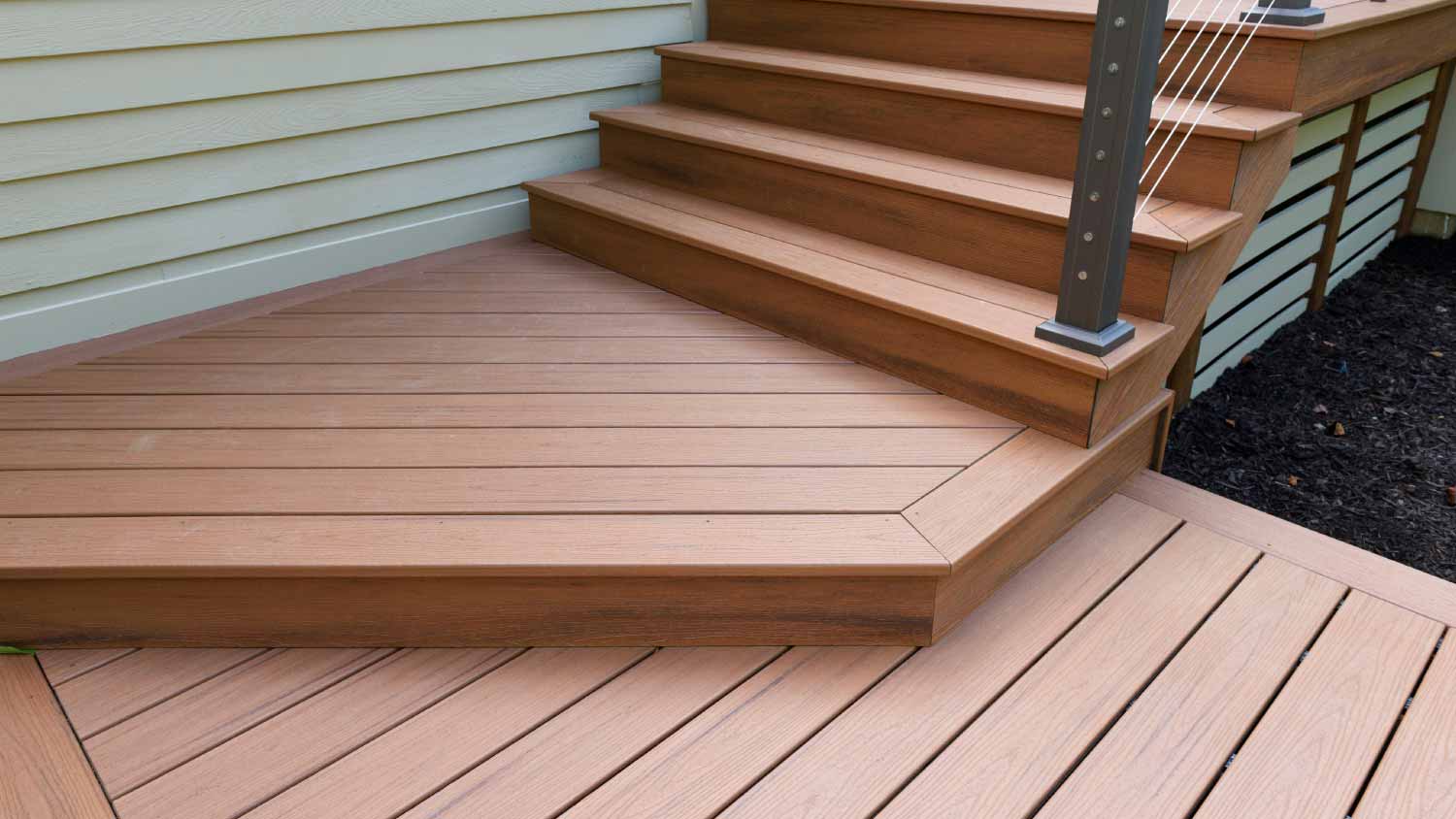
Composite decking is a hybrid type of decking made from recycled plastic and wood fibers. Some styles look like genuine wood, but since composite decking is part plastic, it doesn’t have as many issues or require as much maintenance as natural wood.
| Pros | Cons |
|---|---|
| Low-maintenance and long-lasting | Shorter life span than PVC |
| Can look more natural than PVC | More vulnerable to moisture and rot if uncapped |
| More slip-resistant than PVC | Not fully recyclable |
Best for:
People who want a minimal-maintenance deck with a natural wood look
Anyone needing a deck that won’t warp or overheat in the sun
Pool decks or decks in areas that receive regular rainfall
When it comes to wood decking versus composite decking, upkeep is far easier with the latter. Composite decking—like PVC decking—doesn’t require anywhere near as much maintenance as traditional wood decking. For example, there’s no need to seal, sand, or stain composite decking.
Since composite decking includes both wood and plastic, you get the benefits of both materials. On one hand, because it’s partially made from wood, composite decking looks more natural than PVC. At the same time, the plastic helps ward off moisture, mold, and insects, extending the life span of your deck.
Composite decking is also more slip-resistant than PVC decking, so it’s a good option for rainy locales. Some people even use composite decking around their pool as an alternative to pavers.
With an average life span of 25 years, composite decking lasts longer than many types of wood (including cedar and redwood), but that’s still only half as long as PVC decking, which can last up to 50 years.
If your composite decking is uncapped, you could run into problems with mold and moisture problems. Capped decking is more expensive, but it offers the most protection for your deck.
Also, while composite decking is an eco-friendly and sustainable decking material (it consists of recycled plastic and reclaimed wood fibers), its mixture of plastic and wood isn’t fully recyclable—unlike PVC decking, which can be repurposed.
If you’re deciding between these decking types, it’s helpful to understand how they perform in different categories. Let’s look at composite versus PVC decking in terms of pricing, durability, and more.
Generally speaking, composite decking is the slightly more affordable option. For the materials only, composite decking costs around $4 to $12 per square foot, while PVC decking runs between $5 and $13 per square foot. However, prices depend on the type and quality of decking you choose.
Composite decking lasts around 25 years, but PVC decking is the clear winner in this category, thanks to its 30- to 50-year life expectancy.
If you’re looking for a decking option that more closely resembles real wood, composite decking comes out on top. However, PVC decking also comes in plenty of colors, styles, and designs, and you can work with a local deck builder to find one you like.
Installing composite decking and PVC decking are fairly similar DIY projects. But since PVC is lighter than composite decking, it’s a bit easier to handle and put in place.
The exact cost to build a deck depends on the size and material of the deck, as well as the complexity of the design. However, most people pay between $4,350 and $12,560, or an average cost of $8,220.
Labor makes up around 38% of the total cost, while materials for framing and flooring will be around 62%. The most cost-effective deck material is pressure-treated wood, which costs $2 to $5 per square foot. On the higher end, composite decking costs $12 to $22 per square foot, and metal or aluminum decking costs $15 to $20 per square foot. Opting for a higher-end wood, like redwood, can cost up to $35 per square foot.
Labor makes up a decent chunk of the cost to build a deck, with contractors charging around $15 to $35 per square foot just for labor. This might push you toward the DIY route to save money on the project. However, unless you are experienced with this type of project, it’s best to budget for labor and leave the deck construction to the pros.
Inexperienced DIYers can make simple mistakes during deck building that can lead to expensive fixes down the road. If the deck’s structural foundation isn’t solid, it could be a safety hazard. And if the finished deck isn’t up to code, you might be required to rip it out and start again. Hiring a pro doesn't seem as expensive compared to the potential costs associated with these fixes.
Supreme Brick & Chimney did a great job with a cleaning and inspection of the fireplace! He was efficient, on time, and very pleasant. The space was kept very clean, and the fireplace was spotless when he was done. He also performed a thorough inspection, and did a great job talking us...
 Supreme brick & chimney
Koby & team weâ re great! Moved our two bedroom apartment in about 4 hours, and weâ re super friendly, quick, and careful with are things.
 All My Sons Moving & Storage
We had our houses windows and back door replace this summer by Window Depot USA of Central. He gave us grate advise and saved my family lots money. The team did a fantastic job with installation. If you need help, they sure get job done right!
 Window Depot USA of Central Ohio
Wonderful. I am going to have them remove and replace my driveway in the spring.
 All Star Paving and Sealing
We were having 2”x 2” tile installed . There was a small installation error and the new additional replacement tile was from a different lot and the colors didn’t match. Joe assured us that he would rectify everything , which he did without hesitation. We decided to go with the 18” x 36” tile...
 CarifaTile
Did an amazing job transforming my yard. Also installed sod in places, would recommend to everyone.
 Cardinal Landscaping & Construction LLC
Manuel Calvillo is the best option in the area for roofing and you won't be disappointed.
All around they have done a really great job. <br /> I have used JL Landscapes for the past 8 years. I own and operate my own commercial/residential real estate company where we own, operate, and maintain our own properties. JL Landscapes has been our exclusive landscaper for both our...
 J.L. Landscapes
Outstanding experience! I needed my yard/garden/patio prepared for a party the coming weekend. I contacted Rick and he was able to schedule service that same week. He and his crew did a wonderful job removing the fall foliage, weeding, trimming back plants and hedges, even cleaning up the...
 Distinct Designs Residential Enhancements
We first had Mark fix the back patio and liked his work so much we had him make a brick patio on the side of the house. When we decided to change our concrete walkway to brick, we wanted Mark to do the job because his prices were fair and he did such good work on t he other two projects.
 Mark Monnette Masonry
From average costs to expert advice, get all the answers you need to get your job done.
Building a composite deck can increase your home’s appeal and value. Composite decking costs depend on the size of your deck, the materials, labor, and more.
Can’t decide between TPO versus PVC roofing? Learn about the differences and how to choose the best option for your climate and budget.

When designing a dream deck, knowing the pros and cons of composite decking vs. wood decking is helpful. We’ve broken down the differences to help you decide.
A hot tub can transform a deck from average to amazing, but conceptualizing the layout can be daunting. Use these hot tub deck ideas to help you get started.
Take a deep dive into Trex decking by learning about its pros, cons, pricing, and more. Read on to learn more about Trex decking options.
Ready to upgrade your home’s deck and house color? We’ve got you covered with the best house and deck color combinations you could dream up.